Yacht Logbook: Requirements, What to Record and the Digital Version

A morning inspection at the port, an insurer's request after damage, a buyer asking for the boat's history: in all these cases someone asks you to prove what happened on board and when. The yacht logbook is the simplest and most credible answer to that question. This guide explains what it is for, when it is mandatory, which records exist on a professional yacht, what to record and how to move to a digital format without losing legal value.
The topic is less obvious than it seems, because the requirements change with the flag, the size, the use (private pleasure use or charter) and the type of navigation. Here you will find the principles common to the whole Mediterranean, entry templates to copy and pointers on where to check the rules that apply to your vessel.
The key point: the logbook is the boat's legal memory. Even where the law does not require it, keeping it methodically protects the captain, the owner and the insurance, and increases the boat's value when it is sold.
What Is a Logbook and Why Does It Matter?
The logbook, or ship's log, is the chronological record in which the captain notes the relevant events of navigation and life on board: departures and arrivals, routes, weather conditions, important manoeuvres, breakdowns, incidents, visits and checks. Every entry is dated, timed and signed by the person who writes it.
Its strength lies in being contemporaneous. A note written at the time of the events is worth far more than an account reconstructed weeks later. That is why the log is asked for in very different situations:
- Safety: reconstructing what happened before a breakdown, a flooding or a collision, and making good practice repeatable.
- Insurance: showing that the boat was handled prudently, that the weather was as declared and that maintenance was up to date.
- Incidents and disputes: in the event of a claim the record is often the first document that surveyors and authorities ask to see.
- Resale: a careful buyer appreciates an orderly history of engine hours, work done and passages. We also cover this in our guide to yacht maintenance costs.
- Charter: handovers, returns, damage and the condition declared at check-in are better defended with a punctual record.
Is the Logbook Mandatory? What the Rules Say in General
The honest answer is: it depends. There is no single rule valid for every boat and every flag, and relying on a forum or word of mouth is the quickest way to get it wrong. We can, however, outline the general picture, to be checked always against your own vessel.
Private Pleasure Boats and Smaller Craft
For many small pleasure boats used non-commercially, the recording requirements are limited or absent, and the logbook is kept as good practice. In Italy the rules on pleasure craft are gathered in the Italian recreational boating code and related regulations: to find out whether and which record your vessel needs, ask the harbour authority (Capitaneria di porto) or the office that issued the navigation licence for confirmation, as well as the boatyard or your trusted professional.
Large Yachts, Superyachts and Commercial Use
The larger the boat, the more formal the records become. For larger vessels, for those used in charter or otherwise commercially, and for those under flags that apply professional maritime standards, keeping ship's records is normally required. The exact thresholds (length, tonnage, number of passengers) depend on the flag and the conventions applied: do not trust figures read online without checking them with the flag authority or the classification society.
International Conventions
Certain conventions imposed by the IMO provide for specific records for ships within their scope. MARPOL, for example, provides for oil and garbage records with thresholds based on tonnage and persons carried. Many mid-sized yachts stay below these thresholds, but flag rules and insurers' requirements may still impose the same discipline.
Even when a record is not mandatory, adopting its format is almost always a good idea: anyone who works on professional yachts will recognise it immediately and know how to use it.
Which Records Exist on a Professional Yacht
On the larger vessels there is not a single log but a family of records, each with its own purpose and person responsible. This is the most common breakdown.
| Record | What it contains | Who keeps it |
|---|---|---|
| Deck log | Route, positions, weather, manoeuvres, deck events, mooring and anchoring | Captain and officers of the watch |
| Engine log | Engine hours, parameters, consumption, top-ups, breakdowns, work done | Chief engineer |
| Radio log | Periodic equipment tests, distress and safety communications | Captain or radio operator |
| Oil record book | Operations with oils and oily bilge residues, where required | Chief engineer |
| Garbage record book | Discharges and deliveries of waste, where required by MARPOL | Captain and designated officer |
| Drills and safety record | Man overboard, firefighting, abandon ship, equipment checks | Captain and safety officer |
On a 15-metre family-run boat a single logbook with separate sections may be enough: navigation, engine, safety. What matters is that each type of information has a fixed place and that the person writing it is identifiable.
Deck Log and Engine Log
These are the two most important records and the ones really needed for day-to-day management. The first tells what the boat did, the second how it performed. Comparing them reveals useful deviations: higher consumption than usual on the same route, engine hours growing faster than expected, recurring noises.
Garbage and Oil Record Books
These are environmental records tied to MARPOL. On smaller boats they are often not mandatory, but they remain useful as a discipline, especially for those who charter or cruise in protected areas. If they are required on your vessel, the record must be kept in the approved format and retained for the required period, checking the details with the flag or the classification society.
What to Record in the Logbook: A Practical Template
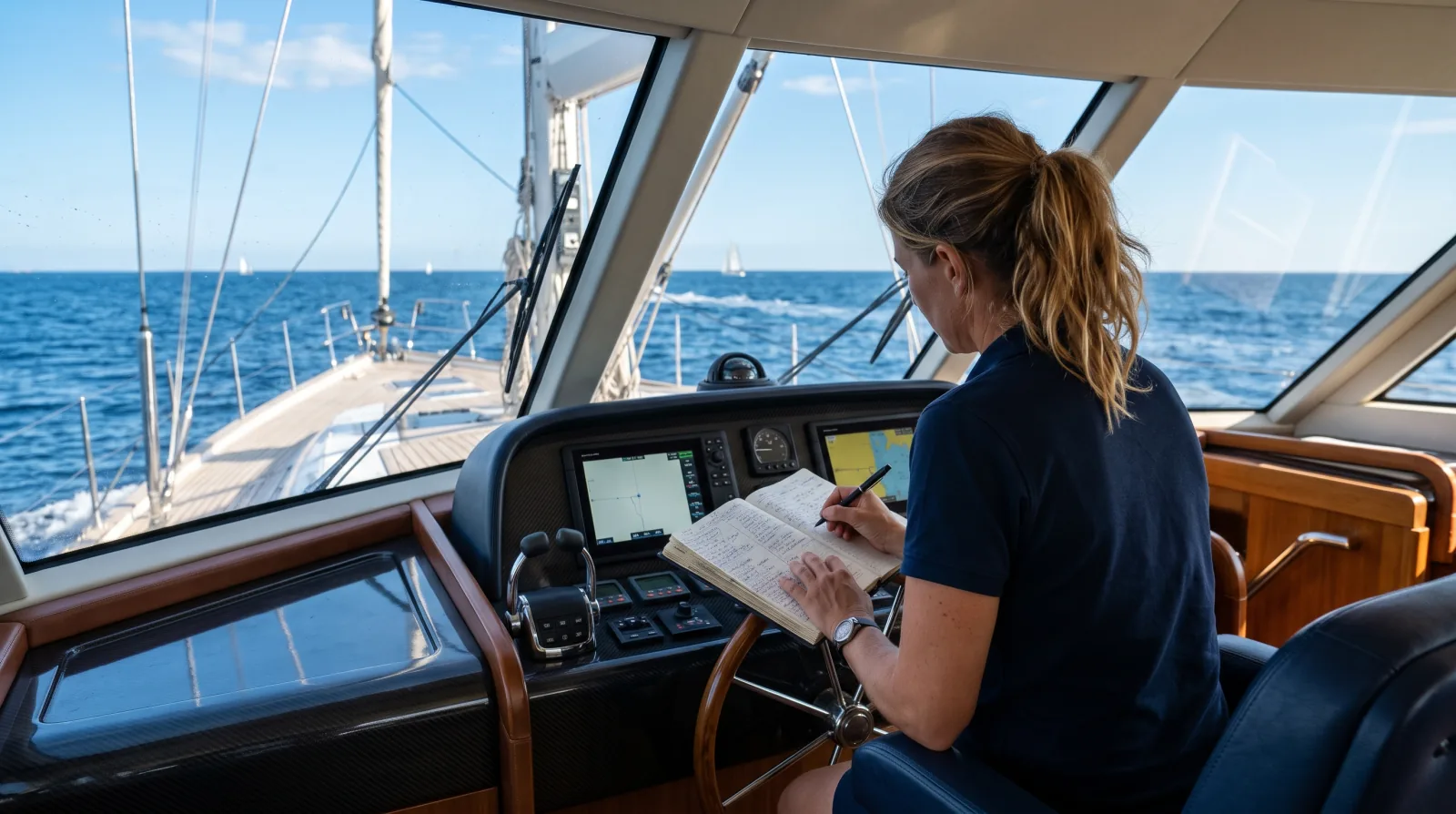
The most common question from a new captain is: what do I write, and how much? The rule is to record whatever lets a third party understand, even years later, where you were, what happened and what you decided. Here is a template of an entry, to adapt to how the boat is used.
Navigation Entries
- Date, local time and position at every significant change of course, and in any case at regular intervals during passages.
- Course, speed and engine hours at the start and end of each leg.
- Weather and sea state: wind, barometer, visibility, forecasts consulted and decisions taken as a result.
- People on board at departure, with any guests or passengers, and the name of whoever is at the helm or on watch.
- Relevant manoeuvres: mooring, anchoring, passages through narrow channels, course changes to avoid traffic.
Engine and Onboard Entries
- Engine and generator hours at the start and end of the day or leg.
- Top-ups: fuel, oil, fresh water, with quantity and place.
- Anomalies: noises, temperatures, alarms, leaks, and how they were dealt with.
- Work carried out on board or by technicians, with reference to invoices and spare parts.
- Routine checks: bilges, batteries, levels, seacocks.
Special Events
One category deserves attention in its own right: incidents, near misses, contact with other vessels, damage, calls for assistance, inspections by authorities. Here it pays to be more detailed: exact time, description of the facts without judgements, witnesses, action taken and people notified. Avoid interpretation and attribution of blame: describe what you saw and did.
Good Practice for Keeping a Credible Record
A record is only as good as the discipline with which it is kept. A few rules make the difference between a document that stands up to scrutiny and one that raises doubts.
- Write at the time. If that is not possible, note it as soon as you can and flag that the entry was made afterwards.
- Never erase. A mistake is corrected with a single line through it that leaves the original text legible, with date and signature next to the correction.
- Do not leave blank spaces between entries: a page filled continuously is harder to alter.
- Sign and date each day or each shift. On boats with several people, everyone signs their own entries.
- Be objective. Facts, times, measurements. No opinions, no comments about people.
- Keep the record on board while it is in use and then archive it in a safe place, for the period set by the applicable rules or required by the insurer.
On the subject of crew certificates, which often need to be referred to in the entries, see our guide on STCW certificates, validity and renewal. For the list of documents that must be on board, there is our guide to mandatory onboard documents.
Paper or Digital Logbook: Which to Choose?
Many captains have an emotional attachment to the paper record, and it has solid reasons: it needs no batteries, it never freezes and the flag recognises it without argument. Digital, however, solves problems that paper cannot. A brief comparison:
| Aspect | Paper | Digital |
|---|---|---|
| Reliability without power | Total | Depends on devices and batteries |
| Search and statistics | Slow, manual | Immediate, filterable by date, event, person |
| Risk of loss | High: a single copy | Low with backups and copies |
| Access from shore | Only on board | For owner, manager and authorised technicians |
| Automatic data (position, weather, hours) | All by hand | Possible, depending on connected instruments |
| Formal recognition | Undisputed | To be checked with flag and authorities |
The most important row is the last one. Before giving up paper, check whether your flag and your classification society accept an electronic record and under what conditions: generally they ask for controlled access, traceability of changes and the ability to print or export a readable copy.
How to Move to a Digital Logbook Without Risk
The switch works best when it is gradual and when the boat is never left without a valid record. A reasonable path in five steps:
- Check the rules. Ask the flag, the classification society or the competent office whether an electronic record is accepted for your vessel and with what requirements.
- Define the template. Decide which fields you need, for navigation, engine and safety, starting from the lists in this guide.
- Run the two records side by side for a season. If something does not work, paper remains the reference.
- Decide who can write and who can read: captain, officers and chief engineer with write access; owner and manager read-only.
- Plan the copies. Regular backups, PDF export at the end of the season and a procedure for days without a connection.
What to Ask of a Digital Tool
- Traceability: every change records who changed what and when, without deleting the previous version.
- Offline use: the boat is often out of coverage, and entries must still be writable.
- Export: a readable PDF for inspections, insurance and sale.
- Roles and permissions distinct for captain, crew, owner and manager.
- Link with maintenance and documents, because the engine hours in the log must feed the scheduled work.
The Most Common Mistakes in Keeping the Record
The mistakes are almost always the same, on very different boats. Knowing them helps you avoid them.
- Entries only when things go wrong. A record that starts filling up after the incident loses credibility. Write on quiet days too.
- Entries reconstructed at the end of the week, with approximate times and forgotten details.
- No distinction between crew and guests, which makes it impossible to reconstruct who was on board.
- Engine hours out of line between the log and the hour meter, which then cause problems with services and warranties.
- Change of captain without a handover: the previous record must be kept and linked to the new one.
- Personal data scattered around, such as guests' names and documents, copied without criteria. If processed, they must be protected according to privacy rules.
How Software Simplifies Keeping the Logbook
The SupaSailing Fleet module includes a digital logbook: electronic recording of navigation with automatic data capture, weather integration and regulatory compliance reports. It makes most sense when the record does not live on its own but talks to the rest of the boat's management.
- A single place for navigation, crew and onboard activity, viewable by captain, chief engineer and fleet manager.
- Engine-hour-based maintenance linked to the history, with reminders before the due date.
- Document management with a certificate archive and expiry alerts.
- Crew certificates with expiry alerts and watch schedules.
- Breakdowns and repairs tracked together with the entries that gave rise to them.
Software does not replace the captain's judgement or the checking of flag rules, but it eliminates the transcription work and makes the history searchable. For more on the link with maintenance, read our guide to predictive maintenance for yacht fleets; for the roles involved there are the dedicated pages for captains, chief engineers and fleet managers.
Frequently Asked Questions
Is a logbook mandatory on a pleasure boat?
It depends on the vessel, the flag and the use. For many small private boats there is no formal record requirement, while for larger vessels or those used commercially, keeping records is normally required.
Confirmation should be sought from the harbour authority (Capitaneria di porto) or the flag authority, who know the rules in force.
What do you write in a logbook?
Date, time and position, course and speed, engine hours, weather conditions, people on board, relevant manoeuvres, top-ups, breakdowns, incidents and safety checks. They are facts, not opinions, written at the time they happen and signed by whoever records them.
How do you correct a mistake in a logbook?
Never with erasures or correction fluid. You draw a single line through the wrong text, leaving it legible, write the correct entry and add date and signature. In a digital record the same principle translates into a change history that keeps the previous version.
Does a digital logbook have legal value?
It depends on the flag and the authority that controls the vessel. In many cases an electronic record is accepted if it guarantees traceability, protection against tampering and the ability to produce a readable copy. Always check before discarding paper.
How long must a logbook be kept?
The period depends on the type of record and the applicable rules, and it may be extended by the insurer or by contractual requirements. As a prudent criterion, keep records well beyond the season, especially those documenting incidents or important work, and ask the competent authority for confirmation.
Who must keep the logbook?
Final responsibility lies with the captain, who may delegate the writing of the relevant sections to officers or the chief engineer. Every entry should show who wrote it and when.
Is a record needed for charter too?
For vessels in charter, keeping records is normally expected by the flag and by insurers. Even where the rule is more flexible, an orderly record with handovers, returns and declared damage protects the owner and the captain in the event of a dispute.
Final Thoughts
The logbook is not bureaucracy: it is the boat's memory, and it costs a few minutes a day against hours of reconstruction when something goes wrong. Whether paper or digital, what counts is consistency, objectivity and the ability to consult it years later.
If you want to see how the Fleet module organises logbook, maintenance and expiry dates in one place, request a demo or contact us.
Related solutions
See how SupaSailing is built around these roles:
See SupaSailing in action
Book a free demo call and discover how one platform can run your charter, marina, fleet, shipyard or brokerage.
Book a Free DemoShare this article