Yacht Maintenance Costs: Annual Schedule and Checklist for 2026

Every boat owner eventually asks the same question: how much does it really cost to keep a yacht in good condition, and what exactly needs doing, and when? The purchase price is a single number you negotiate once. Maintenance is a recurring cost that shows up every week, every season and every haul-out, and it is the one cost that decides whether a yacht holds its value or quietly loses it. This guide breaks down what yacht maintenance costs, where the money goes, and the daily-to-annual schedule that keeps a boat safe, reliable and ready to sell.
Key takeaway: maintenance you plan is always cheaper than maintenance you are forced into. A written schedule, tracked against engine hours and calendar dates, is the single most effective way to control what a yacht costs to own.
Why Maintenance Is the Cost You Can Actually Control
Most of the costs of owning a yacht are fixed by decisions you have already made. The berth fee depends on the marina and the length of the boat. Insurance depends on the value, the cruising area and your claims history. Financing depends on the rates available when you bought.
Maintenance is different. How much you spend depends largely on how you organise the work. Two identical boats in the same marina can have very different annual bills, and the difference usually comes down to three habits:
- Preventive work done on time, before a small issue becomes an expensive failure.
- Records that are complete and easy to find, so nothing is done twice and nothing is forgotten.
- Jobs grouped around haul-outs and quiet periods, instead of emergency repairs in the middle of the season.
A seized raw-water impeller costs little to replace on schedule. Left too long, the same failure can overheat an engine, cancel a week of charter or cruising, and turn into a repair bill many times larger.
How Much Does Yacht Maintenance Cost per Year?
There is no single figure, because a 10-metre sailing boat and a 40-metre motor yacht are completely different projects. The most widely quoted rule of thumb in the industry puts annual upkeep at around 10% of the vessel's value. Treat it as a planning starting point, not a promise.
The real figure moves up or down depending on a handful of factors:
- Age of the boat. Newer yachts under warranty often cost noticeably less in their first years; older boats need more systems replaced.
- Complexity. Stabilisers, watermakers, air-conditioning, generators and entertainment systems all add service items.
- Usage. Engine hours drive service intervals; a boat that cruises all summer needs more than one that stays on its berth.
- Cruising area. Warm, salty water accelerates fouling and corrosion; cold climates add winterisation costs.
- Who does the work. Owner-maintained boats spend less on labour; crewed yachts spend more on crew but catch problems earlier.
Where the Maintenance Budget Actually Goes
Whatever the size of the boat, the budget tends to fall into the same categories. Listing them separately is the first step to understanding which ones you can influence:
- Engines and generators: oil and filter changes, impellers, belts, coolant, injector and turbo servicing at manufacturer intervals.
- Hull and underwater: haul-out, pressure washing, antifouling, anodes, propellers, shaft seals and through-hull fittings.
- Deck and exterior: teak care, varnish, gelcoat polishing, canvas, fenders and lines.
- Rigging and sails on sailing yachts: standing rigging inspection, running rigging replacement, sail servicing.
- Systems: electrical, batteries, pumps, plumbing, air-conditioning, watermakers and navigation electronics.
- Safety equipment: liferaft servicing, fire extinguishers, flares, EPIRB and life jackets.
- Interior: upholstery, soft furnishings, galley appliances and general wear.
The Hidden Costs Owners Forget to Budget
The line items above are predictable. The costs that surprise owners are usually indirect:
- Yard time and storage while the boat is out of the water, often charged per day.
- Travel and logistics to bring contractors or parts to where the boat is.
- Lost use: every week in the yard is a week not cruising, and for charter yachts a week of revenue lost.
- Duplicate work when nobody can find out whether a job was already done last season.
The last one is entirely avoidable. It is also one of the most common, especially on boats that have changed captain, engineer or management company.
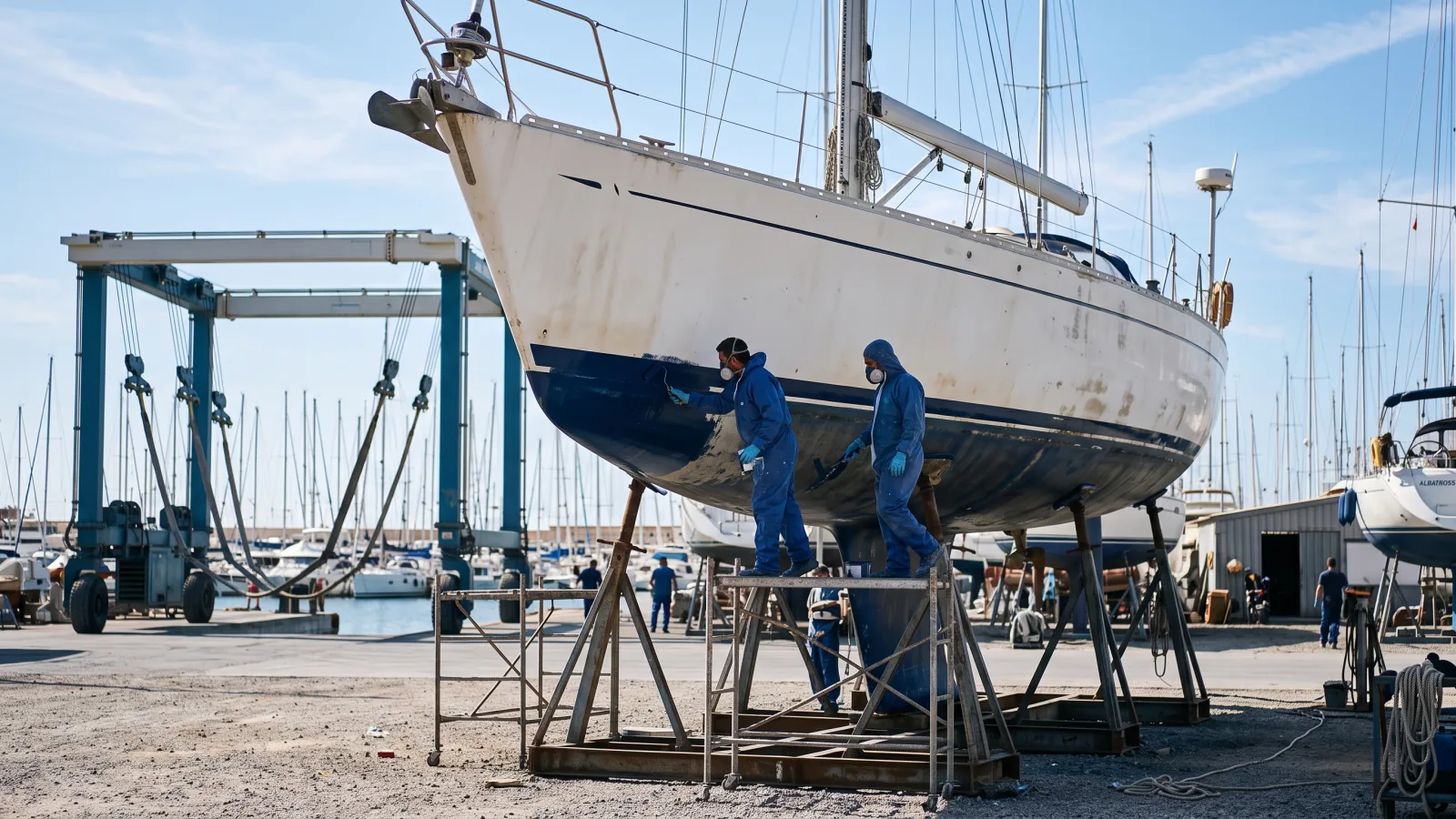
The Yacht Maintenance Schedule: From Daily Checks to Annual Service
A good schedule turns maintenance from a vague worry into a list of specific, repeatable tasks. The intervals below are typical for a well-kept private yacht. Always follow the manufacturer's manuals first, because engines, generators and safety equipment each come with their own required service intervals.
Daily Checks When the Boat Is in Use
These take a few minutes and catch most problems before they grow:
- Engine oil and coolant levels before starting.
- Bilges: look for water, oil or fuel where there should be none.
- Raw-water flow from the exhaust once engines are running.
- Battery charge state and shore-power connection.
- Any new noises, vibrations, smells or warning lights, noted in the log.
Weekly Tasks
- Clean raw-water strainers and check sea cocks operate freely.
- Wash down the deck and rinse salt from stainless steel and windows.
- Check lines, fenders and chafe points on mooring lines.
- Test bilge pumps and float switches.
- Run the generator under load if it has not been used.
Monthly Tasks
- Inspect belts and hoses for cracks, and hose clamps for corrosion.
- Check battery terminals and electrolyte where applicable.
- Test navigation lights, horn and VHF.
- Look over safety equipment: flares' expiry, fire extinguisher gauges, life jacket condition.
- Treat teak and check caulking and sealant around deck fittings.
Service by Engine Hours
Engines and generators are maintained by running hours, not calendar months. Many marine diesels call for an oil and filter change somewhere between 100 and 250 hours, and at least once a year even when hours are low. Fuel filters, impellers, belts and valve adjustments each have their own intervals in the manual.
This is exactly where paper logs fail. An hour-based task is only useful if someone records the hours reliably and compares them against the last service. Missing one entry is enough to push an oil change hundreds of hours past its due point.
Annual Tasks and the Haul-Out
Once a year, usually before or after the main season, the boat comes out of the water. This is the moment for the heavier jobs:
- Antifouling, which on most boats is renewed every one to two seasons depending on the product and the waters.
- Anodes inspected and replaced when significantly worn.
- Propellers, shafts, cutless bearings and shaft seals checked for wear and play.
- Through-hull fittings and sea cocks serviced and tested.
- Full engine and generator service, including impellers, belts and cooling system.
- Standing rigging inspected by a rigger on sailing yachts.
- Safety equipment: liferaft service at the interval set by its manufacturer, fire extinguishers inspected, EPIRB battery and hydrostatic release checked against their dates.
Winterisation and Laying Up
Boats that are laid up for winter need a dedicated routine: fresh-water and raw-water systems drained or protected with antifreeze, engines fogged or run with stabilised fuel, batteries maintained on a charger, and moisture controlled inside. Recommissioning in spring is far easier when the lay-up checklist was completed and recorded, because the crew knows exactly what was drained, removed or disconnected.
Planned Maintenance Systems: How Professional Yachts Stay on Top
Commercial ships and crewed superyachts do not rely on memory. They run a planned maintenance system (PMS): a structured list of every maintainable item on board, each with its interval, its instructions and its history.
A working PMS answers four questions at any moment:
- What is due now, by date or by running hours?
- What is overdue, and by how much?
- What was done last time, by whom, with which parts?
- What spare parts are on board, and what needs ordering before the next job?
The principle scales down perfectly to private boats. An owner with a 15-metre yacht does not need the paperwork of a cargo ship, but benefits from exactly the same logic: one list, clear intervals, recorded history.

Why Maintenance Records Matter as Much as the Work
A complete maintenance history is not just good housekeeping. It has direct financial value in three situations:
- Selling the boat. Buyers and surveyors trust a yacht with a documented service history. Gaps in the records invite lower offers and longer negotiations.
- Insurance and claims. After an incident, proof that equipment was serviced on schedule can make the difference in a claim.
- Changing crew or management. A new captain or engineer can take over in days rather than weeks when the history is in one place.
The records should live with the boat, not with the person. Notebooks, spreadsheets on a personal laptop and invoices in an email inbox all disappear when someone leaves.
How to Build an Annual Maintenance Budget
A maintenance budget does not need to be complicated to be useful. What matters is that it is built from the boat's actual history rather than from a guess, and that it is reviewed against real spending during the season. A simple method works for most private yachts:
- Start from last year's invoices. Group every maintenance invoice by category: engines, hull, deck, systems, safety and interior. This alone often reveals where most of the money really goes.
- Add the scheduled work for the coming year. Look at what falls due by date or engine hours: engine services, antifouling, liferaft servicing, rigging inspection, battery replacement.
- Add a contingency. Unplanned repairs always happen. Owners of older boats usually keep a larger reserve than owners of newer ones.
- Include the indirect costs. Yard days, storage, travel for contractors and transport of parts belong in the budget, not in the surprises.
- Compare with the rule of thumb. If the total is far below or far above around 10% of the boat's value, check whether something has been missed or whether a system is costing more than it should.
Review the budget at least twice a year: once before the haul-out, when the big jobs are planned, and once at the end of the season. The difference between planned and actual spending is the most useful number in the whole exercise, because it shows how much of the maintenance was really under control.
Maintenance Priorities by Type of Yacht
The schedule is the same in principle for every boat, but the priorities shift with the type of vessel:
- Small sailing yachts spend proportionally more on rigging, sails and antifouling, and much of the routine work is done by the owner.
- Motor yachts concentrate the budget on engines, generators, stabilisers and air-conditioning, where hour-based servicing dominates.
- Crewed superyachts run a formal planned maintenance system, and the challenge shifts from remembering tasks to coordinating crew, contractors and class surveys.
- Charter yachts must fit maintenance into short turnaround windows between guests, so planning and spare parts availability become critical.
Five Ways to Reduce Yacht Maintenance Costs Without Cutting Corners
- Plan the haul-out six to eight weeks ahead, with a written job list and parts ordered in advance, so the boat spends fewer days in the yard.
- Track engine hours for every service item, so work happens when it is due, not too early and not too late.
- Keep a spare-parts inventory for impellers, filters and belts, avoiding express shipping and downtime.
- Get comparable quotes for large jobs using the same written scope, so prices can actually be compared.
- Review the year's spending by category, to see which systems cost the most and whether an upgrade would pay back.
How Software Replaces the Notebook and the Spreadsheet
For a single owner-operated boat, a well-kept spreadsheet can work. It starts to break down when there are several people involved, several boats, or both. That is where a yacht management platform earns its place.
The SupaSailing Fleet module is built around the maintenance routine described in this guide:
- Recurring tasks by date or engine hours, with reminders before they fall due.
- Complete intervention history per system, with notes, photos and invoices attached.
- Spare parts and inventory linked to the jobs that use them.
- Documents and certificates with expiry alerts, from liferaft servicing to insurance.
- Shared access for owner, captain, engineer and management company, so the history stays with the boat.
If you want to go further into data-driven maintenance, our article on predictive maintenance for yacht fleets explains how sensors and engine data move the schedule from fixed intervals to actual condition.
Frequently Asked Questions
How much does it cost to maintain a yacht per year?
A common rule of thumb is around 10% of the yacht's value per year for maintenance and upkeep. Newer boats often come in lower, while older or more complex yachts can exceed it. The best way to know your real figure is to track spending by category for a full season.
How often should a boat be antifouled?
Most boats are antifouled every one to two seasons. The right interval depends on the paint system, water temperature, how much the boat is used and how long it stays on its berth.
Should engine maintenance follow hours or calendar dates?
Both. Engine and generator services are usually due at a set number of running hours or after a set period, whichever comes first. A boat that runs few hours still needs an annual service because oil, coolant and rubber parts age over time.
What is a planned maintenance system on a yacht?
It is a structured list of every maintainable item on board, with intervals, instructions and service history. Crewed yachts use it to know what is due, what is overdue and what was done last time.
Do maintenance records really affect resale value?
Yes. A documented service history gives buyers and surveyors confidence, shortens negotiations and supports the asking price. Missing records are one of the most common reasons buyers ask for a discount.
Final Thought
Yacht maintenance will never be cheap, but it does not have to be unpredictable. Owners who know what is due, what it will cost and what was done last time spend less and enjoy their boats more. Start with the schedule in this guide, record every job, and move the history into a system that stays with the boat. To see how the Fleet module organises it for you, request a demo or get in touch.
Related solutions
See how SupaSailing is built around these roles:
See SupaSailing in action
Book a free demo call and discover how one platform can run your charter, marina, fleet, shipyard or brokerage.
Book a Free DemoShare this article