Predictive Maintenance for Yacht Fleets: Reducing Downtime with Data and IoT
Predictive maintenance for yacht fleets has progressed from a pilot-stage idea five years ago to an operational practice that the better-run fleets now treat as routine. The economics are straightforward: an unplanned engine failure on a charter vessel during the season costs an order of magnitude more than the equivalent failure caught at the previous service interval. Multiply that across a fleet, and the case for investment in predictive maintenance is one of the easiest investment cases in maritime IT. This article walks through what predictive maintenance actually looks like in 2026, where the value is real and where the marketing claims still outrun the technology.
"Predictive maintenance is sometimes sold as a magic black box. In practice, it is the disciplined application of data, thresholds, and human judgement to a problem that has always existed. The discipline is what makes it work."— Technical director, Mediterranean charter fleet operator
What "Predictive" Actually Means
The maintenance lexicon has three terms that are often confused. Reactive maintenance fixes things after they break. Preventive maintenance fixes things on a fixed schedule (every 500 hours, every two years) regardless of actual condition. Predictive maintenance fixes things based on observed condition — vibration, temperature, oil quality, pressure trends — that suggest a failure is approaching.
The big shift in the last decade has been from preventive to predictive — not because preventive maintenance is wrong, but because preventive maintenance over-services equipment in good condition and under-services equipment that is degrading faster than the manufacturer's average. Predictive maintenance does the right work at the right time.
The Data Layer: IoT Sensors
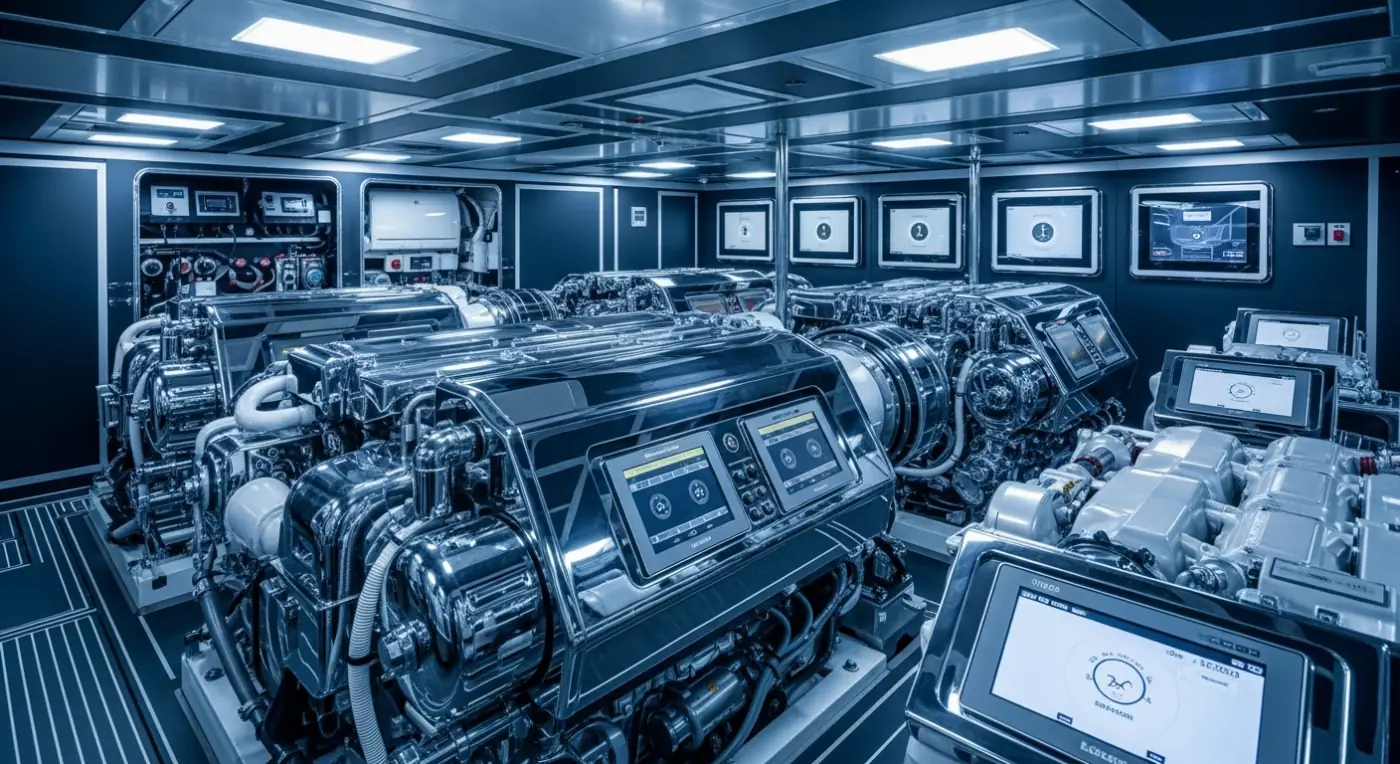
The starting point for predictive maintenance is observation. The modern instrumented engine room has sensors monitoring:
- Vibration on rotating equipment (engines, generators, pumps).
- Temperature at critical points: bearings, exhaust manifolds, alternator.
- Pressure across hydraulics and fuel systems.
- Oil condition (water content, viscosity, wear-particle profile).
- Electrical signatures: motor current and voltage waveforms.
Many modern engines and generators come from the OEM with a basic sensor pack and a manufacturer's monitoring portal. The fleet manager who relies only on the OEM portal is constrained to the OEM's data model and update cadence. The fleet manager who consolidates data across OEMs into a single fleet-wide system has a fundamentally better analytical position.
The Analytics Layer: Patterns and Anomalies
Sensors produce data; analytics produce decisions. The two patterns of analytic value in predictive maintenance are threshold-based alerts and anomaly detection.
Threshold-based alerts are the simpler and most useful starting point: when temperature exceeds X, alert. When vibration exceeds Y, alert. When oil water content exceeds Z, alert. The thresholds are set conservatively at first and tuned as the fleet's actual operating envelope is understood. Most operational value in predictive maintenance comes from competently set thresholds applied consistently.
Anomaly detection — the more glamorous side — looks for deviations from the equipment's own historical pattern. The same engine running 2°C hotter than usual at the same load is a candidate for inspection, even though no fixed threshold has been crossed. Anomaly detection genuinely surfaces issues that thresholds miss, but it requires reasonably clean historical data and disciplined operator response. The alert that no one investigates is no alert at all.
Cross-Fleet Intelligence
The single biggest leverage point in predictive maintenance — and the one that requires consolidated fleet data — is cross-fleet pattern detection. The fleet manager who notices that three of seven generators of the same model are showing similar vibration anomalies after similar operating hours has a fleet-level signal that no individual engineer would see. That signal might be: a known OEM issue worth flagging to all vessels; a fuel quality problem at a particular bunkering port; a maintenance procedure that needs to change.
This kind of insight is intrinsically a fleet-data problem. The yacht-by-yacht spreadsheet model cannot produce it. The OEM monitoring portal cannot produce it because it sees only the OEM's own equipment. The integrated fleet management platform with consolidated maintenance and condition data can produce it routinely.
The Workflow: From Alert to Service
An alert is not a maintenance action. The discipline of predictive maintenance is the workflow that connects the two. The workflow that works in practice has these stages:
- Alert generation: from sensor data or analytics.
- Triage: by the chief engineer or fleet technical superintendent. Real issue, false positive, watchful waiting?
- Investigation: focused inspection of the equipment in question.
- Decision: schedule maintenance now, schedule for next port call, monitor for further evidence, or stand down.
- Execution: the maintenance work, with the parts, technicians and downtime managed accordingly.
- Verification: that the issue has been resolved and the sensor signature returns to normal.
- Learning: capture the case for future reference and threshold tuning.
A predictive maintenance programme that produces alerts and does not consistently complete this loop produces alert fatigue and is gradually ignored. The discipline is operational, not technical.
Spare Parts and Logistics
Predictive maintenance only delivers downtime savings if the parts and skills are available when needed. The fleet that detects an impending failure but cannot get the part in time experiences the failure anyway, just with more notice. The fleet management platforms that integrate predictive condition monitoring with spare-parts inventory, supplier lead times and crew technical skills produce a meaningfully different outcome from the systems that only generate alerts.
A typical pattern is: detect a developing issue, identify the parts and skills needed, check inventory and lead times, and schedule the maintenance window into a planned port call rather than during a charter or transit. Done across a fleet over a season, this kind of orchestration produces the largest measurable downtime reduction.
Crew, Training and the Cultural Layer
The technology works only if the crew uses it. Many predictive maintenance projects in 2025–26 have foundered not on sensor reliability but on crew engagement. The chief engineer who treats the system as another piece of paperwork imposed from shore is not extracting value from it. The chief engineer who treats it as a colleague — extending their experience and judgement — does.
The pattern that works is to involve the technical crew in threshold tuning, alert investigation and outcome documentation from the start. They become co-authors of the system rather than passive recipients of its outputs. Their experience is captured in tunings and rules; their judgement is augmented by data they would not otherwise have.
"We started with three engineers thinking the platform was a threat. Six months in, those same three engineers were leading the threshold-tuning sessions. The shift happened when they saw their own pattern recognition reflected back at them."— Operations manager, fleet of 18 charter motor yachts
The OEM Sensor Pack and Open Standards
Increasingly, OEM sensor packs are converging on open data standards that allow fleet-wide consolidation. The ISO 19847 / 19848 ship data server standards define how shipboard data should be exposed for analysis, and the major engine manufacturers — MAN, MTU, Caterpillar, Volvo Penta, Cummins — are increasingly aligning to these specifications. Operators specifying new vessels or major repowers should make data accessibility a procurement criterion, not an afterthought.
Insurance and the Maintenance Record
Yacht insurance is increasingly attentive to maintenance discipline. Underwriters now ask, in detail, about maintenance schedules, condition monitoring, parts traceability and crew competency. A fleet that can produce a complete and consistent maintenance history attracts better terms; a fleet whose maintenance records are scattered across spreadsheets, paper and email cannot. The data discipline that supports predictive maintenance is, simultaneously, an insurance asset.
Where SupaSailing Helps
SupaSailing's fleet management module integrates predictive maintenance, planned maintenance, parts inventory, supplier management, crew certifications and operational reporting into a single platform. It accepts data from major OEM sensor packs (MAN, MTU, Caterpillar, Volvo Penta, Cummins) as well as third-party sensors, and it produces fleet-wide analytics across consolidated condition data.
The fleets that have moved from spreadsheet-and-email maintenance to integrated software typically report meaningful downtime reductions within the first full season — driven less by the sophistication of the analytics and more by the discipline of consistent measurement and the visibility of cross-fleet patterns. Our security and compliance page covers the data protection posture that supports all of this.
A Practical Roadmap
If your fleet is currently maintaining vessels on preventive schedules with limited sensor data, the practical phase plan is:
- Consolidate maintenance records into a single system, even before adding sensors.
- Standardise terminology and equipment identifiers across the fleet.
- Add sensor coverage on the highest-risk equipment first (main engines, key generators).
- Set conservative thresholds and tune over a season.
- Add anomaly detection only after thresholds are working.
- Integrate parts inventory and supplier lead times into the workflow.
- Capture cross-fleet patterns in regular technical reviews.
Done in this order, the work is achievable and produces visible results within a season. To explore how SupaSailing can support the journey, get in touch or request a demo.
The Vessel Manager's New Toolkit
The technical superintendent or vessel manager role has evolved significantly with the rise of integrated fleet management software. Where five years ago the role was substantially about chasing crews for paperwork and chasing yards for invoices, in 2026 the productive vessel manager spends more time on analytical and decision-making work: which equipment is showing developing issues across multiple vessels; which contractors are delivering on time and which are not; which crew technical practices correlate with longer equipment life; which port calls produce the most frequent maintenance triggers.
The role becomes more strategic when the system handles the routine. The vessel manager who is data-empowered makes recommendations to the owner that are visibly grounded in evidence. The vessel manager who is data-poor makes recommendations grounded in their own experience — which is valuable but not always comparable to a competitor's data-rich proposal.
"We measured a 22% reduction in unplanned downtime in our first full season after consolidating maintenance, condition monitoring, parts inventory and crew certifications onto a single platform. The technology helped, but the real change was that the team could finally see what they were managing."— Technical director, fleet of 24 yachts under management
Crew Certification and Lifecycle Tracking
Crew certifications — STCW, ENG1 medical, GMDSS, advanced firefighting, PSCRB, and the various flag-state-specific qualifications — have certification cycles, expiry dates, renewal requirements and revalidation processes. Tracking this across a fleet of 100 to 500 active crew across multiple flag states and rotations is non-trivial.
The fleet management platform that tracks crew certifications produces visible benefits: no surprise expiries during a charter, no mismatches between vessel certification and crew on board, no flag-state inspection findings on certificate currency. The investment in clean certification data pays back the first time it prevents a missed renewal that would otherwise have stranded a vessel before its next port call. The IMO STCW convention is the authoritative reference for the certification framework that underpins all of this.
Frequently Asked Questions
What sensors are most valuable to start with on an existing fleet?
Vibration sensors on main engines and generators deliver the highest signal-to-noise ratio for the lowest install cost. Temperature sensing on bearings and exhaust manifolds is a close second. Beyond that, oil-condition monitoring on critical equipment and electrical-signature analysis on key motors round out a useful baseline. Coverage everywhere is unrealistic; coverage on the equipment that actually fails is achievable.
How do we deal with false-positive alerts?
False positives are a normal feature of any predictive maintenance system, particularly in the first season. Tune thresholds conservatively at the start and adjust as the operating envelope is understood. The goal is to keep the alert rate low enough that every alert gets investigated but not so low that genuine issues are missed.
Is OEM monitoring enough, or do we need a third-party platform?
For a single-vessel operation, OEM monitoring is often adequate. For a fleet, the OEM data is necessary but not sufficient — it does not allow cross-vessel pattern detection across different OEMs. The fleet platform consolidates OEM data and supplements it with third-party sensors where the OEM coverage is thin.
How do we get buy-in from chief engineers who view the system as paperwork?
Involve them in the design, threshold tuning and outcome documentation from day one. Engineers who feel the system reflects their judgement — rather than overrules it — become its most enthusiastic users. Engineers who feel the system is imposed on them push back, and rightly so.
What return on investment should we expect, and how soon?
Most fleets see meaningful downtime reductions within the first full season after consolidating maintenance, parts and condition data on a single platform. Specific ROI depends on the baseline, but a 15-25% reduction in unplanned downtime within 18 months is a defensible expectation for a fleet of 10+ similar vessels.
Related solutions
See how SupaSailing is built around these roles:
See SupaSailing in action
Book a free demo call and discover how one platform can run your charter, marina, fleet, shipyard or brokerage.
Book a Free DemoShare this article