Required Boat Documents: Registration, Safety Certificate and Equipment
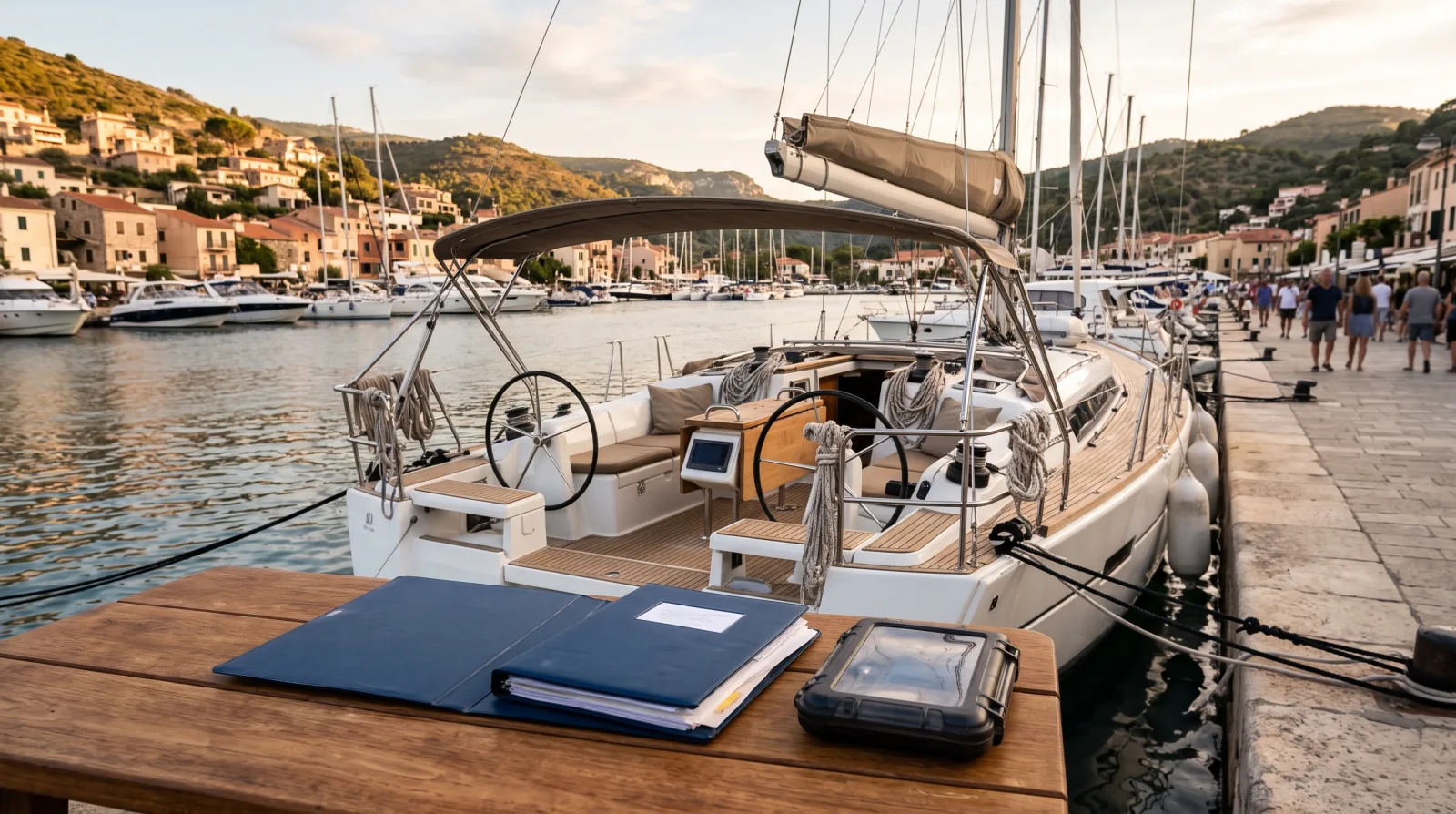
A Coast Guard check at sea, an inspection in a foreign port, a claim involving your insurer: in every one of these cases the first question is the same. Which documents are required on board a boat, and where are they? Skippers who don't have them, or whose papers have expired, risk fines, detentions and disputes that can ruin a day or a whole season.
This guide puts the documents in order. First the categories every boat should carry, in any Mediterranean country; then a section on Italy, with the navigation licence, safety certificate and equipment; finally what is added for charter or commercial use, and how to keep expiry dates under control.
The key point: the list of documents depends on flag, size and use of the boat. Build an on-board file from the categories in this guide, then check the details with the competent authority, because the rules change and the penalties depend on them.
Which Documents Must a Boat Carry On Board?
The rules vary from country to country, but the sensible list of documents is almost always the same. When you sail in foreign waters, a complete and well-ordered file shortens inspections and shows you take compliance seriously.
- Registration document or licence: proof that the vessel is registered, identifying flag, name, dimensions and owner.
- Proof of ownership: bill of sale, invoice or another title linking the owner to the boat.
- Insurance: a policy in force, with the limits and the cruising area covered.
- Radio licence: authorisation for the radio installation and the certificate of the person operating it, if the boat has VHF, an EPIRB or other equipment.
- Safety or inspection certificate, where required by the flag and the use.
- Qualification of the person in command: boating licence or equivalent, plus crew certificates for professional vessels.
- Builder's documents: declaration of conformity, CE marking, owner's manual.
- Engine and systems documentation: logbooks, warranties, servicing certificates for the liferaft and fire extinguishers.
- Personal documents: passports or ID cards of everyone on board, useful at borders.
It is worth adding two items that are often missing: proof of the boat's tax and customs status (useful when sailing outside the flag state) and the emergency instructions with useful phone numbers. On the tax side, always take professional advice.
Tenders, Boats and Yachts: Why the Category Matters
In Italy, pleasure craft are governed by the Italian Recreational Boating Code (Legislative Decree 171 of 2005) and related regulations. The Code splits vessels into three categories, and much of the paperwork depends on the category.
- Natanti da diporto (small craft): vessels up to 10 metres in length.
- Imbarcazioni da diporto (boats): vessels over 10 and up to 24 metres.
- Navi da diporto (yachts): vessels over 24 metres.
The exact definitions and exceptions, for example for certain types of vessel, must be read in the current text. What matters here is the principle: the bigger the boat, the more formal the documentation and the more numerous the inspections.
Navigation Licence: What It Is and When You Need It
The navigation licence (licenza di navigazione) is the main document of Italian boats and yachts. It certifies that the vessel is entered in the registers and records its identifying data, main characteristics and owner. It must be kept on board and shown to whoever carries out an inspection.
Small craft, as a rule, are not entered in the registers and have no navigation licence: their documents are the builder's declaration of conformity, proof of ownership and the qualifications of the person in command. Here too, check the current rules, because the administration of pleasure craft has been simplified several times and now partly runs through online procedures.
What to Do When Something Changes
The licence is a snapshot of the vessel at a given moment. If the owner, engine, dimensions, use or other relevant data change, the document must be updated at the competent office. A licence that no longer matches the real boat is a serious problem in an inspection and in a claim: the insurer may dispute the cover.
- Change of ownership: requires a formal transfer and an update of the paperwork.
- Engine replacement or change of power: may affect the licence, the insurance and the qualifications required.
- Change of use from private to charter: generally brings additional requirements, covered below.
- Loss or theft: report it and request a duplicate before sailing again.
Boat Safety Certificate: Who Needs One
The safety certificate attests that the vessel has been surveyed by an authorised body and found to comply with safety requirements. Not every boat needs one. In general terms, it depends on the type of vessel, its marking and above all its use: vessels engaged in commercial activity are the ones for which the certificate is most often required.
Where required, the certificate does not last forever: it must be renewed through periodic surveys at intervals set by the regulations. The surveys check hull, systems, equipment and the operation of safety systems. The exact schedule and the competent body should be confirmed with the harbour master's office (Capitaneria di porto) or the organisation that issued the certificate, because they depend on category and use.
How to Prepare for the Periodic Survey
- Gather the vessel's documents, including the licence, previous certificates and maintenance reports.
- Check the equipment item by item, verifying quantity, condition and expiry dates.
- Have items serviced in advance: liferaft, extinguishers and flares at authorised service stations.
- Test the systems: bilge pumps, navigation lights, VHF, lamps and sound signals.
- Book early, because surveys bunch up in spring.
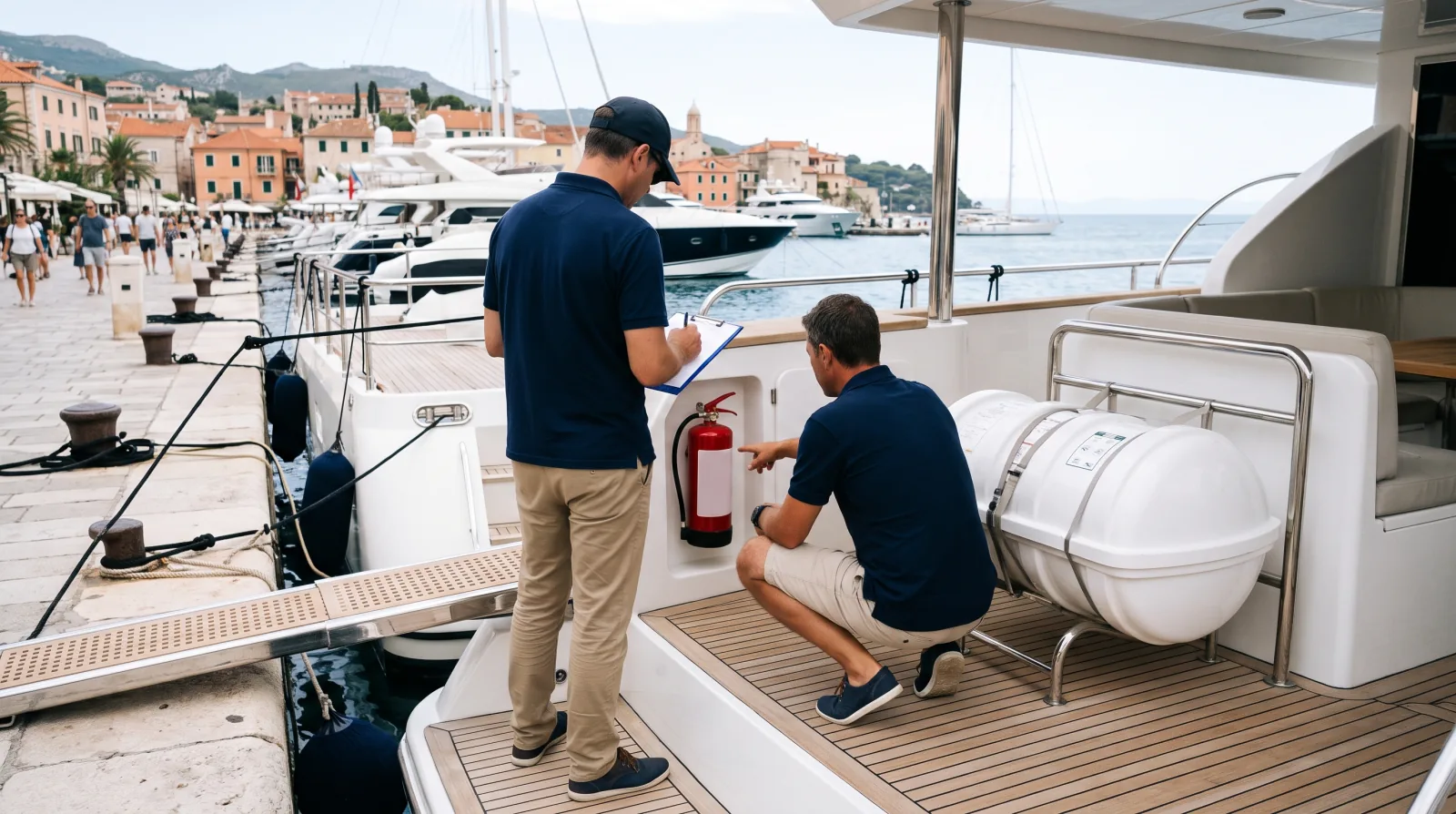
Mandatory Safety Equipment: How It Is Determined
Mandatory safety equipment is the list of gear that must be on board depending on what the boat does. In Italy it depends on two main factors: the distance from the coast at which the vessel sails and its characteristics, such as length, type of propulsion and number of people carried.
Navigation bands are graded: the further you go from the coast, the more complete and demanding the equipment. Moving from one band to the next can mean, for example, a liferaft instead of a simple lifebuoy, or more complete radio equipment.
The Most Common Equipment Categories
- Lifesaving: lifejackets for everyone on board, lifebuoy, liferaft where required, safety harnesses for deck work.
- Fire protection: portable extinguishers of suitable type and number, with periodic servicing.
- Signalling: flares, smoke signals, navigation lights, sound signals.
- Navigation: compass, charts or equivalent instruments, VHF for the bands that require it.
- First aid: medical kit with contents suited to the distance from the coast.
- Anchoring and mooring: anchor, chain, lines and fenders in proportion to the boat.
- Water removal: manual or electric bilge pumps, depending on size.
There is no universal list valid everywhere. Official lists and distance bands must be taken from the regulations in force or from the harbour master's office, and reviewed every time you change use or cruising area.
Boating Licence, Insurance, Radio and Other Personal and Equipment Documents
Boating Licence and Qualifications of the Person in Command
The boating licence (patente nautica) is a personal document that authorises you to operate certain vessels: whether you need one depends on engine power, the type of boat and the distance from the coast. It must be carried on board and shown to inspectors. Like other qualifications, it expires and must be renewed under the rules of the country that issued it.
For those sailing abroad on a chartered boat, there is an International Certificate of Competence (ICC), accepted in many countries, which often comes in handy alongside the national licence. Always check what the country you are sailing in requires, because some waters have their own rules.
For professional crew certificates, those tied to international training, see our guide to STCW certificates, validity and renewal.
Insurance, Radio and Equipment Documents
Three groups of documents are often forgotten, because they don't belong to the boat strictly speaking but are checked just as often.
- Insurance: in Italy, third-party liability cover is required for pleasure craft, with some exclusions. Keep the certificate on board and check expiry, cruising area and any usage limits.
- Radio: a VHF installation requires a station licence and a certificate for the operator. If you have an EPIRB or AIS, also check registration and the associated codes.
- Engine, systems and warranties: manuals, servicing certificates and invoices for work done. They are needed at inspections and at sale.
To this list you can add, for those who keep one, the record of the passage: the yacht logbook is valuable evidence in disputes, even where it is not mandatory.
Charter and Commercial Use: Which Documents Are Added
When the boat is used for charter, the rules change and so do the documents. The overall picture is the same across the Mediterranean, but the details depend on the flag and the country of operation.
| Area | Typical additional documents |
|---|---|
| Authorisation for commercial use | Endorsement of the use on the licence or register, certificates from the classification society or authority, periodic surveys |
| Crew | Crew list, professional qualifications, medical certificates, employment contracts |
| Safety | Emergency plan, minimum safe manning table, drill record, extended equipment |
| Guests | Charter contract, passenger list, safety briefing given |
| Insurance | Policy covering commercial activity, often with higher limits |
| Tax and customs | Documentation on the vessel's tax status, to be agreed with an adviser |
A private policy does not automatically cover charter use, and it is a recurring mistake. If the boat is chartered even only occasionally, tell your insurer about the use before the season and check that the vessel's documents reflect reality.
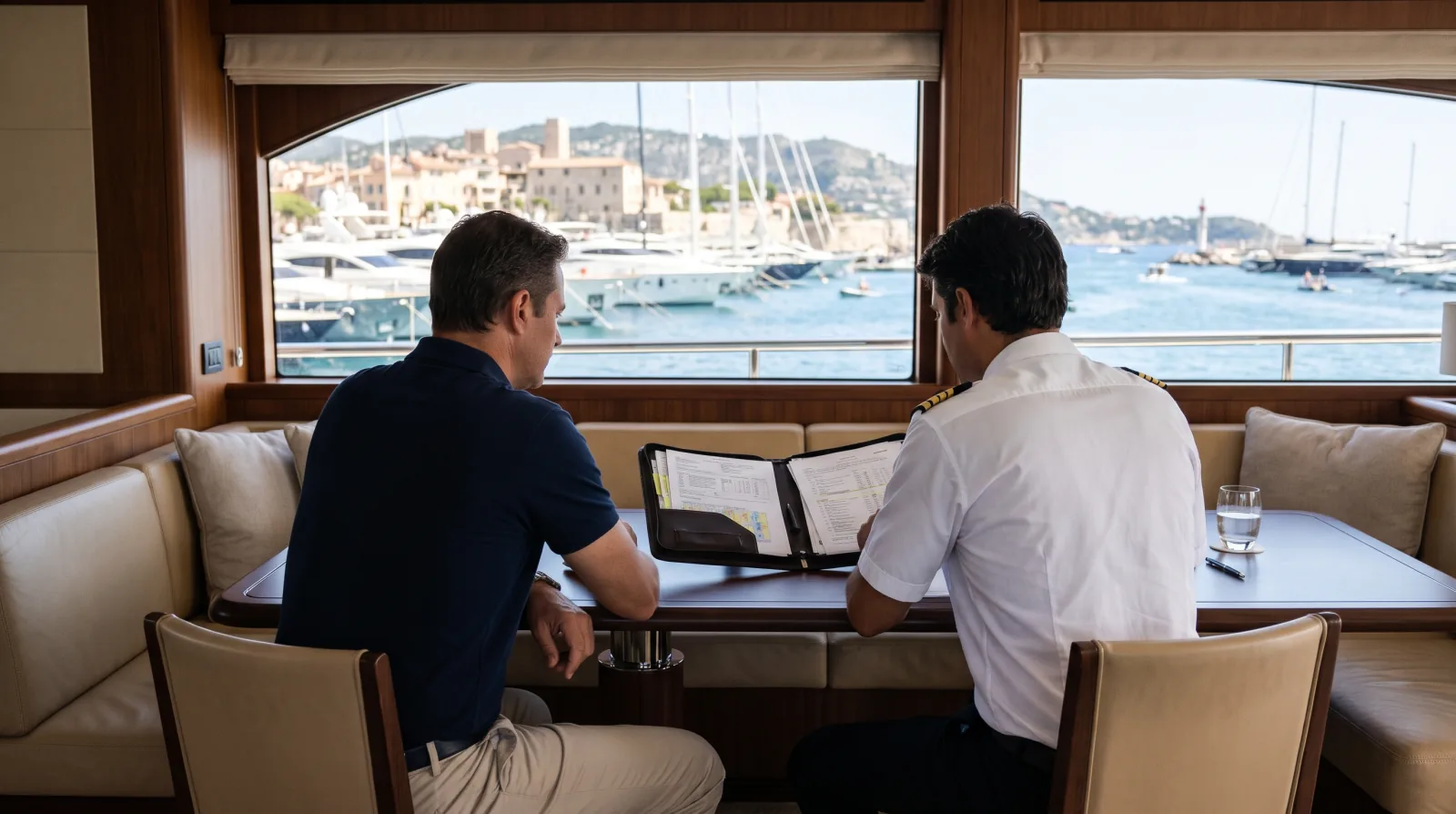
What Happens During an Inspection and How to Behave
An inspection at sea or on the quay usually follows a predictable pattern. For those who are prepared, it is a formality of a few minutes.
- Introduction: the officer identifies themselves and asks for the skipper. Keep a cooperative, clear tone.
- Documents: licence or registration, insurance, qualifications of the person in command, radio licence if any.
- Equipment: spot check of lifejackets, extinguishers, flares, liferaft and lights.
- Report: if irregularities emerge, a report is drawn up with any requirements and deadlines to put things right.
Don't improvise answers on the rules: if you are unsure about something, ask the officer which regulation applies and then check with the harbour master's office or a professional. Penalties and amounts change over time and should not be quoted from memory.
How Long Documents Last and How Not to Miss Expiry Dates
Each document has a different life cycle. Some don't expire but must be updated when things change; others have a fixed expiry; others still depend on the service dates of components. In general terms:
- Registration documents: follow the vessel and are updated when data changes.
- Insurance: usually annual, with renewal not to be left to the last day.
- Safety certificates: renewed through periodic surveys, at intervals set by the regulations.
- Licence and medical certificates: personal expiry, different for each person.
- Liferaft, extinguishers, flares: service or expiry dates printed on the components.
The practical problem is not knowing the rules: it is remembering, without missing any, six, ten or twenty different expiry dates in a year. A shared calendar and a tidy archive, even a digital one, solve most cases. For the budget for this work, see also the guide to yacht maintenance costs.
How Software Simplifies Managing On-Board Documents
The SupaSailing Fleet module provides a central archive for vessel certificates, survey reports and compliance documents, with expiry tracking and automatic reminders. The overview shows overdue maintenance and expiring documents at a glance, so no date slips by unnoticed.
- A single archive for licence, insurance, certificates, manuals and warranties, accessible to owner, captain and fleet manager.
- Expiry alerts on the boat's documents and on crew certificates.
- Preventive maintenance with automatic reminders and compliance tracking.
- Digital passage checklists for safety checks before departure.
It remains the responsibility of whoever manages the boat to know which documents are required: the software remembers the dates and collects the files, but the rules are checked with the competent authority. For the roles involved, see the pages for owners, captains and fleet managers.
Frequently Asked Questions
Which documents do you need on board a boat in Italy?
In general you need the registration document or navigation licence, proof of insurance, the licence of the person in command when required, the radio licence if there is a radio installation, and the documentation for the builder and the equipment. The precise list depends on the vessel's category and use.
To be sure, ask the harbour master's office (Capitaneria di porto) for confirmation.
What is the navigation licence and who needs one?
It is the document certifying that a boat or yacht is entered in the registers and recording its identifying data. It must be kept on board. Small craft (natanti) generally don't have one and are identified by other documents.
Is the safety certificate mandatory for all boats?
No. It depends on the type of vessel, its marking and above all its use: the certificate is most often required for vessels in commercial activity. Where needed, it is renewed through periodic surveys. Check your case with the harbour master's office or the body that issued the certificate.
What is the mandatory safety equipment?
It depends on the distance from the coast at which you sail and on the characteristics of the boat. In general it includes lifesaving gear, fire protection, signalling, navigation instruments, first aid and bilge pumps, in increasing quantity with distance. For the up-to-date list, consult the regulations in force.
Do you need different documents for charter?
Yes, in general. Commercial use brings authorisations, surveys, crew documents and specific insurance cover. Before chartering the boat, even occasionally, inform your insurer and check the requirements with the authority and an adviser.
What do I risk if my documents have expired?
Anything from an administrative fine to detention of the vessel, up to problems with the insurance in the event of a claim. The extent and consequences depend on the document and the rules in force, which change over time. If in doubt, renew before expiry, not after.
Can I keep my documents in digital form only?
It depends on the authority and the type of document. Digital copies are handy as an archive and reminder, but many checks require originals or accepted copies. Keep the required documents on board in the prescribed format and use digital as a second copy.
Final Thoughts
On-board documents are not just bureaucracy: they are what lets you sail with peace of mind, insure the boat, sell it without hitches and pass an inspection in a few minutes. Method matters more than memory: a tidy file, a list of expiry dates and someone responsible for keeping them up to date.
If you want to see how the Fleet module gathers documents, certificates and expiry dates in a single archive, request a demo or contact us.
Related solutions
See how SupaSailing is built around these roles:
See SupaSailing in action
Book a free demo call and discover how one platform can run your charter, marina, fleet, shipyard or brokerage.
Book a Free DemoShare this article