Boat Storage: Types, Costs and Winter Checklist

Every autumn boat owners face the same choice: leave the boat in the water, haul it out, or put it under a shed? Boat storage looks like a simple matter, until the quotes arrive, along with contracts to read and a list of jobs to do before closing the season. A choice made in a hurry is paid for in spring, with batteries to replace, damp on board and an engine that will not start.
This guide explains the types of boat storage, what the price depends on, how haul-out and launch work and how to prepare the boat for winter. You will also find the points to check in the contract, the criteria for choosing a boatyard and the checklist for getting everything running again in spring.
The key point: storage is not just a place to leave the boat. It costs less and pays off more when the choice of location, the winterization and the spring work are planned together, with a written list and a single history of the work done.
What Is Boat Storage and When Do You Need It?
Boat storage means keeping the boat safe out of season, in the water or on land, at a marina, a boatyard or an equipped storage area. It usually includes security, the use of an area or a berth and, depending on the contract, services such as haul-out, launch and covering.
It is needed in three typical situations:
- Winter lay-up: the boat is not used for months and must be protected from cold, damp and storms.
- Planned work: hull care, antifouling, overhauls and refits are easier to carry out with the boat on land.
- Long absence: anyone leaving for months, even in summer, prefers a boat in storage to one sitting idle in the water.
In the Mediterranean many boats stay in the water all year. Even then a long period of inactivity calls for preparation, because sitting idle damages a boat almost as much as heavy use.
What Are the Types of Boat Storage?
The options available vary from area to area, but they come down to five models. Each strikes a different balance between cost, protection and convenience.
In-water storage
The boat stays moored, alongside a quay or on a mooring buoy, often in the berth it occupies in summer. It is the most convenient solution: no haul-out, the boat is always ready and easy to check. The downside is that the hull, propeller and seacocks stay submerged, and that a winter mooring exposed to wind and storms requires lines, fenders and frequent checks.
Outdoor storage on land
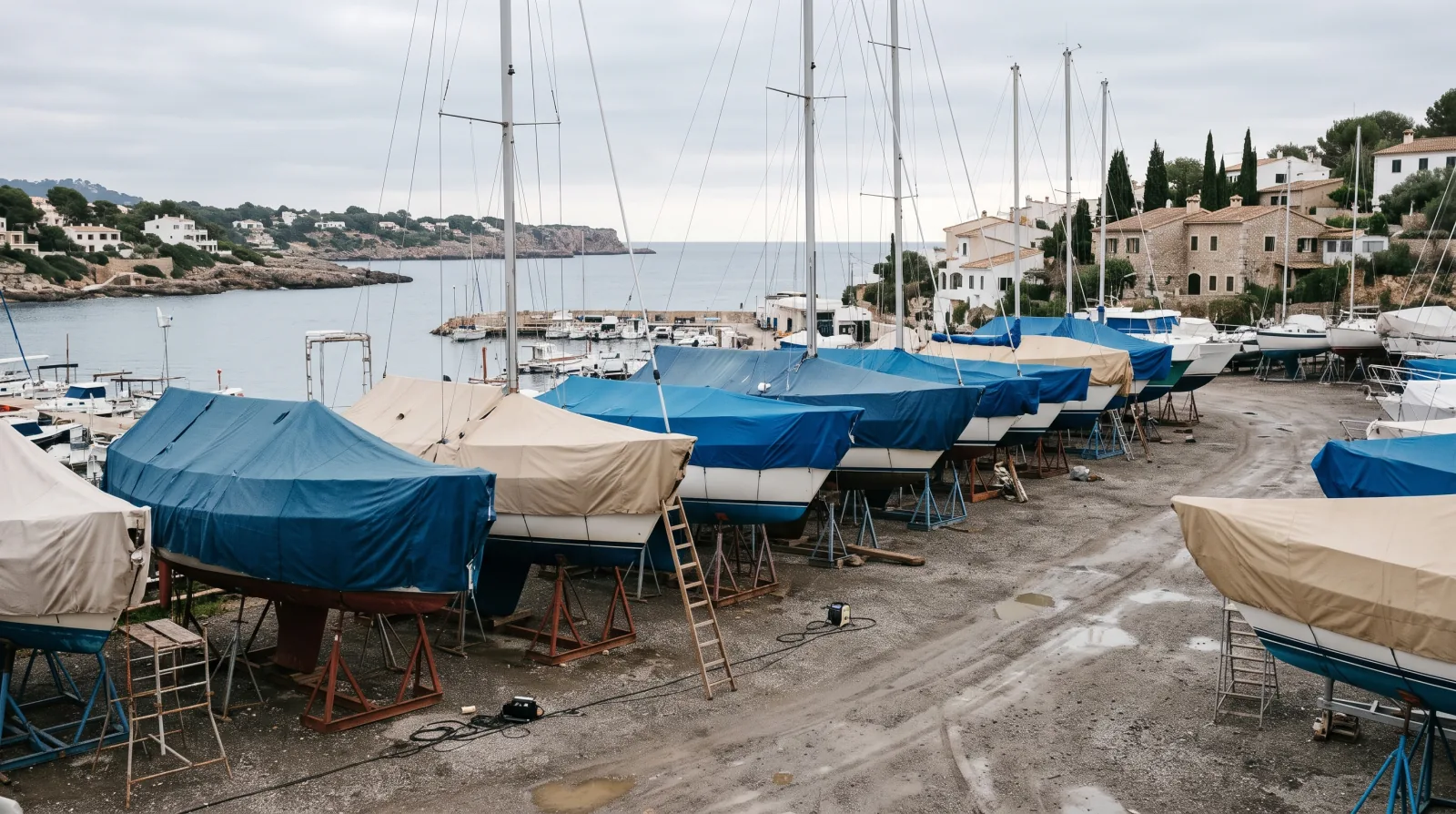
The boat is hauled out and set on a cradle or trailer in a yard. It is the most common option and, as a rule, the cheapest of the on-land options. The hull dries out and you can work on the underwater hull, but the boat stays exposed to sun, rain, wind and cold, so the cover matters a great deal.
Covered or indoor storage
The boat is kept under a roofed canopy or inside a shed. It protects better against bad weather, UV rays and temperature swings, and reduces deck maintenance. It costs more, spaces are limited and it must be booked in advance. It generally makes sense for valuable boats or those with a lot of teak, fabrics and finishes to protect.
Dry stack or vertical storage
Boats, usually powerboats of modest size, are kept on multi-level racks and moved with a forklift. The owner asks for the boat and finds it in the water, ready to go. It works well for frequent use and for anyone who does not want to deal with anything, but it has length and weight limits and an annual cost that is often higher than a yard.
Trailer at home or in a private storage lot
For trailerable boats, keeping the boat at home, in a garage or in a private storage lot eliminates the storage fee. You still have the costs of the trailer, transport, insurance and space. You need to check the weight and size limits for road use and your local council's rules on parking vehicles.
What Is the Difference Between the Types of Boat Storage?
The table summarises the most common trade-offs. These are general indications: details vary from facility to facility.
| Type | Relative cost | Protection | Convenience | Suited to |
|---|---|---|---|---|
| In the water | Depends on the berth | Medium, more exposed to the sea | High | Those who use the boat in winter too |
| Outdoor on land | Moderate | Medium | Medium | Most sailboats and powerboats |
| Covered or indoor | Higher | High | Medium | Valuable boats, lots of teak decking and fabrics |
| Dry stack | Medium-high | High | Very high | Small to medium powerboats, frequent use |
| Trailer at home | Minimal, but with its own costs | Depends on the location | Low | Trailerable boats |
How Much Does Boat Storage Cost?
There is no price list that holds everywhere. The price is built from a base fee, usually calculated on length overall or on the area occupied, to which services are added. Amounts vary greatly between North and South, between coast and lakes, and between high and low season. The figures in circulation should be treated as orders of magnitude and checked with written quotes.
The factors that move the bill are always the same:
- Length, beam and weight: they determine the area occupied and the lifting equipment needed.
- Type of storage: yard, shed, dry stack and in-water have different price structures.
- Duration: many boatyards offer a flat fee for the winter period and a monthly rate for shorter stays.
- Location: proximity to large cities, demand and land costs have a big effect.
- Services included: haul-out, launch, washing, propping up, electricity, security, on-site assistance.
The items added to the base fee
The base fee is rarely the total. Always ask for a quote that lists every item separately, so you can compare different offers:
- Haul-out and launch: often invoiced separately, with a rate tied to length or weight.
- Hull washing after haul-out, with a pressure washer.
- Props or cradle, if not supplied by the boatyard.
- Electricity for battery chargers or dehumidifiers.
- Labour for the work you ask the boatyard to do, hourly or by quote.
As an order of magnitude, for a medium-sized boat winter storage on land can run from a few hundred to a few thousand euros per season, and rise noticeably for large boats, sheds and dry stack. This is an indicative estimate: here a written quote is worth more than any average.
To fit these expenses into the full picture of annual costs, read our guide to yacht maintenance costs and the annual schedule.
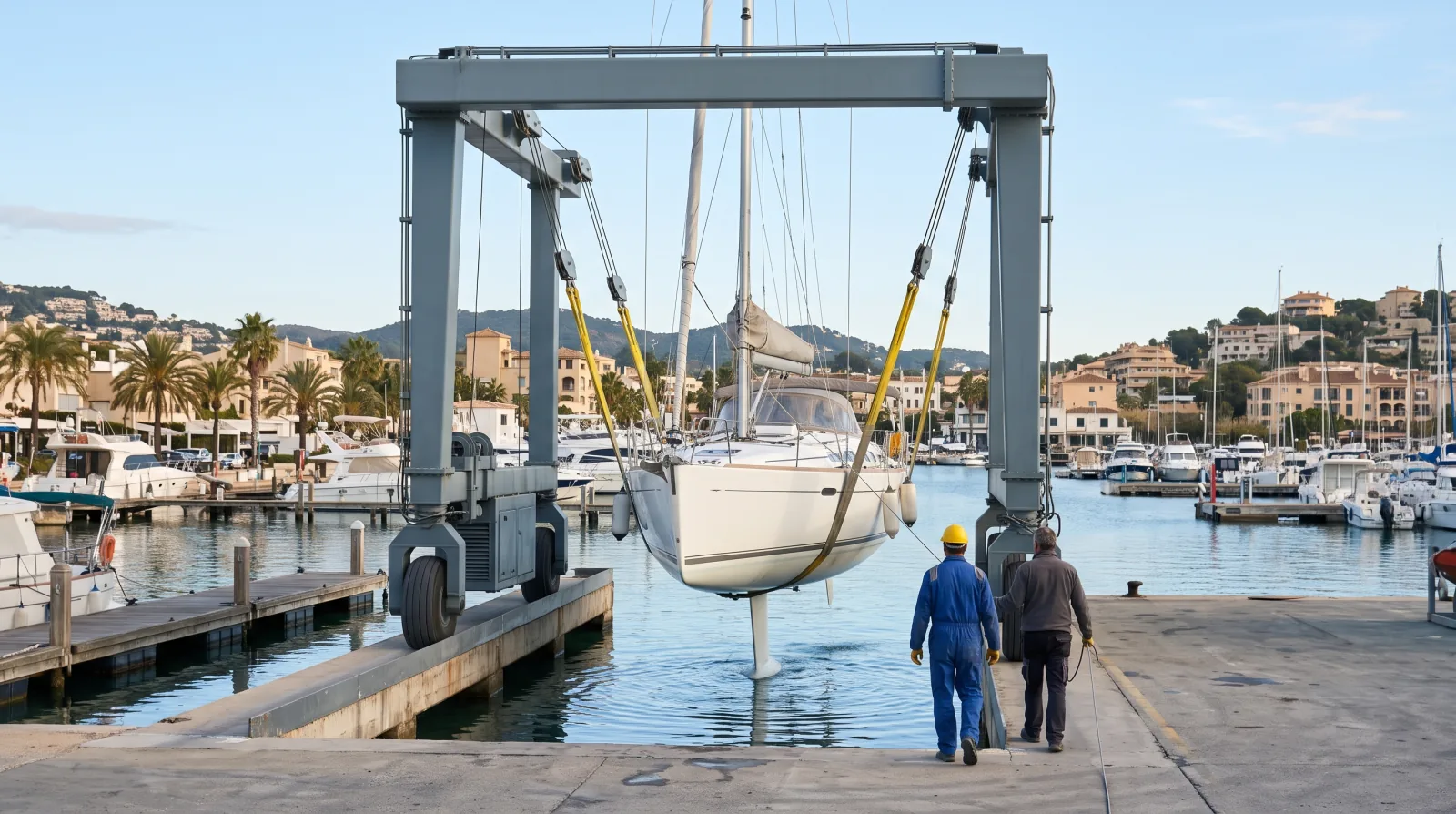
How Do Haul-Out and Launch Work?
Haul-out is lifting the boat out of the water to set it on land. Launching is the reverse operation. Both are carried out at the boatyard with dedicated equipment, depending on the size and weight of the vessel:
- Travel lift: a mobile gantry with slings that lifts the hull and carries it into the yard. It is the most common system in boatyards.
- Crane: used for smaller boats or where there is no travel lift.
- Slipway with trailer or cradle: the boat is pulled onto land on a trailer towed by a vehicle.
- Dry stack forklift: a forklift that takes the boat from the rack and puts it in the water.
What to prepare before haul-out
A good haul-out starts the day before. Before calling the boatyard, it pays to sort out a few things:
- Give the correct data: length, beam, draught, weight and the position of rudders, fins and stabilisers.
- Indicate the lifting points specified by the builder or in the boat's manual.
- Remove anything that interferes: backstays, antennas or other items that obstruct the slings, if required.
- Empty tanks and bilges as far as possible, to reduce weight and leaks.
- Close the valves and secure heavy gear inside.
After haul-out the boat is washed and set on a cradle or props. This is the best time to inspect the propeller, shaft, rudder, anodes and underwater hull. If you plan to do the antifouling, our guide on when and how to apply antifouling explains the timing and the choices to make at the yard.
How Do You Winterize a Boat?
Winterization reduces damage from cold, damp, stagnation and inactivity. The list below is a general basis: adapt it to your model, the builder's manuals and your mechanic's advice.
Engine and transmission
- Change the oil and filters at the end of the season, because used oil contains acids and residues that attack a stationary engine.
- Protect the cooling circuit: flush with fresh water and, where there is a risk of frost, use suitable antifreeze according to the manual.
- Treat the diesel or empty the tank, and replace the separator filters, to limit water and bacteria.
- Check belts, impellers and hoses, replacing anything close to the end of its life.
- For outboards, follow the manufacturer's procedure for fuel, lower-unit oil and cylinder protection.
Water system and drains
- Drain the water heater, tanks and piping where there is a risk of frost, and sanitise with suitable products before closing up.
- Treat the marine toilet and the drain piping, to prevent bad smells and scale.
- Check the seacocks: open and close them several times to make sure they are not seized.
Electrical system and batteries
- Disconnect the loads and open the battery switch, leaving only the necessary services powered, such as bilge pumps.
- Keep the batteries charged: with a suitable charger, or remove them and store them in a dry place. Discharged lead-acid batteries deteriorate, while lithium ones must be handled according to the manufacturer.
Sails, fabrics and deck
- Take off the sails, wash them in fresh water, dry them and store them dry, preferably checked by a sailmaker.
- Remove fabrics and upholstery: mould forms where damp stagnates.
- Protect the teak and secure the boom, lines and fenders so they do not bang about or get damaged.
- Check bolts, through-hulls and deck sealants, where leaks are most likely.
Damp and ventilation
Damp is the main enemy of a boat standing idle. Let air circulate through vented hatches or open the lockers slightly, empty the bilge, lift the mattresses and use moisture absorbers or, if you have power, dehumidifiers. A well-ventilated tent-style cover works better than a tight sheet, which traps condensation.
What Should the Storage Contract Include?
The contract is the part almost everyone reads last, and it is what explains, if problems arise, who is responsible for what. The clauses to check with particular care are these:
- Description of the boat and the area where it will be kept, with dimensions and period.
- Services included and excluded: haul-out, launch, washing, props, electricity, security.
- The boatyard's liability: what it covers in case of damage, theft or weather events, and what compensation limits it applies.
- Insurance: who must have it and what cover is required for the boat on land.
- Access to the boat: hours, notice, rules for working on board and for work carried out by third parties.
- Payment and withdrawal: due dates, deposit, penalties and what happens if the boat is removed early.
- Non-payment: what the boatyard can do and within what time limits.
Check your own policy too: some covers change when the boat is on land, and some exclude frost damage or lay-up periods. For detailed clauses, speak to your insurer or a professional, because the wording matters.
How Do You Choose the Boatyard or Storage Location?
Price is one criterion, but rarely the most important. A neglected facility costs far more than a good one that charges a little extra. Before deciding, go in person and check these points:
- Security and surveillance: fencing, access control, patrols or CCTV.
- Condition of the yard: stable ground, cradles or props in good condition, boats arranged in an orderly way.
- Lifting equipment suited to the size and weight of your boat.
- Freedom to work: whether you can do your own work or must use the boatyard's operators, and on what terms.
- Professional services on site: mechanic, electrician, sailmaker, painter, useful for winter jobs.
- Distance: a nearby boatyard makes checks and work easier, a distant one can cost a lot in travel.
Also ask other owners for references and look at how the boats already there are kept. For larger jobs, the boatyard becomes a partner: to see how an organised yard works, read our guide to refit project management.
What to Do in Spring to Get the Boat Running Again
The spring work is winterization in reverse, with one extra check. Do not just restore things: check what has changed during the lay-up.
- Inspect hull and deck: look for cracks, blisters, leaks and signs of corrosion.
- Carry out the planned work, such as antifouling, replacing anodes and checking the propeller.
- Refit sails, fabrics and equipment, checking for mould and damage.
- Reconnect and check the batteries, then test lights, instruments, pumps and VHF.
- Check the engine: levels, belts, hoses, filters, and then start it on land, only if the cooling circuit is properly supplied.
- Verify the safety equipment, including fire extinguishers, flares, liferaft, lifejackets and their expiry dates.
- Reactivate the water system, sanitise and check the piping.
- Launch carefully, checking the seacocks and the absence of leaks in the first hours.
- Do a sea trial, checking temperature, vibration, rudder and instruments.
Do not forget the paperwork: insurance, certificates and licences must be valid before you go back to sea.
How Software Simplifies Storage and Boatyard Work
Storage generates a lot of information you cannot afford to lose: what has been done, what needs doing in spring, who does it, how much it costs. On paper or in chat, this information gets scattered.
For boatyards, the SupaSailing Shipyard module brings work orders, planner, launch, haul-out, delivery and winter storage checklists, purchasing and invoicing together on a single platform. The Owner Portal lets boat owners see documents, maintenance and history and send requests from their phone.
For marinas that offer storage, the Marina module handles bookings, online-signed contracts and berth invoicing, with occupancy by date.
For the owner or captain, the Fleet module keeps recurring maintenance, documents with expiry alerts and the history of work done, so the spring checklist starts from an up-to-date list and not from scratch. Find out how the solutions for yacht owners and those for boatyard owners work.
Frequently Asked Questions
How much does winter boat storage cost?
It depends on length, type of storage, location and services included. For a medium-sized boat, an outdoor yard can run indicatively from a few hundred to a few thousand euros per season, with sheds and dry stack costing more. Always ask for a written quote that separates the fee, haul-out, launch and services.
Is it better to keep the boat in the water or on land in winter?
It depends on how you use it. In the water it is more convenient and allows winter outings, but it leaves the hull and propeller submerged and needs frequent checks. On land the hull dries out and you can work on the underwater hull, but you need haul-out, launch and good preparation.
When is indoor storage worthwhile?
When the boat has a lot of teak, fabrics or delicate finishes, or when its value justifies greater protection from sun and rain. It costs more and spaces are limited, so it pays to book well in advance.
What is dry stack?
It is a storage system in which boats are kept on multi-level racks and moved with a forklift. The owner asks the staff for the boat, and they put it in the water. It is used mainly for small to medium powerboats.
What should be done to the engine before winter?
In general: changing the oil and filters, protecting the cooling circuit, treating or emptying the fuel and checking belts and impellers. The exact procedure depends on the model, so consult the builder's manual or your mechanic.
Does insurance cover the boat on land?
It depends on the policy. Some covers change or carry specific conditions when the boat is on land, and some exclude events such as frost. Tell the insurer where and how the boat will be kept and ask for confirmation in writing.
Final Thoughts
Good boat storage is not the cheapest: it is the one that suits your boat and the way you use it, with a clear contract and preparation done methodically. Choose the type of storage, compare like-for-like quotes, winterize with a written checklist and keep the history of the work done for spring.
To see how SupaSailing modules help owners, boatyards and marinas keep the season under control, request a demo or contact us.
Related solutions
See how SupaSailing is built around these roles:
See SupaSailing in action
Book a free demo call and discover how one platform can run your charter, marina, fleet, shipyard or brokerage.
Book a Free DemoShare this article