Marina Berth: Contract Types, Prices and How to Choose One

Finding a marina berth seems simple until you compare offers: rates per metre or per square metre, annual contracts that include electricity and others that bill it separately, deposits, cancellation clauses, services that exist only on the marina's website. Two marinas a few kilometres apart can cost very different amounts and offer opposite experiences.
This guide is for anyone who has to choose where to keep a boat, whether for a single transit night, a whole season or several years. We look at the contract types, what determines the price, what a good contract should say, which costs don't appear on the price list and how to compare marinas with a clear grid. At the end, a section on how well-run marinas work.
The key point: the price per metre is only the beginning. The real cost of a berth depends on what is included, how flexible the contract is and how easy it is to deal with the marina, so always compare the annual total and the clauses, not just the rate.
What Types of Boat Slip Are There?
Names vary from marina to marina, but the formulas come down to a few families. Understanding the difference is the first step, because each answers a different use of the boat and carries different obligations.
- Transient or daily: you pay per night, usually book shortly before arrival, and the berth is not guaranteed for the future. It is the most expensive formula per night, but commits you to nothing.
- Seasonal: covers a defined period, typically the summer months. It suits those who only sail in season and prefer to leave the boat ashore or elsewhere in winter.
- Annual: a twelve-month contract, with the lowest cost per night and a guaranteed berth. It is the typical choice of those who live aboard all year or use the boat at weekends.
- Multi-year or right of use: in some marinas you buy a right to use the berth for many years, with a substantial initial payment. The legal terms vary greatly, so they should be read with a professional.
- Mooring buoy or mooring field: the boat is moored to a buoy and reached by tender. It costs less, but offers no quay, electricity or water.
There is also an in-between case: many marinas let the holder of an annual contract sublet the berth to transient visitors while the boat is out sailing. We come back to this below, because it changes the sums for both owner and marina.
Transient, Seasonal or Annual: Which to Choose?
The right question is not which is cheapest, but how many nights a year the boat really sleeps in the marina. Those who sail a lot, perhaps cruising for weeks, pay for an annual berth that stays empty. Those who sail little and opt for transient berths risk finding no space on the mid-August weekend.
A practical rule is to count the actual nights and compare the annual contract's cost per night with the transient rate. If you comfortably exceed two thirds of the year in the marina, the annual berth almost always wins. Below half, it is worth comparing with seasonal or a mixed solution.
| Formula | Duration | Cost per night | Flexibility | Suited to |
|---|---|---|---|---|
| Transient | Single nights | High, varies with the season | Maximum, but no guarantee of a berth | Cruising, short stops |
| Seasonal | A few months | Medium | Medium | Those who sail only in summer |
| Annual | 12 months | Low | Low, with notice required to cancel | Frequent use, weekends |
| Right of use | Many years | Low in the long run | Depends on the contract | Those who stay in the same marina for a long time |
| Mooring buoy | Variable | The lowest | High | Small boats, anchorage stops |
How Much Does a Marina Berth Cost?
There is no single price, and anyone who promises one is oversimplifying. An annual berth for a twelve-metre boat can cost, indicatively, from a few thousand to over ten thousand euros a year, depending on where the marina is. These are orders of magnitude, not quotes: price lists should always be requested in writing.
The difference between one location and another is often much larger than the difference between two boats of the same length. A marina in a famous destination, in high season, can cost several times more than a small provincial harbour, even with similar services.
What Determines the Price
The factors that move the rate are few and almost always predictable:
- Length and beam: many marinas calculate the rate on square metres (length times beam) and not just on overall length. A very wide catamaran pays like a much longer boat.
- Location and prestige: it costs more where demand exceeds the berths available and where the marina is close to services, airports and towns.
- Season: in high season transient rates can rise noticeably compared with low-season months; annual contracts keep the price fixed, which is their advantage.
- Position of the berth: a sheltered outer quay, close to services or with more room to manoeuvre, costs more than an inner, awkward berth.
- Services included: electricity, water, wifi, parking, security, cleaning of the washrooms: each marina adds them up differently.
Mind the measurements: the length that counts is the one stated in the contract, generally the overall length including bowsprit, bathing platform and tender on the stern. If the boat exceeds the declared size, the marina may ask for an adjustment or refuse the mooring.
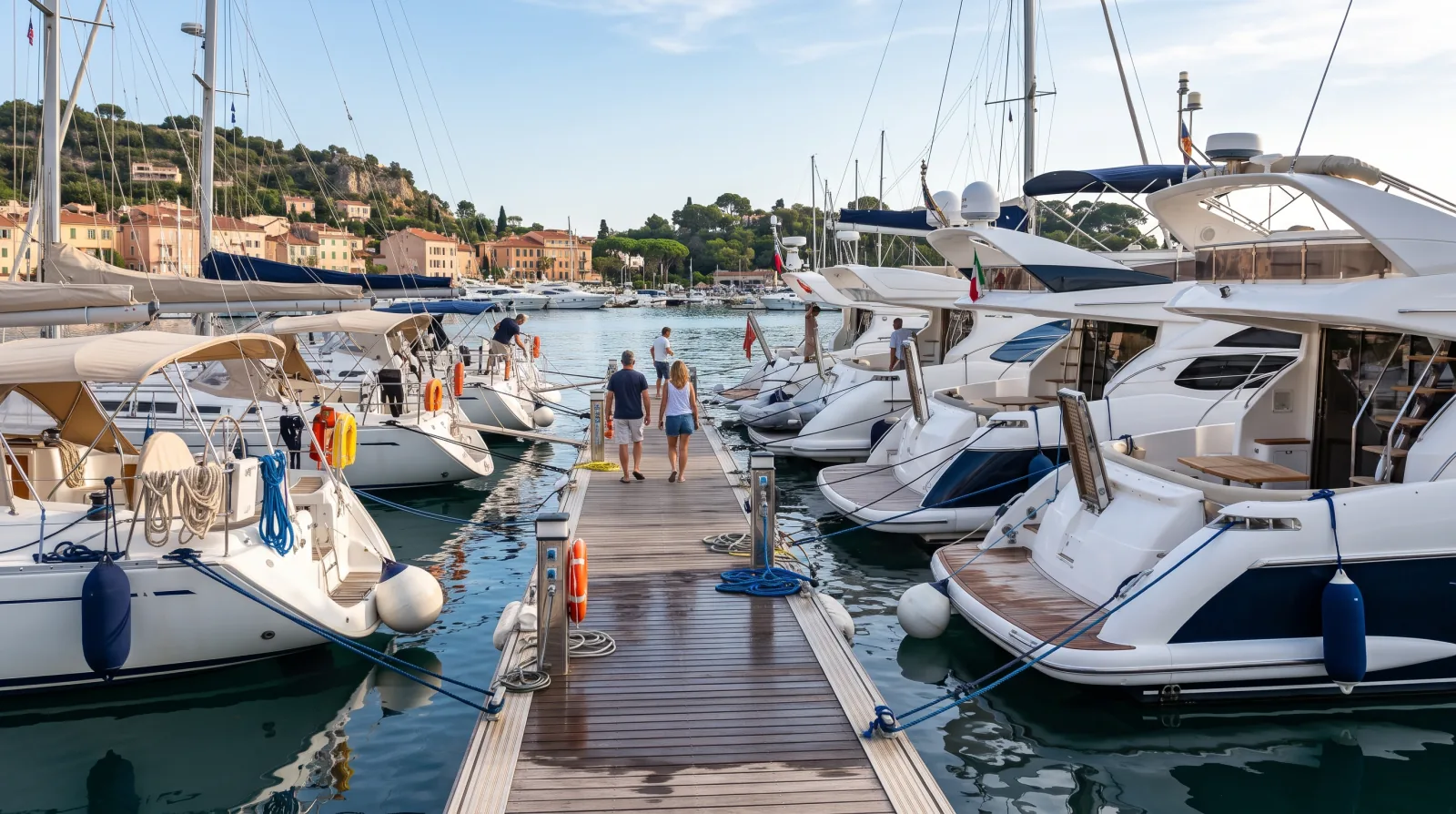
What Should a Marina Berth Contract Say?
The contract is the document that turns a commercial promise into a right. Before signing, read it as if you had to rely on it when something goes wrong, because that is exactly what will happen if it does. Here are the points that cannot be missing.
- Identification of the berth and the boat: berth number or area, maximum length and beam allowed, details of the boat and the owner.
- Term and renewal: start and end dates, whether the contract renews automatically and with how much notice you can terminate it.
- Fee and payments: amount, due dates, any deposit or security payment, how the rate is updated in following years.
- Services included and excluded: water, electricity, wifi, waste, cleaning, parking, mail collection, all listed item by item.
- Insurance and liability: what cover is required of the owner and how far the marina's liability for damage, theft or bad weather extends.
- Subletting and use of the berth in your absence: whether the marina can assign the berth to others while the boat is out sailing and whether the owner receives a share.
- Transfer and change of boat: what happens if you sell the boat or buy a bigger one.
- Cancellation and withdrawal: terms, penalties, refunds, and what happens if either party defaults.
Some marinas are on concession land and apply very detailed internal regulations, which the contract refers to. Ask to read them before signing: they contain rules on noise, work on board, guests, pets and use of the moorings that can affect daily life.
Liability, Insurance and Bad Weather
Many contracts limit the marina's liability for damage caused by events beyond its control. That is not unfair, but it means that your insurance must cover mooring, storm surge and third-party liability. Check that the policy covers time in port and that the limit is adequate.
Also ask what happens in a weather warning: who moves the boat, who reinforces the lines and who pays. A serious marina has a written procedure. If the answer is vague, factor that into your comparison.
What Are the Hidden Costs of a Marina Berth?
The price list often shows only the base rate. The surprise comes at the end of the year, when the invoice adds up items that weren't obvious at the start. Before deciding, ask for a written quote with every possible item, even those you don't expect to use right now.
- Metered utilities: electricity is often metered and can weigh heavily with air conditioning or heating always on; water may be measured too.
- Deposit and security payment: paid at the start and returned at the end, but only if the contract says so and if the condition of the berth allows it.
- Local taxes and duties: taxes that vary by country and type of use may apply to mooring fees, so ask whether the prices are inclusive.
- Additional services: haul-out, storage, cleaning, checking of moorings in your absence, washing, car parking and a space for the trailer.
- Rate adjustments: annual increases or indexation provided for in the contract.
- Early cancellation penalties: those who change their mind mid-year can lose a substantial part of what they paid.
A simple trick for comparing is to calculate the expected total annual cost: base rate, estimated utilities, services you will really use and taxes. Two marinas with a similar rate can end up surprisingly far apart once everything is added up.
How Do You Compare Marinas Before Choosing?
Visiting the marina in person is irreplaceable, but a visit without criteria leads to deciding on first impressions. A written grid, the same for every candidate, makes the comparison honest. Here are the questions that really matter.
- Protection from sea and wind: how does the marina behave in the prevailing winds of the area? Ask your berth neighbours, who know the truth.
- Depths and manoeuvring: real depth at the entrance and at the quay, room to turn, presence of current or surge.
- Security: access control, night watch, CCTV, fire protection, emergency management.
- Services: fuel, workshop, haul-out, storage, provisioning and a nearby boatyard in case of breakdown.
- Distance from home and connections: a beautiful but distant marina is used less and costs more per night actually enjoyed.
- Atmosphere of the marina: the quality of the people working there, cleanliness, the tone of the owners' community.
- Administrative clarity: how invoices arrive, how quickly the marina replies, whether everything can be managed online.
If you are also looking for somewhere to leave the boat over winter, a berth in the water is one of the options. In our guide to boat storage, costs and winter preparation you will find the comparison with haul-out and storage ashore.
How Do You Book a Transient Berth in High Season?
In July and August, in the most popular destinations, arriving without a reservation is a real risk: marinas fill up in the morning and the alternative may be an uncomfortable anchorage. The rule is simple, book early and declare the boat's real dimensions, but a few precautions make the difference.
- Contact the marina in advance and send the exact dimensions, the draught and the number of people on board.
- Ask for the cancellation terms before paying any deposit, especially in unsettled weather.
- Prepare the documents required on arrival, such as insurance and boat papers, to shorten check-in.
- Give your expected arrival time and warn them if it changes: a berth left empty past the time can be reassigned.
- Keep an alternative nearby, perhaps a second marina with transient berths, in case of bad weather or delays.
Marinas with online booking and written confirmation of the mooring details, sent by email or SMS, reduce misunderstandings. If the marina answers only by phone in limited hours, bear in mind that on the day of arrival you may not be able to get through.

How Do Owner and Marina Communicate During the Year?
A berth doesn't end with the signature. During the year there is communication about payment deadlines, work on the quay, weather warnings, insurance renewals and documents. When it passes through phone calls, messages and scattered sheets of paper, something gets lost, usually at the wrong moment.
For the owner, good practice is to keep a copy of the contract, receipts, policy expiry dates and marina contacts in one place. For those who are not always on site, a captain or local representative who knows whom to call is worth more than any discount.
Subletting also deserves a clear conversation: if you want the berth to be available for transient visitors while you are cruising, agree in advance how absence dates are communicated and how the owner's share is credited. When the rules are written down, disputes don't arise.
What Do Well-Organised Marinas Do?
Choosing a good marina also means recognising how it works. Marinas that treat customers well share a few habits, easy to check with a few questions at first contact.
- They know which berths are free and on which nights: they answer precisely, without having to "check and call you back".
- They document everything: signed contract, clear invoices, utility readings linked to the right stay.
- They anticipate arrival: booking details sent beforehand, documents collected in advance, quick check-in when the boat is at the dock.
- They manage absences: they use annual holders' berths for transients only with a clear agreement and no surprises.
- They measure their own work: occupancy, average rate and revenue per period, overdue invoices, unanswered requests.
If you are a manager and want to go deeper into allocating berths and improving revenue, read the guide to berth management and revenue optimisation. For those evaluating tools, there is also the comparison of the best marina management software.
How Software Simplifies Managing the Marina Berth
On the marina's side, the difference between a good experience and a confusing one depends on how data and processes are managed. The SupaSailing Marina module lets you manage berth bookings for transient, seasonal and annual customers, with the details sent to customers by email or SMS.
Contracts are signed online and feed scheduled invoices; quotes, proformas and SEPA direct debits are also provided. Meter readings land on the invoice for the right stay, and for any date the map shows which berths are occupied and which are free.
The marina can keep a waiting list of requests and sublet to transient visitors the nights when annual holders are away. Customers upload documents and sign before arriving, so check-in is quick. For those running the pontoons, the dock master finds a useful tool in this flow; for management, the page dedicated to marina managers describes the full picture.
For the owner the benefit is indirect but concrete: fewer email exchanges, written confirmations, readable invoices. If you also keep the boat organised, the page for owners shows how to order documents and expiry dates.
Frequently Asked Questions
How much does a marina berth cost per year?
It depends on location, size and services. Indicatively, for a twelve-metre boat it ranges from a few thousand to over ten thousand euros a year. Always ask for a written quote including electricity, water, taxes and services, because the base rate is only part of it.
Is an annual berth or transient better?
It depends on how many nights you really spend in the marina. If you use the boat often and want a guaranteed berth, the annual costs less per night. If you sail little or go cruising, transient avoids paying for an empty berth, but in high season it doesn't guarantee availability.
Can you sublet your own berth?
Only if the contract or the marina's regulations allow it. Some marinas assign the berths of absent holders to transient visitors and credit the owner with a share. Always check in writing the conditions, how dates are communicated and how revenue is split.
What is a mooring buoy and when is it worthwhile?
It is a mooring on a buoy in a mooring field, with no quay, electricity or water: you reach it by tender. It costs less than a quayside berth and suits small boats or those who use the boat little, but it requires more attention to the weather and a reliable tender.
How do you book a transient berth in August?
Contact the marina well in advance, give the real dimensions and ask for written confirmation with the cancellation terms. Always keep a nearby alternative ready. Arriving without a reservation in the most popular places is a real risk.
What happens if I sell the boat during the contract?
It depends on the contract: in some cases the berth stays with the owner and can be used for the new boat, in others it lapses or can be transferred with the marina's consent. Read the transfer and cancellation clauses before signing and, if the amount is significant, ask a professional for advice.
Final Thoughts
Choosing a berth doesn't mean looking for the lowest price, but the marina that costs the right amount for the way you use the boat and behaves transparently. Count the real nights, read the contract to the end, ask for the annual total and check how the marina responds before you sign.
If you run a marina and want to see how the Marina module organises bookings, contracts and invoices, request a demo or contact us.
Related solutions
See how SupaSailing is built around these roles:
See SupaSailing in action
Book a free demo call and discover how one platform can run your charter, marina, fleet, shipyard or brokerage.
Book a Free DemoShare this article