How to Sell a Used Boat: Price, Documents and Negotiation Step by Step
Sooner or later every owner asks how to sell a used boat without giving money away and without spending months on fruitless phone calls. The answer is not a lucky listing, but three things that depend on you: a credible price, a well-presented boat and the paperwork in order before the first buyer even turns up.
This guide follows the sale from start to handover: choosing between a private sale and a broker, setting the price, preparing the boat, gathering the documents, writing the listing and taking photos, handling viewings, sea trial and survey, and finally the offer, deposit and transfer of ownership. It closes with the mistakes that cost the most.
The key point: a boat sells well when price, condition and documents tell the same story. The buyer is buying trust: every gap in the documents or the history becomes a discount demanded in the negotiation.
Selling Privately or Through a Broker: How to Choose?
This is the first decision and it shapes everything else. There is no answer that holds for everyone: it depends on the value of the boat, the time you have and how much you want to handle viewings, negotiation and paperwork yourself.
| Aspect | Private sale | Sale through a broker |
|---|---|---|
| Cost | No commission, but time and advertising expenses | Commission on the sale price, generally a single-digit percentage that varies with the value and the arrangement chosen |
| Visibility | Depends on the portals and your contacts | Client network, professional portals, marina showcase |
| Viewings and trials | You handle them yourself, even on inconvenient days | The broker organises them, often with the boat already on display |
| Negotiation | Direct, with more emotional involvement | Mediated by a professional |
| Paperwork and contracts | You coordinate them, with an adviser's help | The broker sets them up and follows the process |
| When it makes sense | Lower-value boats, a seller with time and experience | Medium to high-value boats, a seller who is far away or has little time |
If you choose a broker, ask for the mandate in writing: duration, exclusive or not, commission, advertising costs you bear and what happens if you find the buyer yourself. To understand how this profession works you can read our guide on how to become a yacht broker.
How Do You Set the Price of a Used Boat?
The right price is the one at which an informed buyer actually buys, not the one you dreamed of when you bought. To find it you need comparisons and honesty about the condition. A price that is too high lengthens the time and, as the months pass, ends up weakening you in the negotiation.
- Look for comparable boats by model, year, length and engine, looking at asking prices and, if possible, those actually concluded.
- Assess the real condition of hull, deck, interior, systems and sails, without overlooking the small things a buyer notices immediately.
- Consider the engine hours and the maintenance history: they count for more than the year of build.
- List the equipment that adds value: recent electronics, watermaker, generator, tender, sails in good condition.
- Take account of the season and the local market: in spring demand is generally livelier than in midwinter.
An independent valuation, done by a surveyor or a broker, costs little compared with the mistake of starting with the wrong figure. Also set a minimum threshold below which you will not go, before sitting down to negotiate.
How Do You Prepare the Boat for Sale?
A clean, well-kept boat sells faster and with fewer discounts. You do not need major work: you need tidiness, a deep clean and the repair of anything a buyer will use as an argument to push the price down.
- Thorough cleaning: hull out of the water if possible, deck, teak, interior, lockers, fridge and cabins, with no musty or damp smell.
- Small repairs: bulbs, hinges, portholes, upholstery and minor leaks, which cost little on their own but lower the impression of care.
- Clearing out personal belongings: fewer objects means more visible space and makes it easier to imagine being the owner.
- Preventive technical checks: engine, electrical system, bilge pumps and safety gear, so you do not discover problems in front of the buyer.
- Equipment inventory: what is included in the sale and what is not, written down from the start.
Think of the boat as "survey-ready": if a surveyor looked at it tomorrow, what would they find? Better to fix it before it gets written in a report.
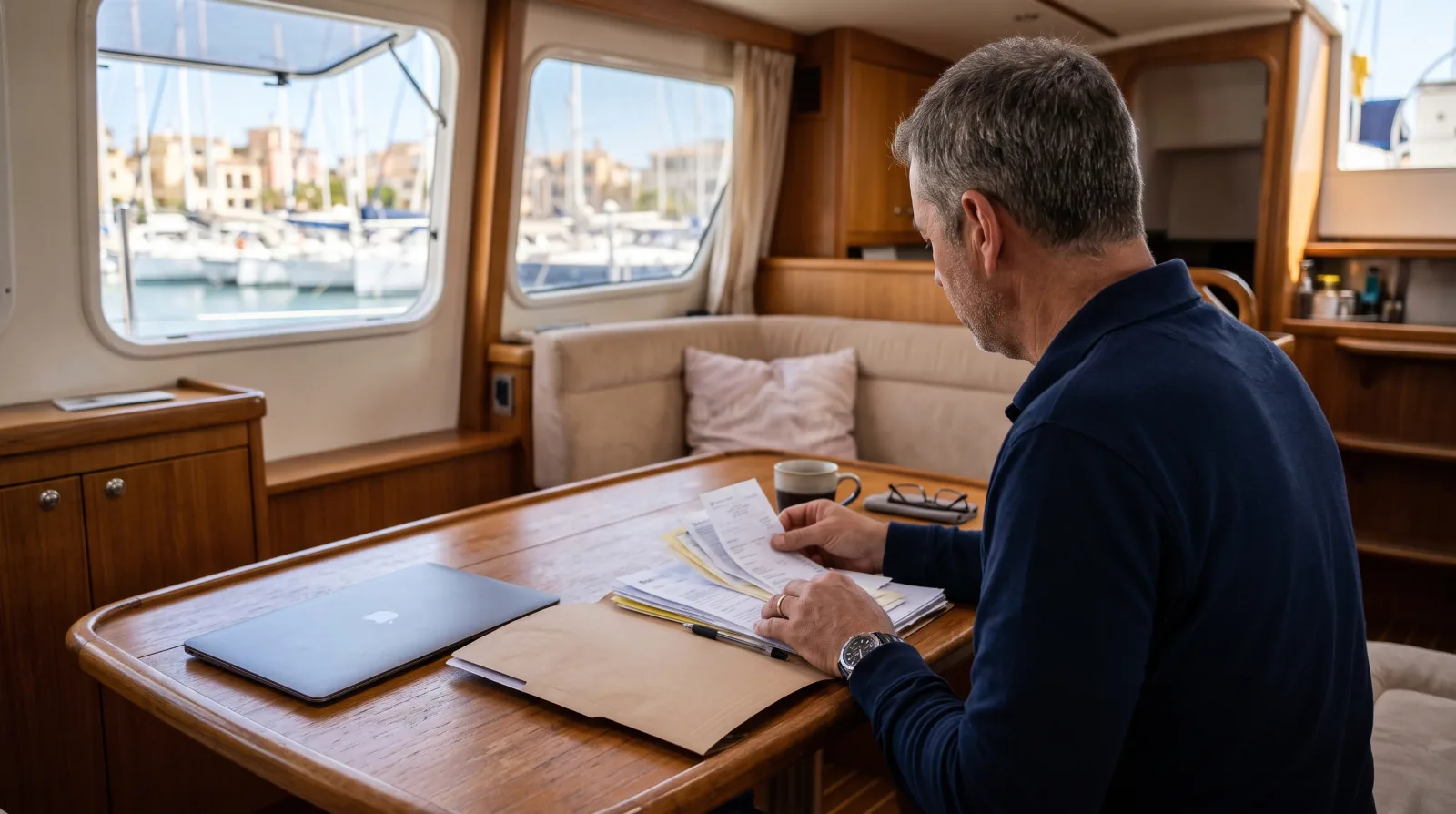
What Documents Do You Need to Sell a Boat?
The documents are the part that often slows down a sale. Preparing them in advance conveys seriousness and lets you reach the contract without surprises. The exact requirements change with the flag, the type of vessel and the country: for the formal side it always pays to use a professional.
| Document | What it is for |
|---|---|
| Proof of ownership and registration details | Shows you are the owner and allows the vessel's registration to be checked |
| Navigation licence or equivalent document | Onboard document that identifies the vessel and authorises it to navigate |
| CE declaration of conformity and builder's documents | Certify the design category and the construction data |
| Engine and main systems documents | Serial numbers, manuals and warranties still valid |
| Maintenance log and invoices | Prove the boat's real history |
| Proof of VAT status | Clarifies the boat's tax position, to be assessed by an accountant |
| Certificates of release from mortgages or liens | The boat must be free of encumbrances, or the encumbrances must be discharged at transfer |
| Insurance and latest inspections | Show continuity of cover and the checks already carried out |
Check three points carefully: that the name on the title is yours, that there are no mortgages or detentions left undischarged, and that the boat's tax situation can be demonstrated. For details on transferring ownership in Italy or in another country, check with a professional or the competent office.
How Do You Write a Boat Listing That Works?
The listing is the first viewing of the boat. A good listing gives concrete information and invites contact; a poor one loses serious buyers who cannot be bothered to investigate.
The text must immediately say what needs to be known: model, year, length, engine and hours, where the boat is, price or price range, main equipment and general condition. Every claim must be verifiable: stating what is not true is the quickest way to burn a negotiation.
Photos Matter More Than Text
Shoot in natural light, on a clear day, with the boat tidy. You need exterior views from several angles, deck, cockpit, saloon, galley, cabins, heads, engine compartment, electrical panel and instruments. Show minor defects too, without hiding them: an honest photo avoids pointless viewings.
- Exterior: bow, stern, sides and, if possible, the boat under way.
- Interior: bright, tidy spaces, with made beds and clear surfaces.
- Technical: engine, systems, batteries and panel, which speak to the more experienced buyers.
- Valuable details: electronics, sails, tender and recent equipment.
How Do You Handle Viewings and the Sea Trial?
Viewings are the moment the negotiation really begins. Organise them at agreed times, with the boat clean and the documents to hand. Avoid leaving strangers alone on board and accompany visitors, showing both the strengths and the points to improve.
The sea trial is the decisive step for the buyer. Define beforehand who drives, who pays for fuel and berthing, which insurance covers the trial and what will be checked: engine at speed, manoeuvres, onboard systems, sails, any vibrations or noises.
- Prepare the boat: oil and water levels, fuel, charged batteries and safety gear on board.
- Set the rules: who is in command of the boat during the trial and who is liable for any damage.
- Drive yourself or have a trusted person drive for the more delicate manoeuvres.
- Note the buyer's observations, which will be the basis of the negotiation.
What Is the Buyer's Survey and How Do You Prepare?
Almost every serious buyer has a survey carried out by an independent technician. The surveyor checks the hull, osmosis, structure, engine, systems, safety and documents, and writes a report with any defects and recommended work. On valuable vessels the survey may also include an inspection with the boat hauled out.
For the seller the survey is not a threat but an opportunity: if the boat is in good order, the report confirms the price. If problems come up, it pays to weigh calmly whether to repair them or grant a reasonable discount, avoiding emotional reactions.
- Who pays for it: as a rule the buyer, who chooses the surveyor, but it must be agreed beforehand.
- When it is done: after the agreement in principle and before signing the final contract.
- What happens afterwards: the purchase can be confirmed, the price renegotiated in light of the defects, or the buyer can withdraw under the agreed conditions.
Offer, Deposit, Contract and Handover: How Is the Deal Closed?
When the buyer is convinced, an offer arrives. Always reply in writing and make clear what is included, what the handover date will be and what conditions suspend the agreement, for example a satisfactory survey and sea trial.
A sale contract is then signed, often preceded by a preliminary agreement with a deposit. The deposit shows the seriousness of the offer, but its legal nature and the consequences of withdrawal depend on how the contract is written: that is why it pays to have it drafted or checked by a professional.
What a Sale Contract Should Contain
- Details of the parties and precise identification of the vessel, with serial number and registration details.
- Price and payment terms, with timing and deposit.
- List of what is included: tender, sails, electronics, safety equipment.
- Conditions precedent, such as survey and sea trial.
- Declaration that there are no encumbrances and liability for defects, according to the applicable law.
- Date and place of handover, with any haul-out or transfer costs.
For large payments people often rely on an escrow account or an intermediary who holds the funds until the formalities are completed. Ask your professional which solution is most suitable in your case.
Handover and Transfer of Ownership: What Is Left to Do?
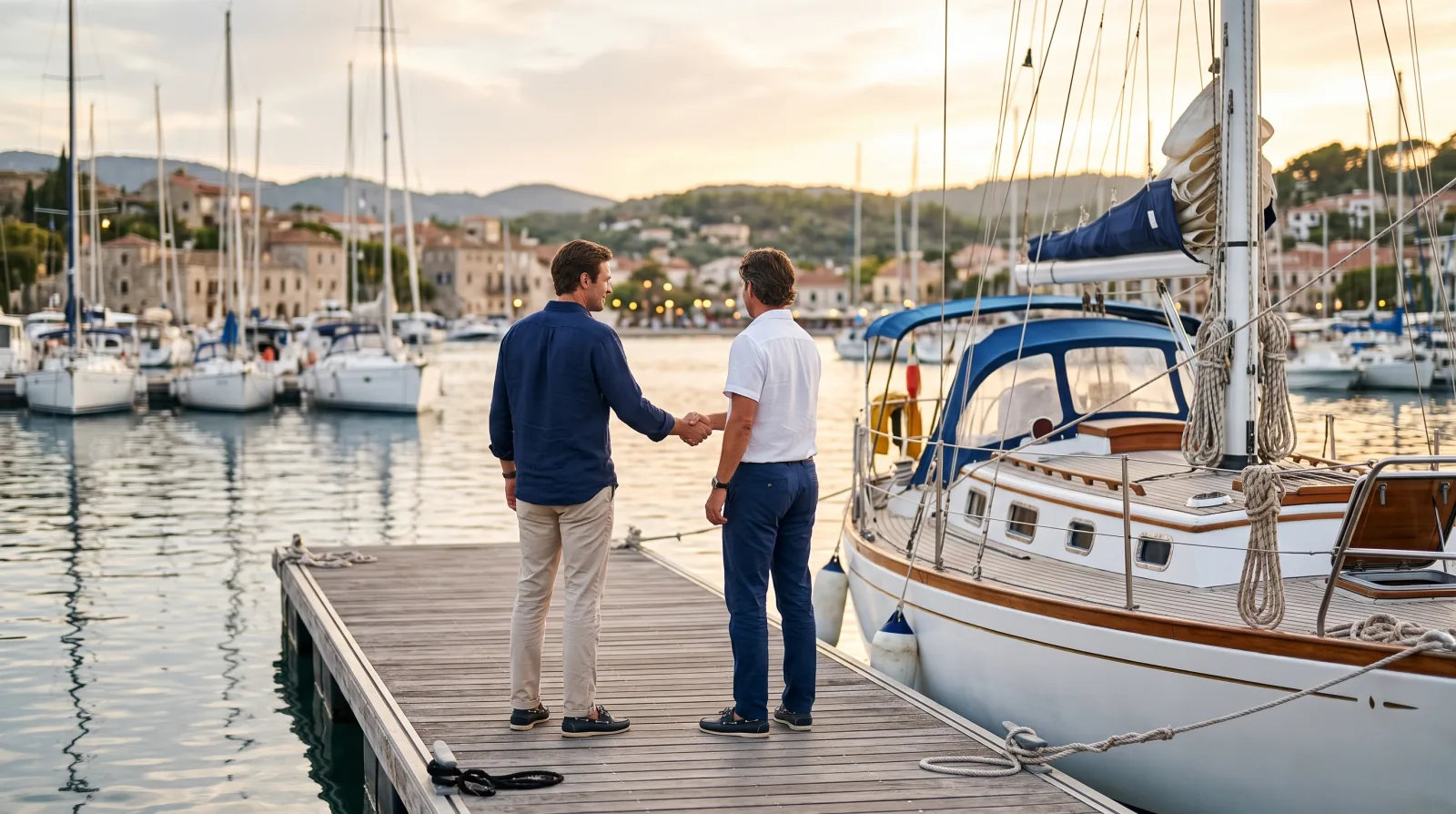
At handover you check together with the buyer that the boat is in the condition described, inventory in hand. A handover report is signed, keys, manuals, original documents and the agreed equipment are handed over, and payment is completed as agreed.
Transfer of ownership then requires registration or annotation at the competent office, in ways that depend on the type of vessel and the place of registration. In Italy, registered pleasure craft follow specific procedures, while unregistered small craft are transferred more simply: check with a professional or the harbour authority (capitaneria), because the rules can change.
Do not forget the ancillary tasks: cancelling or transferring the insurance, notifying the marina or boatyard, closing storage or mooring contracts and any service subscriptions.
The Mistakes That Cost the Most Money
- A price chosen with the heart: asking too much lengthens the time and leads to bigger discounts later.
- Incomplete documents: every gap becomes a reason to lower the offer.
- Hiding defects: the survey finds them, and you lose trust and credibility.
- Sea trials without rules: damage and arguments over who pays for fuel and repairs.
- Verbal agreements only: everything that matters must be written down, from the inventory to the conditions precedent.
- Ignoring the history: an orderly maintenance history supports the price; for this we recommend our guide to yacht maintenance costs.
- Overlooking the buyer's financing: if they are buying with a lease or a loan, the timing changes; you will find an overview in our guide to boat leasing.
How Software Simplifies Selling a Boat
When you sell boats every day, or sell on behalf of others, the problem is following contacts, viewings, offers and documents without losing information. A spreadsheet holds up with a few boats, then becomes a risk.
The SupaSailing Broker module is built for exactly this. It brings together a deal pipeline with stages and probabilities, a CRM for buyers and sellers, a record for each vessel with specifications, photos and documents, branded brochures and listings published on partner portals via feed, plus contracts with electronic signature.
- One pipeline for each boat, to know who has viewed it, who has made an offer and where the negotiation stands.
- Documents in a single archive, ready to share with the buyer and the surveyor.
- Enquiries from portals and the website that go straight into the CRM, with no need to re-enter them.
The pages dedicated to the listing broker and the sales broker explain how to organise the work; those selling privately will find guidance on the page for the yacht owner. For a comparison of tools there is our guide to the best yacht brokerage software.
Frequently Asked Questions
How much is my used boat worth?
The value depends on model, year, condition, engine hours, equipment and the local market. The most reliable way is to compare similar boats for sale, perhaps with the opinion of a surveyor or a broker who knows the area.
Is it better to sell the boat privately or through a broker?
Selling privately saves the commission but takes your time and you manage everything alone. With a broker you pay a percentage, but you get visibility, screening of enquiries and support with the paperwork. For high-value boats the second route is often safer.
What documents are needed to sell a boat?
Generally you need proof of ownership, navigation licence or equivalent document, CE declaration, engine documents, maintenance history, proof of VAT status and the absence of mortgages. The exact list depends on the flag and type of vessel, so ask a professional to confirm.
Who pays for the survey?
As a rule the buyer pays, and chooses the surveyor. It is best to agree this in writing beforehand, along with what happens if significant defects come up.
How is the transfer of ownership of a boat done?
A bill of sale is signed and then registration is completed at the competent office, with different rules for registered vessels and unregistered small craft. Procedures vary from country to country: check with a professional or the harbour authority.
Can you sell a boat that has a mortgage?
As a rule the mortgage has to be discharged or dealt with at the time of sale, because the buyer wants a boat free of encumbrances. How to do this with the lender should be agreed beforehand, with a professional's help.
In Conclusion
Selling a used boat is simpler when you work methodically. A realistic price, a well-kept boat, documents ready and written contracts shorten the time and protect the value. Anyone who arrives at the first viewing with the title, certificates and maintenance history conveys trust, and trust is what closes negotiations.
To see how the Broker module organises listings, contacts and negotiations, request a demo or contact us.
Related solutions
See how SupaSailing is built around these roles:
See SupaSailing in action
Book a free demo call and discover how one platform can run your charter, marina, fleet, shipyard or brokerage.
Book a Free DemoShare this article