Complete Guide to Yacht Charter Management Software in 2025
Running a yacht charter operation without purpose-built software is like navigating open ocean without instruments — theoretically possible, but unnecessarily risky and wildly inefficient. Yet as recently as 2022, industry surveys revealed that more than half of charter operators still relied primarily on spreadsheets, generic CRM tools, and manual email workflows to manage their bookings, crew, and maintenance. The hidden cost of this approach — in missed bookings, administrative overhead, compliance gaps, and poor guest experiences — is enormous.
The global yacht charter market is valued at over $15 billion and growing at approximately 5.8% annually. Demand for premium charter experiences is robust across the Mediterranean, Caribbean, and Pacific. Yet operators who fail to modernize their operational infrastructure are finding it increasingly difficult to compete with tech-enabled rivals who can respond to enquiries faster, offer frictionless booking experiences, and deliver higher reliability.
This guide examines everything operators need to know about yacht charter management software in 2025: what it does, which features matter most, how to evaluate platforms, and what ROI looks like in practice. Whether you manage a single superyacht or a fleet of twenty sailing yachts, the principles are the same.
What Is Yacht Charter Management Software?
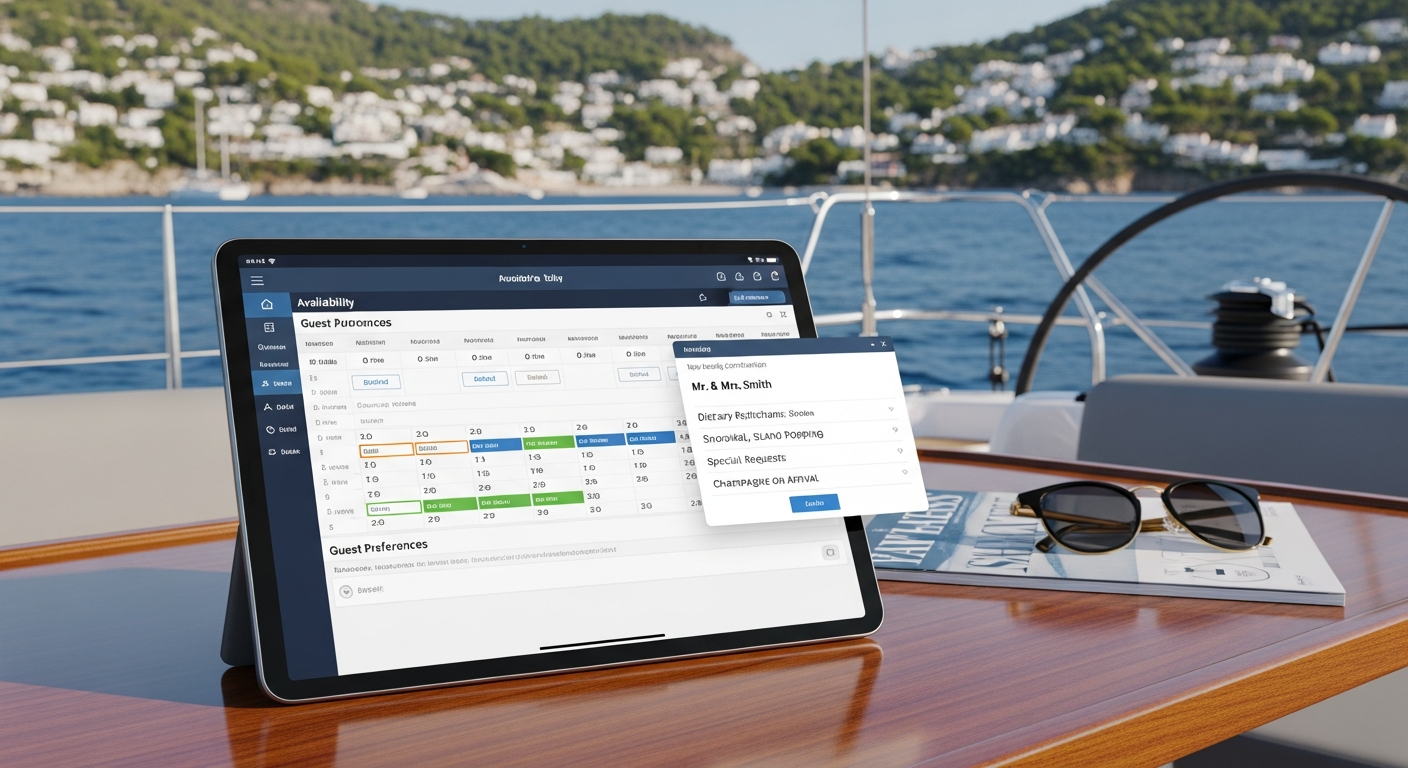
Yacht charter management software is a purpose-built technology platform that consolidates and automates the core operational functions of a charter business. Rather than using separate tools for bookings, contracts, crew scheduling, maintenance, and billing — and spending hours connecting them manually — charter management software provides a unified system where all these functions are integrated.
A well-designed platform serves three primary stakeholder groups simultaneously:
- Charter operators and fleet managers — who need visibility across all vessels, bookings, and operational activities
- Crew members — who need access to schedules, maintenance tasks, guest preferences, and safety documentation
- Charter clients and brokers — who need a seamless enquiry, booking, and pre-arrival experience
The best platforms also integrate with external systems: weather APIs, marina booking platforms, payment gateways, electronic signature tools, and flag state compliance portals.
Core Features of Charter Management Software
When evaluating charter management software platforms, there are essential features that every serious operator requires, and differentiating features that separate market leaders from basic tools. Understanding this distinction is critical for making the right procurement decision.
Availability and Booking Management
The foundation of any charter software is a real-time availability management system. This means a single source of truth for each vessel's availability, synced automatically across:
- Your direct booking website
- Charter broker portals (EYBA, MYBA, specialist brokers)
- Online travel agencies (where applicable)
- Internal management calendars
When a booking is confirmed on any channel, all others are instantly updated. This eliminates double bookings — one of the most damaging operational failures a charter company can experience — and ensures accurate availability information is always presented to prospective clients.
Advanced systems also support options and holds, allowing brokers to provisionally reserve vessels while client confirmation is pending, with automatic expiry and release if not confirmed within a defined window.
Contract Generation and E-Signature Workflows
Charter contracts are complex documents that must comply with jurisdiction-specific requirements (MYBA agreements, MCA regulations, flag state requirements) while capturing all commercial terms. Manual contract preparation is time-consuming and error-prone.
Modern charter management platforms maintain a library of approved contract templates that are populated automatically with booking data — vessel details, charter dates, port of departure, client information, and commercial terms. The generated contract is delivered to the client via an integrated e-signature workflow, eliminating printing, scanning, and email chasing. From contract generation to fully executed agreement can now take minutes rather than days.
Guest Experience Management
Premium charter clients have high expectations. They want to feel personally attended to, not processed. Charter software supports exceptional guest experiences through:
- Pre-arrival preference surveys — capturing dietary requirements, preferred provisioning, activity interests, and personal preferences automatically, weeks before embarkation
- Digital guest guides — branded pre-arrival information packs with itinerary details, destination guides, and onboard information delivered via branded client portals
- Real-time communication tools — secure messaging between guests and crew during the charter
- Post-charter feedback collection — automated survey delivery and response management
The data collected through these tools also feeds analytics, helping operators understand what drives guest satisfaction and repeat bookings.
Crew and Staffing Management
Charter operations require more than a booked vessel — they require the right crew, properly qualified, properly rested, and properly briefed. Charter management software handles:
- Crew assignment to specific charters based on availability, qualifications, and client preferences
- Certification tracking with automated renewal reminders (STCW, medical certificates, flag endorsements)
- Rest hour recording in compliance with MLC 2006
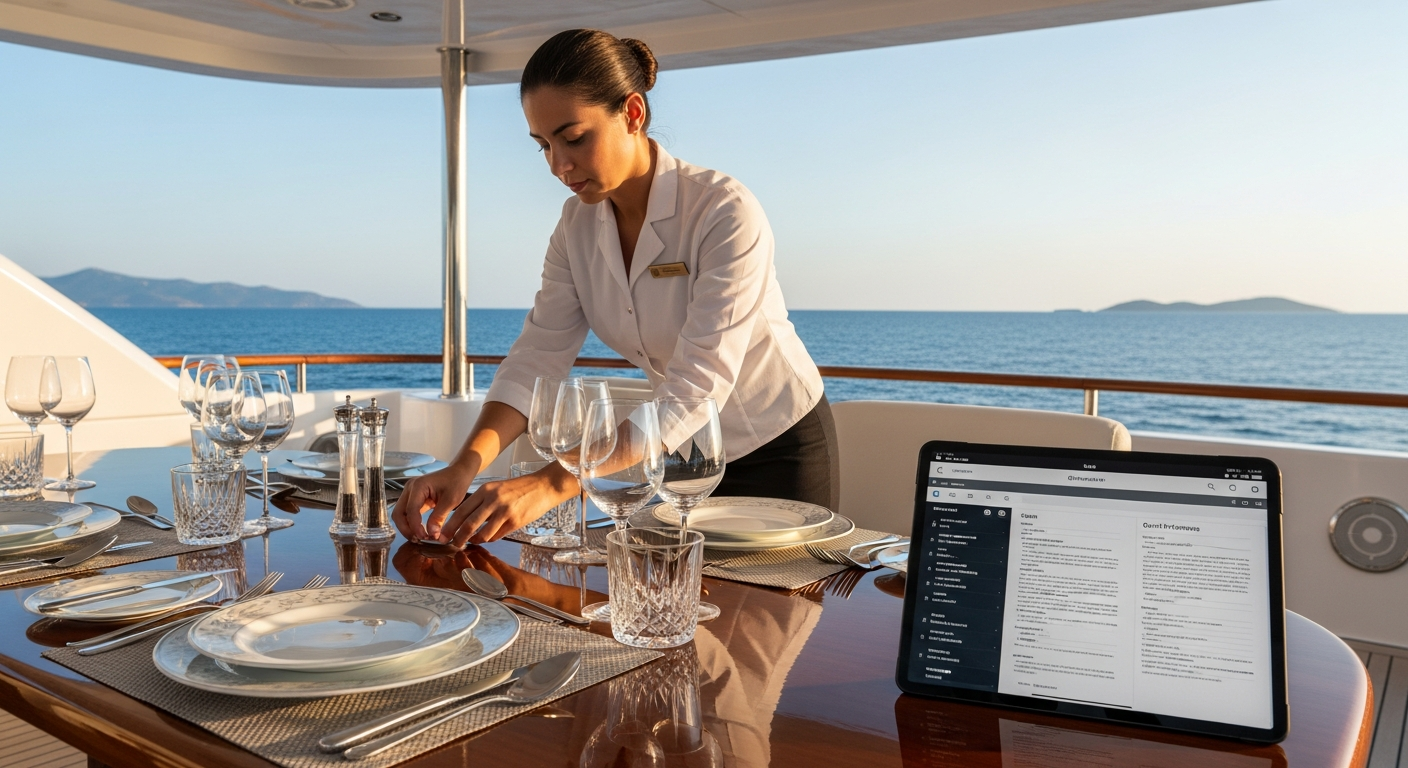
- Crew briefing document distribution — guest preference summaries, itinerary details, safety plans
- Payroll calculation including sea allowances, overtime, and port-specific rates
For operators managing crews across multiple vessels and nationalities, this automation is essential for compliance and operational continuity.
Maintenance and Technical Management Integration
A charter yacht that breaks down during a client's holiday is a commercial catastrophe. Beyond the immediate cost of emergency repairs and potential compensation claims, the reputational damage — particularly in the review-driven charter market — can be long-lasting.
Integrated maintenance management within charter management software prevents this outcome by:
- Maintaining a comprehensive service history for each vessel and its systems
- Scheduling maintenance tasks around charter bookings, ensuring vessels are always operationally ready
- Managing spare parts inventory and generating procurement orders automatically when stock falls below minimum levels
- Tracking defects reported by crew with work order management workflows
- Generating technical reports for insurance purposes and flag state surveys
The most advanced platforms integrate with IoT sensor data from onboard systems to enable predictive maintenance — identifying developing issues before they become operational failures. SupaSailing's fleet management integration provides this level of technical oversight directly within the charter management environment.
Billing, Invoicing, and Financial Reporting
Charter operations generate complex billing workflows. The base charter fee is straightforward, but additional items — Advance Provisioning Allowances (APA), fuel, port fees, extras requested during the charter, crew gratuities, and tax obligations in multiple jurisdictions — create invoicing complexity that manual systems handle poorly.
Charter billing software should:
- Generate accurate invoices automatically based on booking terms and actual expenses
- Manage deposit schedules with automated payment reminders and collection
- Reconcile APA accounts with actual expenditure and generate clear statements for clients
- Handle multi-currency transactions correctly, with appropriate exchange rate treatment
- Generate VAT/sales tax documentation compliant with the applicable jurisdiction (EU VAT on yachts is particularly complex)
- Provide profitability reporting by vessel, by season, and by booking source
Access to accurate financial reporting is what separates operators who grow strategically from those who are perpetually surprised by their actual margins.
Broker and Distribution Management
Most charter operators rely on a network of brokers to generate a significant proportion of their bookings. Managing these relationships — tracking enquiries, providing accurate availability and pricing, processing commissions, and maintaining broker relationships — is administratively intensive when done manually.
Modern charter management platforms provide:
- Broker portals — dedicated interfaces where accredited brokers can check availability, submit enquiries, and track bookings in real-time without requiring operator staff involvement for every interaction
- Commission management — automated calculation and payment of broker commissions based on agreed rates and booking values
- Enquiry attribution — tracking which brokers and channels are generating the most valuable bookings, enabling data-driven relationship investment
- Rate sheet management — distributing current pricing to the broker network automatically when rates are updated
For operators with twenty or more active broker relationships, portal-based management can reduce broker communication overhead by 70% or more.
Choosing the Right Charter Management Software Platform
With multiple platforms on the market, selection requires careful evaluation against your specific operational context. Key criteria to assess include:
Fleet Scalability
Does the platform support your current fleet size and your growth plans? Some solutions are optimized for single-vessel operators; others are designed for fleets of fifty or more. Ensure the architecture can scale without requiring platform migration as you grow.
Integration Capability
What APIs and native integrations does the platform offer? The ability to connect with broker platforms, payment gateways, accounting software, and weather services is critical for operational efficiency. A platform that operates as an island — requiring manual data transfer to and from other systems — will never deliver its potential value.
Mobile Accessibility
Crew, captains, and operators are rarely at a desk. The platform must be fully functional on mobile devices, enabling crew to access guest preferences, update maintenance records, and communicate with the base team from anywhere.
Support and Training
Maritime operations run seven days a week, often across multiple time zones. Verify that the platform vendor offers appropriate support coverage and that training resources are sufficient for your team to reach proficiency quickly.
ROI: What Returns Should You Expect?
The business case for charter management software is well-documented among operators who have made the investment:
- Booking conversion rates improve by 20–35% when response times fall from hours to minutes through automated enquiry handling
- Administrative overhead per booking reduces by 50–70%, enabling the same team to manage significantly higher booking volumes
- Double booking incidents drop to near zero, eliminating the significant financial and reputational cost of these failures
- Maintenance cost per vessel typically falls 15–25% through proactive scheduling and better parts management
- Annual fleet revenue increases 10–20% through yield management, reduced availability gaps, and improved upsell capabilities
For a charter fleet generating $2 million in annual revenue, these improvements represent $200,000 to $400,000 in additional annual value — against typical platform costs of $15,000 to $60,000 per year. The financial case is compelling.
Implementation: Getting Started Successfully
A successful software implementation requires more than purchasing the right platform. The most common implementation failures result not from technology shortcomings but from inadequate change management and data migration planning.
Best practice implementation follows four phases:
- Data audit and migration — catalogue all existing vessel, crew, booking, and maintenance data, clean it, and migrate it to the new platform before go-live
- Configuration and customization — set up the platform to reflect your specific fleet, contract templates, rate structures, and workflow preferences
- Team training — ensure all staff, crew, and broker partners understand how to use their respective interfaces before launch
- Phased go-live — start with core booking and availability management, then activate additional modules progressively to avoid overwhelming the team
Most operators achieve full operational proficiency within six to eight weeks of go-live, with productivity improvements visible within the first month.
Frequently Asked Questions
What is the difference between charter management software and a general CRM?
A general CRM manages customer relationships and sales pipelines. Charter management software includes CRM functionality but extends far beyond it — handling vessel availability, crew certification, maintenance scheduling, contract generation, APA reconciliation, and regulatory compliance. A general CRM cannot replace purpose-built charter software for serious operators.
Can charter management software handle multi-lingual and multi-currency operations?
Leading platforms like SupaSailing support multiple languages for client-facing communications, multi-currency pricing and invoicing, and jurisdiction-specific tax handling. This is essential for operators serving international clients and basing vessels in multiple countries.
How much does yacht charter management software typically cost?
Pricing varies significantly based on fleet size and feature set. Entry-level platforms suitable for operators of one to three vessels typically cost $200–$600 per month. Enterprise platforms for larger fleets range from $2,000 to $8,000 per month. Most platforms price per vessel, making costs predictable and proportional to revenue scale.
Conclusion
The charter operators who will thrive in 2025 and beyond are those who treat technology as a core operational investment, not an optional overhead. Purpose-built yacht charter management software delivers measurable returns in booking efficiency, fleet utilization, cost control, and guest experience — all of which compound into competitive advantage over time.
Selecting the right platform requires careful evaluation of your fleet's specific needs, growth trajectory, and operational context. SupaSailing's charter management solution is purpose-built for the modern charter operator, integrating booking management, crew operations, maintenance, and financial reporting in a single platform. Speak with our team to learn how we can streamline your charter operations and grow your fleet's revenue.
Related solutions
See how SupaSailing is built around these roles:
See SupaSailing in action
Book a free demo call and discover how one platform can run your charter, marina, fleet, shipyard or brokerage.
Book a Free DemoShare this article