Yacht Broker Management Software: Complete CRM & Sales Pipeline Guide
The yacht brokerage industry runs on relationships — but relationships alone cannot scale a business. A top-performing broker managing 40 active listings across three markets, nurturing 200 buyer prospects at various stages of interest, and tracking six concurrent deals through survey, sea trial, and closing is operating at the edge of what human memory and spreadsheets can handle. The margin for error is thin, and the cost of dropped follow-ups is measured in commission checks that never arrive.
Yacht broker management software has emerged as the decisive competitive differentiator in modern yacht sales. Brokers equipped with integrated CRM, listing syndication, and pipeline management tools consistently outperform peers relying on manual processes — not because they work harder, but because their systems work smarter. According to industry surveys, brokers using dedicated management platforms close deals 23% faster on average and manage 40% more active listings than those using generic tools.
This guide provides a comprehensive overview of what modern yacht broker management software offers, how each component of the system contributes to sales performance, and what to look for when evaluating platforms for your brokerage operation.
Centralized Listing Management: The Foundation of Broker Efficiency
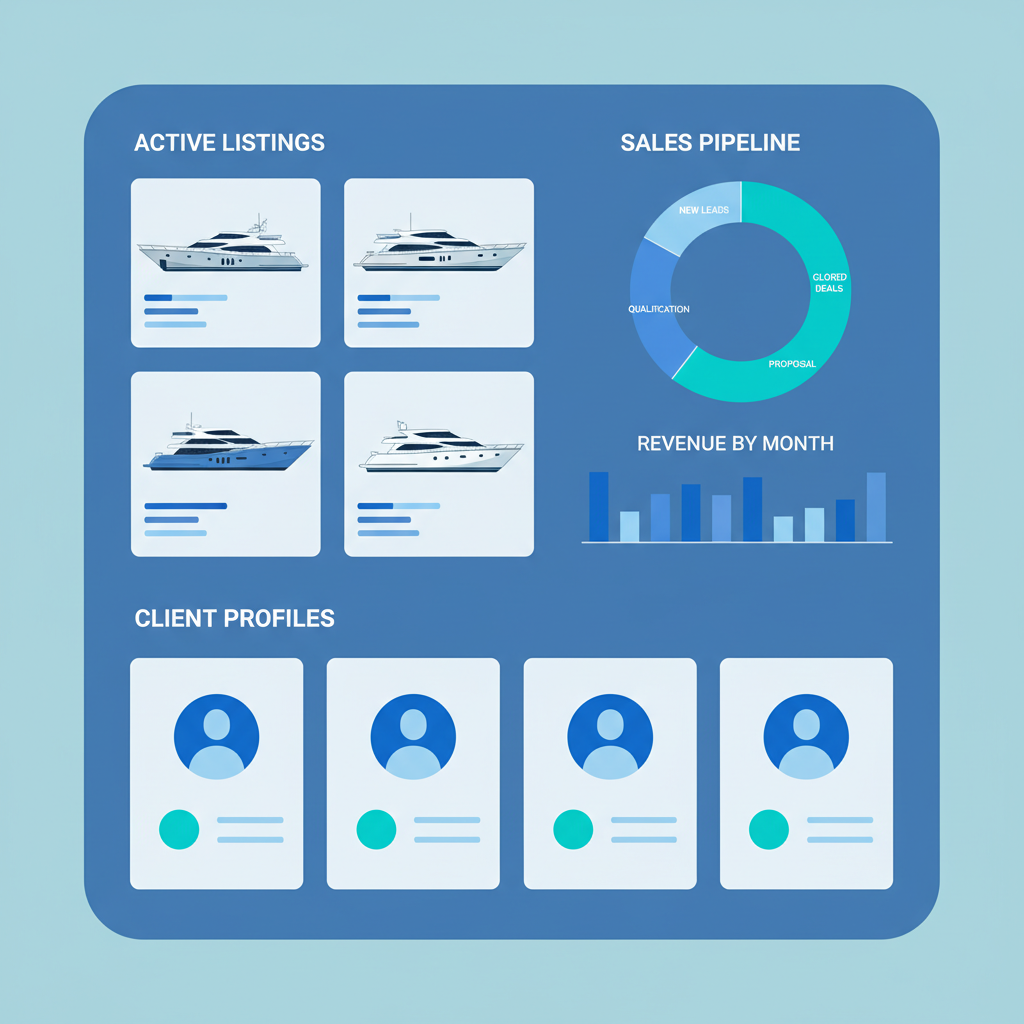
Every brokerage operation begins with listings. Managing listing data across a portfolio of vessels — each with dozens of specification fields, multiple photo sets, survey documents, pricing history, and showing logs — is inherently complex. Without centralized management tools, critical data lives in disconnected locations: photos in Dropbox, specs in email threads, pricing notes in personal spreadsheets.
What Centralized Listing Management Delivers
A purpose-built listing management module provides a single authoritative source for all vessel data:
- Structured specification capture: Standardized data entry for vessel dimensions, engine details, equipment, recent surveys, and sea trial results — ensuring consistency across all listings regardless of which broker entered the data
- Media management: Organized photo libraries with tagging, ordering, and direct publishing integration — no more hunting through email attachments for the hero image
- Document repository: Survey reports, registration documents, maintenance records, and marketing materials attached directly to the listing record
- Pricing history: Complete audit trail of price changes with dates and reasons, invaluable for negotiation context and market analysis
- Showing log: Every showing, open boat, and viewing documented with attendee records and feedback — automatically associated with buyer profiles in the CRM
The business impact is significant: brokers report saving 5-8 hours per week on listing administration tasks when moving from manual to centralized systems. That time redirects to client relationship building and deal acceleration.
Co-Brokerage Coordination
A substantial portion of yacht sales involve co-brokers — the listing broker and a buyer's broker splitting the commission. Managing co-brokerage relationships manually is friction-intensive: email chains to share showing schedules, phone calls to confirm offer parameters, manual coordination on survey access. Listing management software with co-brokerage features provides a shared workspace where both brokers access the same listing data, view the same showing schedule, and track deal progress in real time — eliminating the communication friction that slows transactions and occasionally sours relationships.
Lead Scoring and CRM: Converting Interest into Transactions
The buyers who inquire about your listings represent a diverse spectrum of purchase readiness. Some are ready to move to survey within weeks; others are gathering information for a purchase 18 months away. Treating all inquiries identically — with the same follow-up cadence and the same messaging — misallocates broker time and creates poor buyer experiences at both ends of the readiness spectrum.
Lead Scoring Methodology
Maritime CRM platforms implement lead scoring models that automatically assess buyer readiness based on behavioral signals:
- Inquiry recency and frequency — buyers who have submitted multiple inquiries within a short window are demonstrating active search behavior
- Listing view depth — prospects who repeatedly view specific listings, including the photo gallery and specification sheet, signal genuine interest in those vessels
- Response engagement — open rates on broker emails, link clicks, and direct reply frequency feed into the score
- Stated timeline and financing status — buyers who have indicated a specific purchase timeline or confirmed financing pre-approval receive automatic score boosts
- Showing attendance — attending a showing is a high-commitment action that significantly elevates lead score
The output is a prioritized prospect list that tells brokers exactly where to focus their daily attention. High-score leads receive intensive, personalized outreach. Lower-score leads enter automated nurture sequences that maintain engagement without consuming broker bandwidth.
CRM Database Architecture for Yacht Sales
Effective yacht brokerage CRM goes beyond a simple contact list. The data model must capture:
- Buyer profile: vessel type preferences, size range, price range, use case (cruising, racing, charter, investment)
- Geographic preferences and cruising ground targets
- Timeline and financing status
- Previous viewing history across all listings
- Communication preferences and contact schedule notes
- Relationship context — how the buyer was referred, previous business relationships
This rich profile enables brokers to match new listings to prospects instantly rather than manually reviewing the buyer book when a relevant vessel comes to market.
Multi-Platform Listing Syndication: Maximum Exposure Without Maximum Work
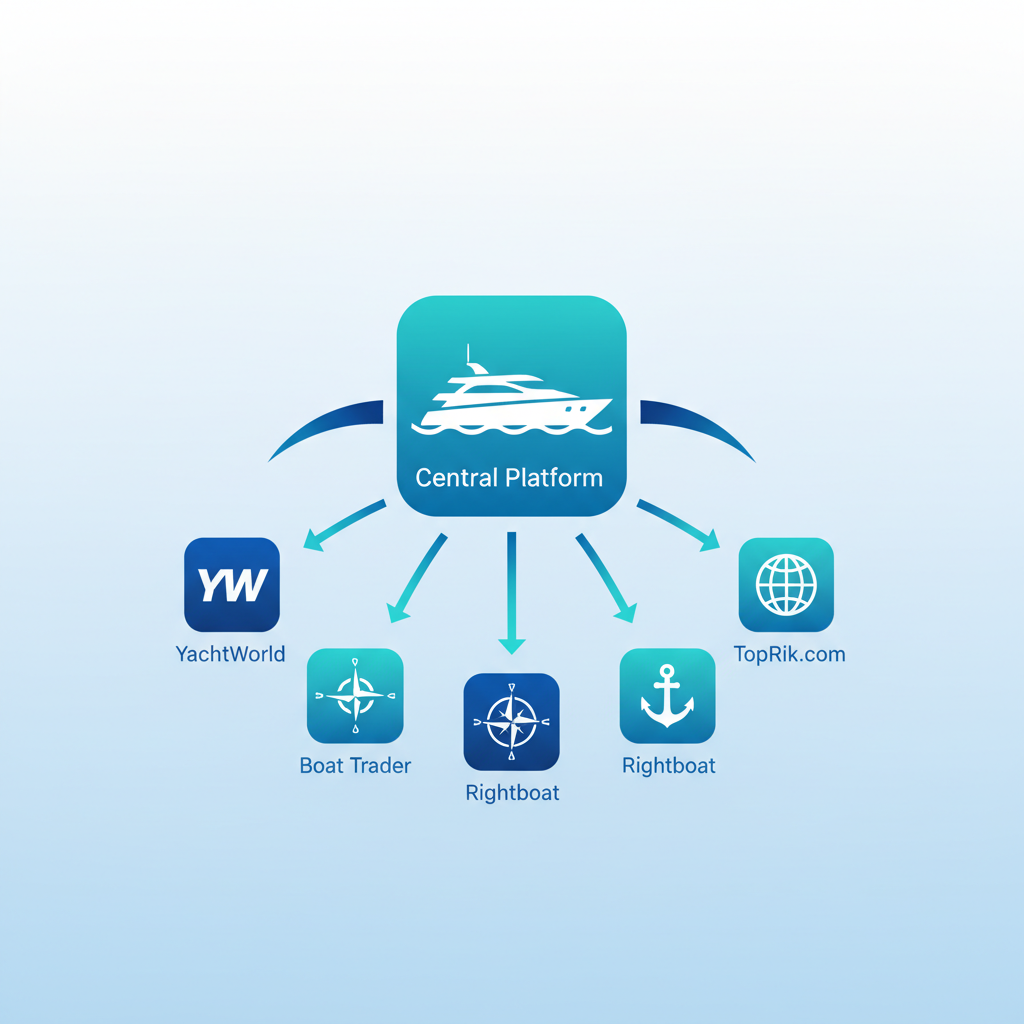
A yacht listing that lives only on the brokerage website reaches a fraction of the available buyer market. The professional yacht market spans multiple high-traffic aggregator platforms: YachtWorld, Boats.com, Yatco, BoatTrader, and numerous regional portals. Additionally, listings need to populate the brokerage's own website, social media channels, and partner broker networks.
Without syndication tools, publishing to each platform requires duplicating data entry for every listing and every update. A price reduction on a 58-foot sailing yacht means logging into five separate platforms and updating the price manually — then monitoring each platform to confirm the change propagated correctly. This process is not just time-consuming; it creates inconsistencies when updates are missed on some platforms, presenting buyers with conflicting information.
How Listing Syndication Works
Modern listing syndication functionality centralizes the publishing workflow:
- Data entered once in the broker platform automatically populates all connected portals
- Price changes, status updates (sold, under contract, withdrawn), and specification corrections propagate across all platforms simultaneously
- Photo updates and new marketing materials push to all channels without manual re-upload
- Platform-specific field mapping handles differences in data structure between portals automatically
The practical result: a broker can update a listing specification and have it reflected across eight platforms in the time it previously took to update one. Brokers using syndication tools report handling 35-50% larger listing inventories with the same administrative time investment.
Syndication Analytics
Advanced syndication platforms capture performance data from each channel: views, saves, and inquiry rates per platform per listing. This data answers critical marketing questions: Which platforms deliver the most qualified inquiries for mid-range sailing yachts? Which channels are underperforming for powerboat listings in your market? Brokers can reallocate listing upgrade investments to the platforms that generate results, rather than applying a uniform budget across all channels.
Sales Pipeline Management: Visibility from Inquiry to Closing
A yacht sale involves more complexity than most asset transactions. From initial offer to closing, a single deal passes through offer negotiation, deposit receipt, survey scheduling, sea trial coordination, survey review and renegotiation, flagging and documentation, financing contingency resolution, and final funds transfer. Each stage has dependencies, deadlines, and multiple stakeholders. Without structured pipeline management, deals stall at untracked stages and time-sensitive milestones get missed.
Deal Stage Tracking
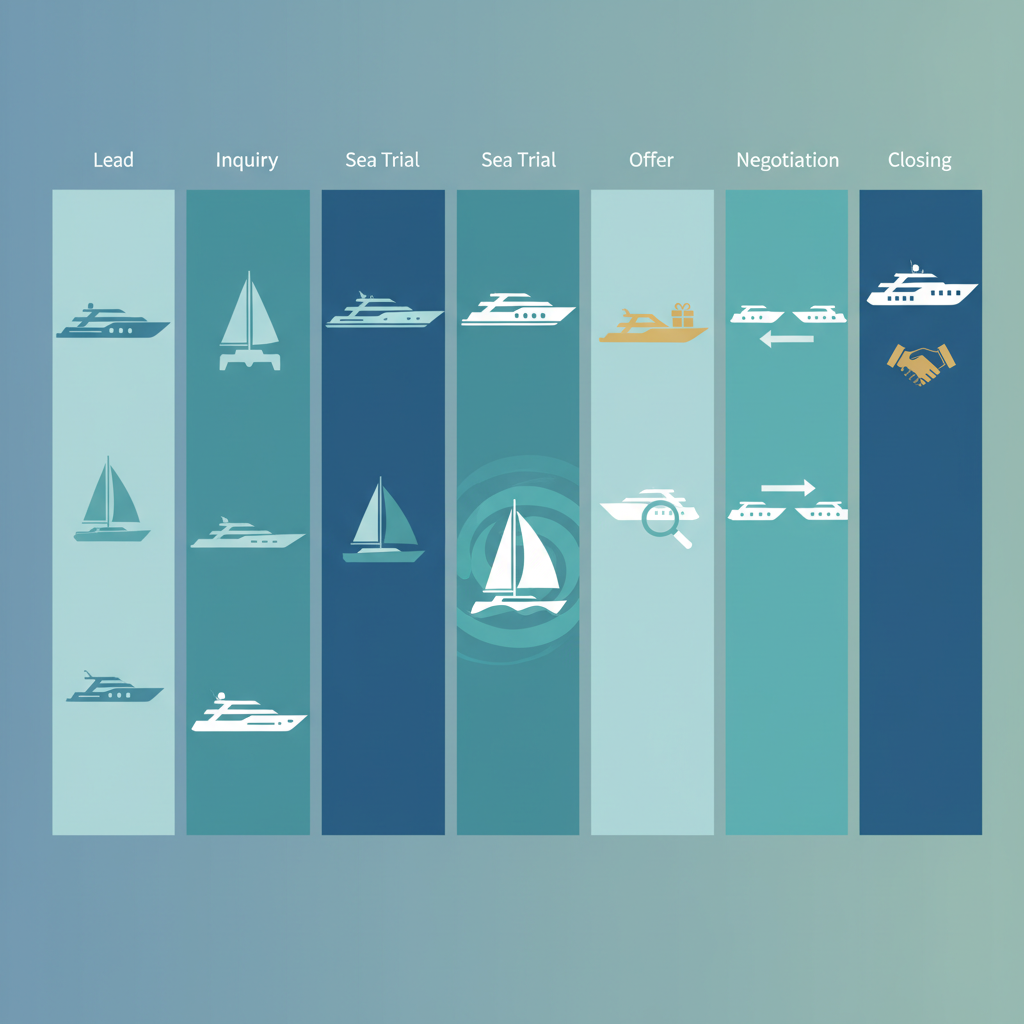
Pipeline management software maintains a real-time view of every active transaction, with each deal positioned at its current stage:
- Offer received — initial offer terms, seller response tracking, counter-offer history
- Accepted / Deposit pending — deposit deadline tracking with automatic reminders
- Survey scheduled — surveyor assignment, date confirmed, access coordination notes
- Post-survey — survey finding documentation, repair negotiations, price adjustments
- Closing preparation — document checklist, title search status, funds coordination
- Closed — commission calculation, disbursement records, seller and buyer thank-you workflow
Brokers and managers see the entire pipeline at a glance — total deal value, days in current stage, upcoming deadlines, and deals that have stalled longer than expected. This visibility enables proactive intervention before missed deadlines derail transactions.
Automated Follow-Up Sequences
The most consistent brokers are those whose follow-up is genuinely systematic. CRM platforms with automated follow-up capabilities allow brokers to define sequences triggered by specific events:
- New inquiry received — immediate automated acknowledgment plus broker task to follow up personally within 2 hours
- Showing completed — automated thank-you email with showing summary link, plus broker follow-up task at 48 hours
- Offer submitted but no response in 48 hours — automated reminder to buyer's broker
- Deal closed — automated seller review request plus 90-day buyer check-in sequence
These sequences ensure consistent communication standards across all brokers in the office and eliminate the follow-up gaps that allow competitive brokers to capture buyers who feel neglected.
Reporting Dashboards and Business Intelligence
Brokerage management requires more than deal-by-deal visibility — it requires understanding business performance trends that inform strategic decisions. Which listing categories sell fastest? What is the average days-on-market by vessel size? Which lead sources produce the highest conversion rates? Which brokers close deals at or above asking price most consistently?
Modern broker management platforms provide pre-built reporting dashboards covering:
- Listing performance: Days on market, view-to-inquiry conversion rate, price reduction frequency and magnitude
- Pipeline metrics: Average deal velocity by vessel type, stage conversion rates, deal fall-through analysis
- Broker performance: Listing volume, closing rate, average commission per deal, response time metrics
- Market intelligence: Sold price vs. asking price ratios, seasonal transaction patterns, inventory turnover by category
This data transforms brokerage management from intuition-based to evidence-based — enabling principals to identify what's working, where process improvements are needed, and how to allocate marketing investment for maximum return.
Client Relationship Nurturing: The Long Game in Yacht Sales
Yacht buyers are not one-time customers. The typical yacht owner purchases multiple vessels over a sailing or boating lifetime — upgrading as experience and finances evolve, sometimes stepping down as circumstances change. A buyer whose 42-foot sloop purchase you facilitated today is a potential 60-foot motor sailor buyer in five years, and a potential listing when they eventually sell. The broker who maintains a genuine, ongoing relationship captures these repeat transactions; the one who treats clients as one-time leads does not.
CRM platforms support long-term relationship management through:
- Birthday and boat anniversary reminders that prompt personal outreach at meaningful moments
- New listing alerts automatically matched to stored buyer profiles — when a vessel matching a past buyer's stated preferences comes to market, they are notified immediately
- Industry news and market updates sent as a regular value-add communication to the entire client database
- Event invitation management for boat shows, open days, and brokerage social events
SupaSailing's broker management platform integrates all of these relationship management capabilities with the listing, syndication, and pipeline tools that modern brokerages require, providing a unified workspace that replaces the disconnected collection of tools most brokerages currently rely on.
Benefits and ROI of Yacht Broker Management Software
The performance impact of dedicated broker management software is well-documented across the industry:
- 23% faster deal velocity: Structured pipeline management and automated follow-ups keep deals moving through stages without manual shepherding
- 35-50% larger listing capacity: Syndication and centralized management allow brokers to handle significantly more listings without proportional administrative overhead
- 40% improvement in lead response time: Automated acknowledgments and CRM task creation ensure no inquiry goes without timely response
- 15-25% increase in repeat business: Long-term CRM nurturing converts one-time clients into repeat customers and referral sources
- 8-12 hours per week saved on administrative tasks including listing updates, syndication management, and manual follow-up tracking
- Improved close rates: Lead scoring ensures premium follow-up attention reaches the most-ready buyers, improving conversion from inquiry to transaction
For a brokerage generating $500,000 annually in commissions, even a 15% improvement in close rate translates to $75,000 in additional revenue — well in excess of platform subscription costs for most operations.
Frequently Asked Questions About Yacht Broker Management Software
What is the difference between generic CRM software and dedicated yacht broker management software?
Generic CRM platforms (Salesforce, HubSpot, etc.) are built for horizontal sales applications and lack maritime-specific functionality: listing syndication to yacht portals, survey and sea trial workflow management, vessel specification data structures, and co-brokerage coordination tools. Dedicated yacht broker management software is purpose-built for the yacht transaction lifecycle, delivering functionality that would require extensive custom development to replicate in a generic CRM.
How long does it take to migrate existing listings and contacts to a new platform?
For a brokerage with 20-50 active listings and up to 500 contacts, migration typically takes 2-4 weeks including data import, photo upload, and team training. Most modern platforms provide migration support and import templates. The operational disruption is minimal when the migration is structured properly, and the productivity gains are typically visible within the first full month of use.
Does listing syndication software work with all major yacht portals?
Coverage varies by platform. Evaluate any solution against your specific portal requirements before committing. Priority portals for North American and European markets typically include YachtWorld, Boats.com, Yatco, and BoatTrader. Regional portals vary by market. Confirm both the list of supported portals and the data fields that sync bidirectionally before making a platform selection.
Conclusion
Yacht brokerage remains a relationship business at its core — but the infrastructure that supports those relationships has been transformed by purpose-built management software. Brokers who invest in integrated CRM, listing syndication, and pipeline management tools operate with a structural advantage that compounds over time: more listings handled without more overhead, better-nurtured prospects who convert at higher rates, and systematic follow-up that captures opportunities manual processes miss.
For brokerages evaluating their technology stack, the question is not whether to adopt these tools but which platform best fits the operation. SupaSailing's yacht broker management platform delivers the integrated listing management, syndication, CRM, and pipeline tracking that modern brokerages need — purpose-built for the yacht market and designed to scale with your business as it grows.
Related solutions
See how SupaSailing is built around these roles:
See SupaSailing in action
Book a free demo call and discover how one platform can run your charter, marina, fleet, shipyard or brokerage.
Book a Free DemoShare this article