Yacht Broker CRM: Streamline Sales Pipeline and Client Management
What separates a top-producing yacht broker from one who struggles to close deals consistently? In most cases, it is not market knowledge, negotiation skill, or even the quality of their listings. The differentiator is systems. According to industry research, professional sales teams that use dedicated CRM software close up to 41% more deals than those relying on spreadsheets and email folders. In the world of high-value yacht brokerage, where a single transaction can represent millions of euros and months of client relationship work, the cost of a disorganised pipeline is enormous. Every missed follow-up, every duplicated effort, every lead that slips through the cracks represents a commission lost forever. This guide explores how a purpose-built yacht broker CRM transforms the way modern brokerage businesses manage listings, nurture leads, and close high-value deals at scale.
Yacht brokerage operates in one of the most complex sales environments in the world. Deals can take six to eighteen months to close. Buyers are often international, with precise specifications and demanding expectations. Sellers require regular updates and transparent marketing activity reports. At the same time, brokers must juggle dozens of active listings, hundreds of leads at various stages, and a constant flow of new enquiries from multiple channels. Without the right brokerage software, this complexity quickly becomes unmanageable, even for experienced professionals.
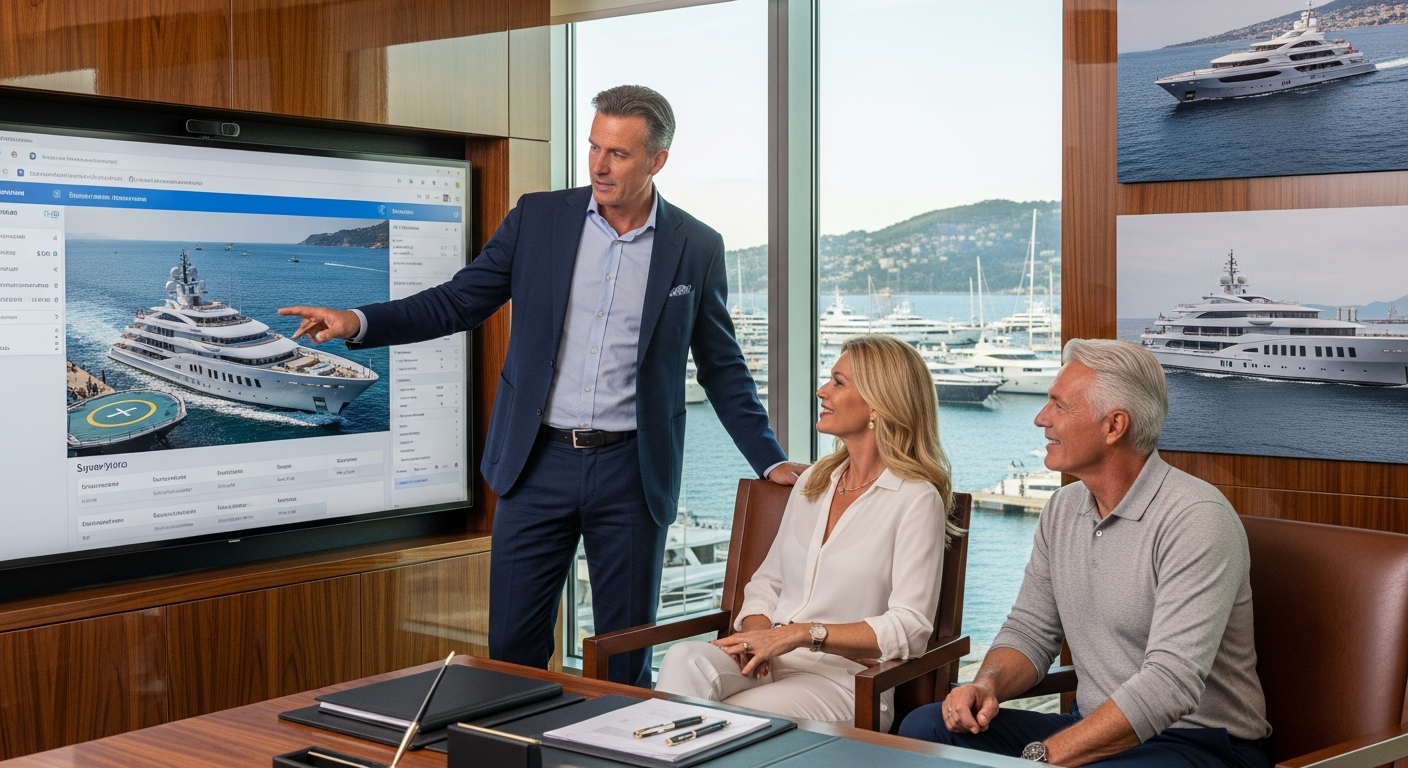
Why Yacht Brokers Need a Dedicated CRM
Generic CRM platforms designed for insurance, real estate, or software sales were not built for the specific workflows of yacht brokerage. They lack critical features like vessel specification databases, integration with international listing portals, MYBA contract templates, and sea trial scheduling. A generic tool forces brokers to adapt their process to the software, rather than the software serving the process.
A purpose-built yacht broker CRM is designed from the ground up for the brokerage sales lifecycle. It understands that a lead is not just a name and email address, but a complex profile of preferences: preferred LOA, engine configuration, year of construction range, budget ceiling, intended cruising area, desired flag state. It understands that a listing is not just a price and a photograph, but a rich technical file including MCA classification, classification society certificates, equipment inventories, and recent survey reports. When these two data sets connect intelligently, brokers can work with precision and speed that is simply impossible to replicate manually.
The Cost of Not Having a CRM
Brokers who rely on email, spreadsheets, and memory to manage their pipeline pay a hidden price. Studies in high-ticket B2B sales consistently show that without systematic follow-up, 80% of prospects who eventually buy do so after the fifth contact, yet fewer than 10% of salespeople make that fifth contact. In yacht brokerage, where a single follow-up could represent a EUR 50,000 commission, the mathematics of inconsistency are brutal. A CRM eliminates this problem with automated reminders, structured follow-up sequences, and a complete history of every interaction with every contact.
Lead Management and Pipeline Visibility
At the core of any effective sales pipeline is clarity. A broker should be able to open their CRM at any moment and know exactly where every active lead stands, what the next action is, and what the projected revenue value of the pipeline looks like for the next ninety days. This visibility is what allows a brokerage to forecast revenue, allocate marketing budgets, and identify where the business is leaking opportunities.
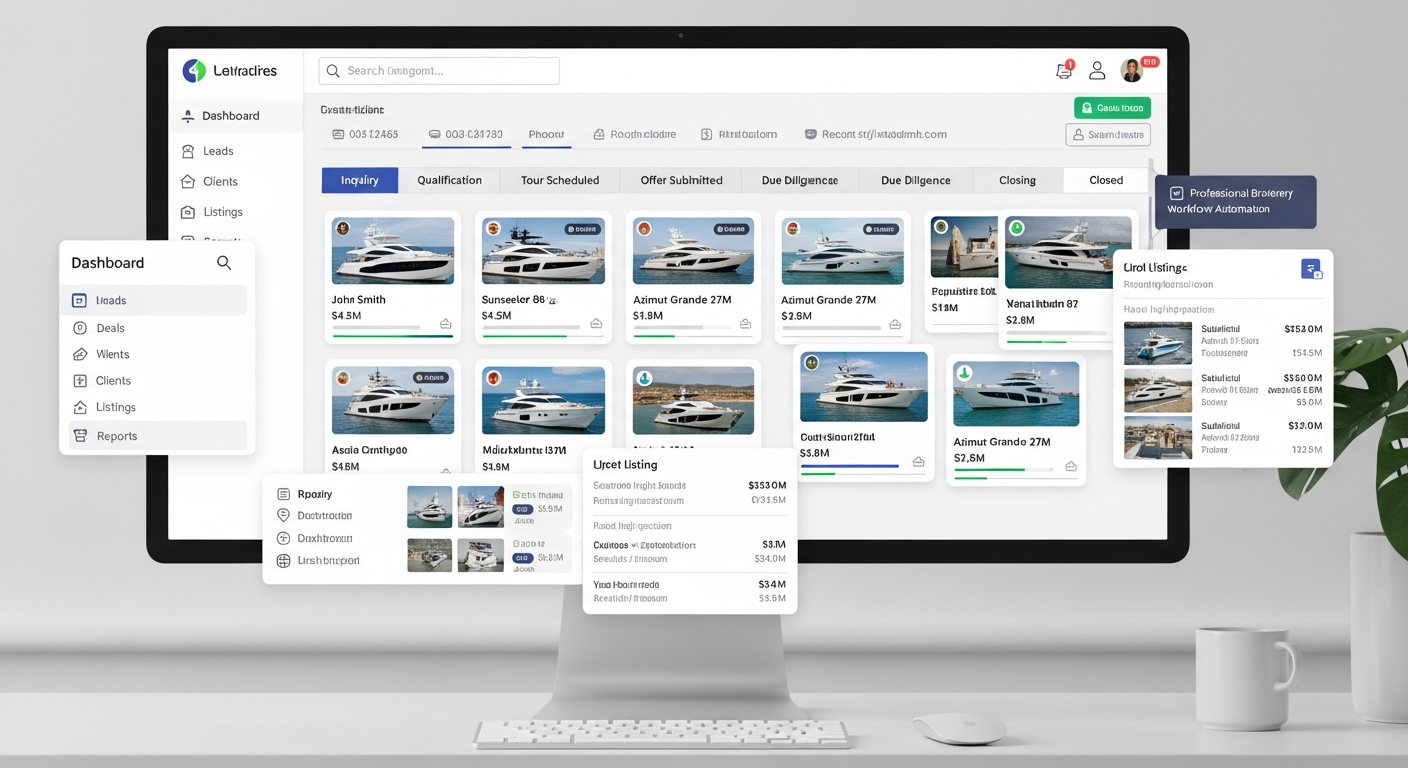
A well-structured yacht brokerage CRM typically organises the pipeline into defined stages that reflect the real sales process:
- New Enquiry - Initial contact captured from website, referral, or exhibition
- Qualification - Budget verified, timeline confirmed, specification understood
- Presentation - Shortlisted vessels shared and discussed
- Viewing / Sea Trial - Physical or virtual boat visit arranged
- Offer Stage - Formal offer submitted and under negotiation
- Under Contract - MYBA agreement signed, deposit in escrow
- Survey and Closing - Professional survey completed, closing documentation processed
- Closed Won - Transaction completed, commission paid
Each stage in the pipeline can be configured with mandatory tasks, automatic reminders, and escalation triggers. If a lead has been in the Viewing stage for more than two weeks without activity, the system flags it automatically and prompts the responsible broker to take action. This discipline, enforced systematically across the entire team, transforms pipeline management from a reactive scramble into a proactive, data-driven process.
Lead Scoring and Qualification
Not all leads deserve equal attention. A first-time enquirer who fills out a contact form with vague requirements is a very different prospect from a returning client who bought a 30-metre motor yacht three years ago and is now asking for 40-plus metre sailing yachts. A sophisticated yacht broker CRM assigns lead scores based on multiple data points: budget range, purchase timeline, prior purchase history, engagement with marketing emails, responsiveness to follow-ups, and referral source. High-scoring leads automatically receive priority attention and are flagged for immediate personal contact from a senior broker. Lower-scoring leads enter a nurture sequence where they receive regular, relevant content until their readiness increases.
Listing Database and Intelligent Vessel Matching
One of the most powerful features of brokerage-specific software is the ability to connect buyer profiles directly to available listings through intelligent matching algorithms. When a new vessel is entered into the database, the system automatically checks all active buyer profiles and identifies potential matches. The broker receives a notification: "This new 28-metre Ferretti matches the specifications of 4 registered buyers." This proactive matching capability reduces the time from listing to first showing dramatically, which is critical in a market where desirable vessels often receive multiple offers within weeks of coming to market.
The listing database in a professional brokerage software platform stores far more than basic vessel details. A comprehensive listing record includes:
- Full technical specifications: LOA, beam, draft, displacement, fuel capacity, engine hours
- Classification society status and certificate expiry dates
- Recent survey reports and condition notes
- Full equipment inventory with ages and service histories
- High-resolution photo and video gallery
- Price history and motivation of the seller
- Showing history and buyer feedback from previous viewings
- Marketing distribution record across listing portals
Having all of this information centralised and instantly accessible means a broker can answer any buyer question immediately, without hunting through email attachments or calling the listing agent. This professional efficiency builds buyer confidence and accelerates the decision-making process significantly. Learn more about how SupaSailing's broker tools support a complete listing and CRM workflow for professional brokerage teams.
Client Communication Tracking and History
In luxury goods sales, relationships are the foundation of the business. A client who buys a yacht today may refer three colleagues over the next decade, or return themselves for a larger vessel five years later. The entire value of that relationship depends on the broker's ability to maintain a consistent, personalised, and attentive dialogue over many years, even during long periods of inactivity between transactions.
A yacht broker CRM captures every touchpoint in the client relationship: every email exchanged, every phone call logged, every property shown, every offer made. When a broker opens a client record before a call, they see a complete timeline of the relationship. They know that the client's wife prefers sailing yachts to motor yachts, that they have a preference for Northern European build quality, and that they mentioned wanting to cruise the Baltic the following summer. This level of contextual knowledge, available instantly, makes every conversation feel personal and thoughtful rather than generic and transactional.
Modern CRM platforms also integrate directly with email clients, ensuring that every email sent or received in relation to a client or listing is automatically captured and attached to the correct record. There is no risk of important correspondence being trapped in a single broker's inbox and lost when they change roles or leave the brokerage.
Multi-Channel Marketing and Listing Distribution
Effective yacht broker marketing requires presence across multiple channels simultaneously: major international listing portals, the brokerage's own website, social media channels, email newsletters to registered buyers, and participation in boat shows and industry events. Coordinating this activity manually is time-consuming and prone to inconsistency. Integrated brokerage software automates and streamlines this process.
A dedicated platform can push listing updates to multiple portals simultaneously with a single action. When a price is reduced or a vessel's status changes to "under offer," the update propagates across all channels automatically. Email campaigns can be targeted precisely to buyer segments based on specification preferences: buyers looking for sailing yachts under 20 metres at a specific price point automatically receive alerts when a matching vessel comes to market.
Seller Reporting and Transparency
One of the most significant sources of seller dissatisfaction in yacht brokerage is the perception of poor communication from their broker. Sellers want to know that their vessel is being actively marketed. With a CRM that includes seller-facing reporting tools, brokers can automatically generate and share weekly marketing activity reports: the number of enquiries received, portals where the listing is displayed, viewing requests processed, and feedback from potential buyers. This transparency builds trust, reduces anxiety, and reduces the number of inbound calls asking for status updates, freeing the broker to focus on active selling.
Reporting, Analytics, and Business Intelligence
At a management level, a well-implemented yacht broker CRM provides the business intelligence needed to make informed strategic decisions. Real-time dashboards display key metrics across the entire team: total pipeline value by broker, average days to close by vessel category, lead-to-close conversion rate by enquiry source, and revenue generated per marketing channel. These metrics allow brokerage principals to identify their highest-performing brokers, their most valuable lead sources, and the stages in the pipeline where deals are being lost.
Historical reporting enables trend analysis: is the average commission per deal growing or shrinking? Are sea trial conversion rates improving? Which listing portals are generating the most qualified enquiries versus the most unqualified traffic? This kind of data-driven management was once reserved for large organisations with dedicated analytics teams. Today, modern brokerage software makes it accessible to any professionally run brokerage, regardless of size.
ROI and Business Impact of Yacht Broker CRM
Investing in a dedicated CRM is not simply a technology cost; it is a revenue-generating decision with measurable returns. Professional brokerage teams that implement structured CRM platforms report consistent and significant improvements across key performance indicators:
- 30-50% increase in overall deal closure rate due to systematic follow-up and pipeline management
- 25% reduction in average days-to-close as intelligent matching accelerates the viewing and offer process
- 40% reduction in administrative overhead per broker, freeing time for client-facing selling activity
- 60% improvement in lead response time when enquiry routing is automated and notifications are real-time
- 35% increase in repeat business and referrals due to improved long-term relationship management
For a mid-sized brokerage generating EUR 2 million in commissions annually, even a 15% improvement in conversion rates represents EUR 300,000 in additional revenue. Against the cost of a professional CRM platform, the return on investment is realised typically within the first quarter of full deployment. Visit the SupaSailing solutions page to explore how integrated platforms deliver these results for brokerage businesses of all sizes.
FAQ: Yacht Broker CRM and Brokerage Software
What is the difference between a generic CRM and a yacht broker CRM?
A generic CRM manages contacts and deals but lacks the vessel-specific data structures, listing portal integrations, MYBA contract templates, and sea trial scheduling workflows that professional yacht brokerage requires. A purpose-built yacht broker CRM is designed specifically for the brokerage sales lifecycle, making brokers significantly more productive without requiring manual customisation.
How long does it take to implement a yacht broker CRM?
A cloud-based yacht broker CRM can typically be deployed and populated with existing contact and listing data within two to four weeks. Most platforms offer data migration services and dedicated onboarding support to ensure the transition from spreadsheets or legacy systems is smooth. Full team adoption and workflow optimisation usually takes one to three months.
Can a yacht broker CRM integrate with listing portals and websites?
Yes. Leading brokerage software platforms offer direct integrations with major international listing portals such as YachtWorld, Boats.com, and YachtCharterFleet, as well as APIs for custom website integration. This allows listing data to be maintained in a single system and distributed automatically, eliminating duplicate data entry and ensuring consistency across all public-facing channels.
Conclusion: The Competitive Advantage of a Professional Sales Pipeline
In the competitive world of yacht brokerage, the brokers and businesses that will thrive over the next decade are those who combine deep market knowledge with systematic, technology-driven client management. A dedicated yacht broker CRM is not an optional addition to a successful brokerage; it is the operational foundation that makes consistent, scalable performance possible. From lead capture to closing, from listing distribution to seller reporting, the right brokerage software eliminates inefficiency, reduces lost opportunities, and provides the business intelligence needed to grow with confidence. Explore how SupaSailing's broker platform can transform your brokerage's sales pipeline and client management today.
Related solutions
See how SupaSailing is built around these roles:
See SupaSailing in action
Book a free demo call and discover how one platform can run your charter, marina, fleet, shipyard or brokerage.
Book a Free DemoShare this article