Weather Routing and Climate Change: How Mediterranean Yachting Is Adapting
The Mediterranean has changed. Anyone who has worked at sea in the western basin for more than a decade has felt it directly: longer summer seasons, more intense storms when they arrive, more frequent extreme heat events at anchor, and increasingly unpredictable transitions in shoulder seasons. None of this is anecdote. The IPCC's regional climate reports confirm what captains have been observing: the Mediterranean is warming faster than the global average, and operational planning that worked in 2010 is no longer adequate in 2026.
This article looks at how modern weather routing and climate-aware planning are reshaping yachting operations — and what tools are actually useful, beyond the marketing claims.
"The Mediterranean basin is warming approximately 20% faster than the global average. Operators who plan for the climate of the past will, increasingly, be surprised by the climate of the present."— IPCC AR6, Mediterranean regional summary
What Has Actually Changed
The Mediterranean's surface water temperature has risen by approximately 1.5°C since the early 1980s, with the western basin warming faster than the eastern. The practical consequences for yachting include: a longer window of viable charter operations (April to October now reliably, rather than May to September); more frequent and more intense convective storms in late summer (the so-called "medicanes" — Mediterranean tropical-like cyclones); higher anchorage temperatures putting strain on cooling systems; and increased frequency of marine heatwaves that affect everything from algal blooms to the timing of seasonal weather patterns.
For owners and operators, the meaningful change is not that weather is "worse" but that it is less predictable using historical patterns. The 30-year averages that captains were trained on are receding into the past faster than they can be replaced.
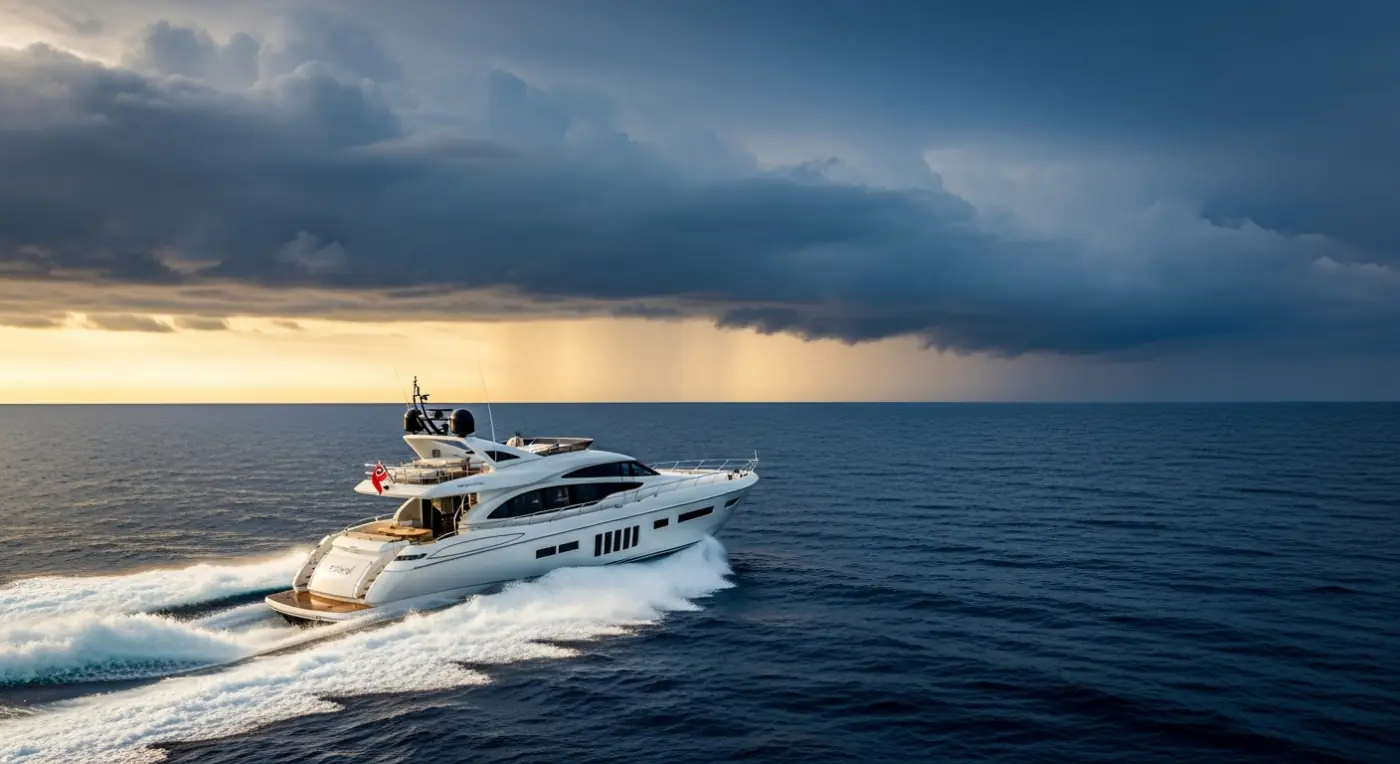
The Modern Weather Routing Stack
Weather routing for yachts in 2026 is layered. At the foundation sits global numerical weather prediction — the GFS, ECMWF and ICON models — typically accessed via subscription services such as PredictWind, SailGrib, or Bidata. On top sit higher-resolution regional models that resolve the Mediterranean's complex coastal effects: the Tramontana sweeping down from the Pyrenees, the Mistral funnelled through the Rhône valley, the Sirocco lifting up from North Africa. Above all of this sit AI-augmented services that combine multiple model outputs with historical bias correction to produce probabilistic forecasts.
The captain in 2026 is not choosing between models. They are looking at an ensemble of forecasts, evaluating where they agree and where they diverge, and making decisions accordingly. The most useful tools surface not the central forecast but the uncertainty around it.
Routing Beyond Wind
Wind is not the only consideration. Modern weather routing for charter yachts takes account of:
- Wave height and period: especially for yachts with guests prone to seasickness.
- Sea state direction: a 1.5-metre swell from the bow is a problem; a 1.5-metre swell from astern is barely noticeable.
- Anchorage shelter: which bay is protected from tomorrow's wind shift?
- Visibility: fog risk in the eastern Mediterranean spring and autumn.
- Lightning risk: especially relevant for fixed metal masts and electronics.
- Sea surface temperature: for swimming, for diving, and for marine life observation.
AI in Weather Routing — Honestly
Marketing claims around AI-powered weather routing in 2026 vary widely. The honest assessment is this: machine learning is genuinely improving short-range forecasts (24–48 hours) by combining multiple model outputs with regional historical bias data. The improvements are real and measurable: typical accuracy gains in the 5–15% range, with the largest gains in localised wind effects that classical models struggle with.
What AI is not yet doing is reliably predicting medium-range storm tracks. The fundamental physics constraints have not changed: beyond about five days, ensemble spread grows rapidly, and no amount of clever modelling overcomes that. The competent captain treats AI tools as another voice in the ensemble — useful, often correct, never sufficient on its own.
Climate Adaptation in Charter Itinerary Design
One of the most underappreciated areas of climate adaptation is itinerary design itself. The "classical" Mediterranean charter itinerary — Saint-Tropez, Sardinia, the Amalfi coast in early August — was designed for a climate that is becoming uncomfortable. Smart operators are now offering shoulder-season alternatives that capture lower temperatures, less crowded anchorages, and dramatically lower port fees: Greek islands in May, Croatia in June, Turkey in October. Charter clients increasingly appreciate the recommendation.
SupaSailing's charter operations module captures historical weather and itinerary data across the fleet, making it possible to surface which routes performed best in which conditions and to recommend climate-smart alternatives during the booking conversation.
Practical Tools and Workflows
A modern yacht's weather workflow in 2026 looks roughly like this:
- Subscription to one or more global model services with Mediterranean regional resolution.
- A daily morning briefing on the bridge, ideally with a printed summary in addition to the screen.
- Decision rules agreed in advance with the owner or charter manager — for example, "if forecast wind exceeds 25 knots from a beam direction, we delay departure".
- Automatic logging of the decisions taken and the actual conditions observed, so the next season's planning improves.
The fourth point matters more than people realise. The crews and operators who systematically log weather decisions and outcomes build, over years, a private knowledge base that no off-the-shelf tool can replicate.
"You cannot outsource judgement at sea. But you can capture the lessons of every decision in a system that future captains can learn from. That is what genuinely changes outcomes over time."— Captain on a Mediterranean charter fleet
The Climate Risk Conversation With Owners
Owners increasingly ask climate questions: how is the operating window changing? Are there parts of the Mediterranean that are becoming less suitable? What does this mean for the residual value of the yacht? These are legitimate questions and deserve thoughtful answers.
Among the answers operators can offer with reasonable confidence in 2026: the operating season is longer, not shorter. Some classical anchorages are becoming uncomfortable in peak summer due to crowding combined with heat. New regions are becoming reliably attractive (Greek islands in early summer, Croatia in early autumn). Insurance pricing is differentiating based on operating area and season. None of this requires alarm. All of it requires planning.
Insurance and the Climate Pricing Signal
Yacht insurance pricing has begun to incorporate climate signals more explicitly. Underwriters now differentiate premiums based on operating area, season, and the operator's documented evidence of weather decision discipline. A yacht with a logged history of conservative weather routing in difficult conditions will, over time, attract better terms than one with no documented decision history.
This is another reason the operational data layer matters: it is, increasingly, an insurable asset. The operators investing in good capture today will benefit from premium differentials tomorrow.
Hurricane Season Planning Outside the Mediterranean
Yacht operators with mixed-season programmes — Mediterranean summer, Caribbean winter, transatlantic crossings in shoulder seasons — face an additional layer of climate planning. Atlantic hurricane season has lengthened in recent years, and operators who plan transits using historical mid-November as a safe window are increasingly being caught out by late-season storms. The NOAA National Hurricane Center remains the authoritative source, and competent operators monitor it actively from August through early December.
Pulling It Together
Climate change is not a future problem for Mediterranean yachting. It is a present reality, and the operators who are quietly adapting — better tools, better routing, smarter itineraries, systematic measurement — are the ones whose seasons run smoothest. Software is not a substitute for seamanship. But integrated software that captures weather decisions, routing outcomes, fuel consumption, and guest comfort scores in a single record is a measurable advantage over fragmented spreadsheets and memory.
SupaSailing's charter and fleet modules capture exactly this kind of operational data, and our platform's security architecture ensures it stays where it should. To see how, get in touch or book a demo.
The Ankering Question Under a Changing Climate
Higher sea-surface temperatures, more frequent severe weather events, and tighter regulation around Posidonia oceanica seagrass meadows are converging to make anchoring in the Mediterranean more complex than it was a decade ago. The captains who plan with seagrass charts in hand, who know which bays have designated mooring fields, and who treat anchoring permits as part of the cruising calendar rather than an afterthought, deliver smoother charters with fewer regulatory surprises.
The data layer is again where this becomes manageable. A modern charter management system holds, per anchorage, the regulatory status (free / mooring field / restricted / forbidden), the documentation required, the seasonal availability and the local contacts. The captain plans against this dataset rather than building it from memory and rumour.
Insurance, Climate Disclosure and the Owner Conversation
Yacht insurance underwriters are explicitly incorporating climate disclosure into their proposal forms in 2026. Operating area, season, anchoring discipline, weather decision logs and incident history all factor into the risk assessment. Operators who can produce structured evidence of climate-aware operations attract better terms over time. Operators who cannot, do not.
The owner conversation about climate is now a normal part of an annual fleet review. The questions are increasingly precise: what does our fuel intensity look like compared with comparable vessels; how is our season changing; what risks should we plan for in the next three to five years; what does our insurance cost trajectory look like. The operator who has the data ready answers these questions in twenty minutes. The operator who does not spends three weeks reconstructing them, often unconvincingly.
Frequently Asked Questions
Which weather model is most accurate for the Mediterranean?
No single model is consistently best. ECMWF tends to lead for medium-range synoptic forecasts; GFS tends to update more rapidly and is sometimes better for short-range Mediterranean specifics; high-resolution regional models (ICON, AROME) resolve coastal effects classical models miss. The honest answer is to look at an ensemble and trust the agreement, not any single source.
Can AI weather routing replace the captain's judgement?
No. AI tools improve short-range forecasts and surface anomalies humans might miss, but they do not replace the captain's responsibility for decisions about safety, comfort and timing. Treat AI tools as an additional voice in the ensemble — useful, often correct, never sufficient on their own.
How far in advance should we plan around forecast uncertainty?
Beyond 5 to 7 days, ensemble spread grows rapidly and probabilistic forecasts become more useful than deterministic ones. For week-ahead planning, treat the central forecast as a working hypothesis and build flexibility into the itinerary. For 24 to 48 hour horizons, probabilistic forecasts have improved dramatically.
What is a medicane?
A medicane (Mediterranean tropical-like cyclone) is a low-pressure system that develops some characteristics of tropical cyclones in the Mediterranean basin. Historically rare, they have become more frequent and more intense in recent decades and are now a recognised seasonal hazard, particularly in late summer and early autumn.
Do guests really notice slower transit speeds?
Less than operators usually fear. Most charter guests are aboard for the experience of being on the yacht, not for transit time. A 10% reduction in cruising speed is barely perceptible on a comfortable yacht and produces a 25% fuel saving. Crews who have made the transition are nearly unanimous: the conversation about slow steaming was harder than the practice itself.
Putting It Into Practice This Season
If your fleet currently relies on a single weather model, a single voice, and crew memory for routing decisions, the practical first step is not to install new software. It is to write down the decision rules you already use implicitly, share them with the crew, and start logging the decisions and outcomes systematically. Within a single season, the patterns become visible: which forecasts you trust, which models bias high or low for your operating area, which weather conditions actually matter for guest comfort versus those that you over-react to. This data is not glamorous but it compounds over years, and the operators who capture it have a structural advantage that no off-the-shelf software can replicate. The Copernicus Marine Service publishes Mediterranean-specific climate datasets that are free to access and increasingly useful as a baseline against which to interpret each season's observations.
Related solutions
See how SupaSailing is built around these roles:
See SupaSailing in action
Book a free demo call and discover how one platform can run your charter, marina, fleet, shipyard or brokerage.
Book a Free DemoShare this article