Sustainable Yachting in 2026: Hybrid Propulsion, ESG and Operational Efficiency
Sustainability in yachting is no longer a slogan reserved for designers and pressure groups. In 2026, the conversation has moved decisively into the heart of operational decision-making — and the operators who embrace it are finding measurable savings, regulatory advantages, and a growing pool of charter clients who actively select greener vessels. This article walks through the state of sustainable yachting in 2026: the technologies that work, the metrics that matter, and the role that operational software plays in turning intent into measurable progress.
"The Mediterranean is warming faster than the global average. Yacht operations that worked in 2010 are no longer adequate in 2026 — but adaptation, when measured and managed, is also a major commercial opportunity."— IPCC AR6 Working Group I, regional summary
The Industry Pressure Points
Yachting faces converging pressures. The IMO's tightening Carbon Intensity Indicator (CII) rules apply to commercial yachts above 5,000 GT, and class societies are extending similar voluntary frameworks to smaller vessels. EU ports increasingly offer differentiated berthing fees based on environmental rating. Charter clients — particularly the next generation of HNW individuals — are explicitly asking about emissions, waste handling, and ESG reporting. Insurance underwriters are starting to differentiate premiums based on environmental risk.
None of this makes sustainability optional. It makes it a competitive parameter.
Hybrid and Diesel-Electric Propulsion
The most visible technology shift is in propulsion. Diesel-electric and hybrid systems — once exotic — are now standard offerings from every major shipyard. The benefits are not theoretical. A modern hybrid propulsion package on a 50-metre yacht typically delivers fuel savings of 15–25% over a comparable conventional diesel system, with significantly lower emissions in port and at low speeds. Battery-only operation in protected anchorages eliminates noise pollution and exhaust fumes, dramatically improving the guest experience.
Retrofitting hybrid systems on existing yachts is increasingly viable, particularly during major refits. The economics depend on the operating profile: yachts that spend significant time in port or at anchor (most charter yachts) recover the investment fastest. The Water Revolution Foundation publishes a useful methodology for quantifying the environmental impact of refit and new-build decisions.
Energy Management Beyond Propulsion
Propulsion gets the headlines, but hotel loads — air conditioning, lighting, water makers, kitchen equipment — account for a surprisingly large share of total fuel consumption. The most efficient sustainable yachts of 2026 share several non-glamorous design choices:
- LED lighting throughout, with automated occupancy sensors and circadian dimming.
- Variable-speed air conditioning compressors that match load instead of cycling on/off.
- Heat-recovery ventilation that pre-conditions incoming air using exhaust air.
- Solar films on superstructure surfaces, contributing 10–30 kWh per day in Mediterranean conditions.
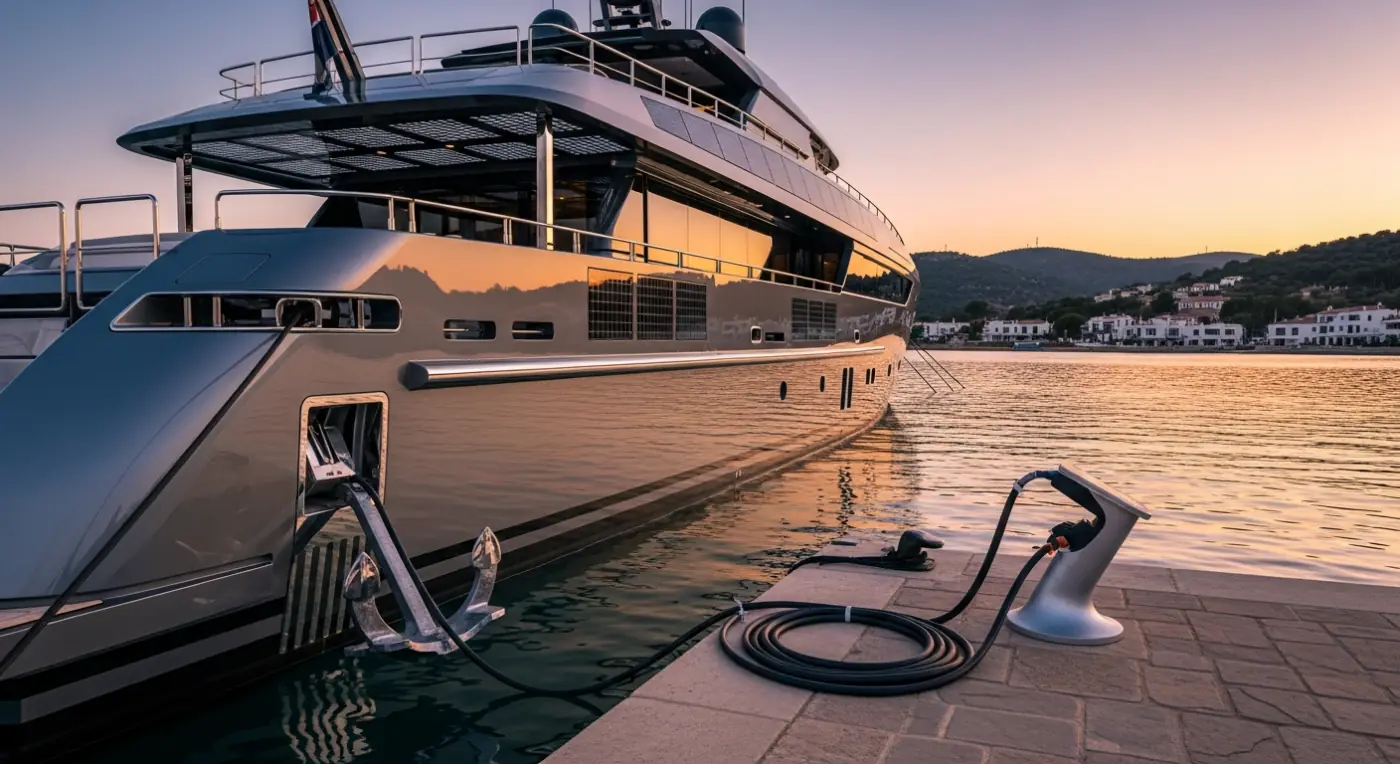
- Shore-power capability matched to the most common ports of call.
Waste, Water and Fuel
The environmental footprint of a charter season is not only measured in CO₂. Plastic waste, grey-water management, fresh-water consumption and antifouling paint all matter. The compliant and increasingly common practices in 2026 include:
- Refillable glass-bottle programmes replacing single-use plastic.
- Advanced grey-water treatment exceeding MARPOL Annex IV requirements.
- Smart water makers that produce only what is needed, not what tanks can hold.
- Biocide-free antifouling paints, especially for vessels operating in marine protected areas.
- Verified fuel sources, including biofuels and HVO (hydrotreated vegetable oil) where bunkering allows.
The Data Layer: Measuring What You Manage
None of the above is meaningful without measurement. The operator who claims a 20% emissions reduction must be able to prove it — to insurers, to charter clients, to ESG-focused investors, and increasingly to regulators. This is where modern yacht management software earns its place in the sustainability conversation.
A well-instrumented yacht in 2026 captures, automatically:
- Fuel consumption per main engine, per generator, per voyage.
- Energy demand by deck and by major system.
- Waste produced by category and discharge port.
- Fresh water made and consumed.
- Speed, distance and engine hours by leg.
This data, normalised across the fleet, makes voluntary CII calculation trivial, surfaces inefficiencies that no individual crew member would spot, and produces the ESG reports that owners and insurers increasingly demand.
Operational Practices That Actually Move the Needle
Beyond hardware, the largest emissions reductions of the last five years have come from operational practices: slower transit speeds (a 10% speed reduction can yield a 25% fuel saving), optimised routing using weather data, demand-driven generator usage instead of always-on, and crew incentives tied to efficiency metrics.
None of this requires capital investment. All of it requires cultural change and good measurement.
"Slow steaming is the single highest-leverage operational change available to a yacht today. Crews adapt quickly. Guests rarely notice. Fuel bills drop measurably."— Operations director, Mediterranean charter fleet
ESG Reporting and the Charter Client
The next generation of charter clients increasingly asks ESG questions during the booking conversation. Family offices, in particular, are integrating sustainability metrics into their leisure choices. The operator who can produce a one-page sustainability summary at the end of a charter — fuel consumed, emissions per guest-night, waste handling, local sourcing — is increasingly the operator who gets repeat business.
SupaSailing's fleet management module and charter operations module capture the operational data required to produce these reports automatically, with no separate data-entry burden on the crew. Fuel logs, energy consumption, waste manifests and port calls are recorded in the normal flow of operations and aggregated into customisable sustainability reports.
Marine Protected Areas and the Anchoring Question
The Mediterranean now has nearly 1,300 designated marine protected areas, and the regulations governing each are tightening. Posidonia oceanica seagrass meadows — fundamental to Mediterranean marine ecology — are particularly vulnerable to indiscriminate anchoring. France, Italy, Spain and Greece have all introduced anchoring restrictions or designated mooring fields in sensitive areas, and enforcement has become routine rather than exceptional.
The compliant operator in 2026 plans anchoring with seagrass charts in hand, prefers designated mooring fields, and trains crew to recognise restricted zones. The reputational risk of being filmed dragging anchor through a Posidonia meadow is now significant. The IUCN's marine protected area guidance is the canonical reference.
Where to Start
If sustainability is currently a one-line statement on your website rather than a measured operational practice, the practical starting point is not buying new equipment. It is starting to measure what you have. Once the baseline is clear, the highest-impact, lowest-cost improvements become obvious. Most operators discover that a 10–15% reduction in emissions is available within a single season, just from operational practice changes guided by data.
Hardware upgrades — hybrid propulsion, solar, advanced water treatment — pay back over years rather than seasons but compound the operational improvements.
To explore how SupaSailing supports sustainability tracking and ESG reporting across charter, fleet, marina and refit operations, get in touch or request a demo. Our security and compliance page covers how we handle the operational data underpinning all of this.
The Charter Client Conversation: A New Set of Questions
Charter inquiries in 2026 increasingly include sustainability questions that were rare five years ago: what is the propulsion system; what is the typical fuel consumption per guest-night; how is plastic waste handled; what is the local sourcing approach; is shore power used in port; are there marine-protected-area considerations in the proposed itinerary. The operators who have answers to these questions, supported by data, win business at premium rates.
This is not simply a compliance exercise. It is a competitive realignment of the charter market around environmentally-conscious clients with both budget and influence. Family offices in particular are increasingly vocal about ESG criteria for the leisure choices they make on behalf of principals. The brokerage and management firms that build sustainability evidence into their booking material are not adding overhead — they are adding margin.
"We started producing per-charter sustainability summaries — fuel, emissions, waste, local sourcing — and within two seasons it was the most-quoted section of our booking material. The clients who care, really care."— Charter manager, Italy-based fleet of 9
Crew Engagement and Onboard Culture
The data tells the story; the crew tells the data. Sustainability metrics that are not part of the daily life of the yacht remain abstract. The fleets that have embedded sustainability culturally typically share a few practices: monthly fuel-consumption reviews with the engineering team; visible posters in the galley and deck areas showing waste-stream sorting; chef-led kitchen practices that minimise food waste; explicit incentives in the crew bonus structure for measured efficiency improvements.
This is leadership, not technology. But the technology underneath — the daily fuel logs, the energy-by-system breakdown, the waste manifest by leg — is what makes the leadership conversation grounded in evidence rather than slogan.
Frequently Asked Questions
Are biofuels and HVO interchangeable with conventional diesel?
Mostly, with caveats. Hydrotreated vegetable oil (HVO) is a drop-in replacement for diesel and works in most modern engines without modification. Other biofuel formulations vary in their compatibility — always check with the engine OEM before bunkering an unfamiliar formulation, particularly on common-rail diesels which can be sensitive to fuel chemistry.
How much fuel does shore power actually save?
For a 50-metre yacht with a typical hotel load profile, shore power eliminates the need to run a generator while in port — saving roughly 40 to 80 litres of diesel per day in port, with proportional emissions reductions. Across a typical Mediterranean season with significant port time, this adds up quickly.
Is hybrid propulsion worth retrofitting on an older yacht?
It depends on the operating profile. Yachts that spend significant time at low speed, in port, or at anchor — most charter yachts — see meaningful payback. Yachts that primarily transit at high speed see less. The economics of a retrofit during a planned major refit are usually better than a standalone retrofit project.
What is the Carbon Intensity Indicator and does it apply to my yacht?
The CII is the IMO's operational efficiency rating for ships, applied at the moment to vessels above 5,000 GT. Most yachts are below this threshold and not formally in scope, but several class societies offer voluntary CII-style ratings for smaller vessels, and charter clients increasingly ask for the metric. Treating it as a useful internal benchmark is sensible even where it is not legally required.
How do we credibly measure local sourcing?
The simplest and most defensible approach is a clear definition (for example, "produced within 200 kilometres of the port of provisioning"), supplier-level documentation, and per-charter aggregation. Software that integrates the provisioning workflow with supplier metadata produces this report automatically; a manual approach produces it inconsistently and slowly.
Industry Resources for Sustainable Yachting
The following resources are useful starting points for operators building a structured sustainability programme: the Water Revolution Foundation publishes a Yacht Assessment Tool methodology that produces comparable environmental scoring across hull, propulsion and operational dimensions. The IUCN marine protected area guidance remains the canonical reference for vessels operating in or near protected waters. The IMO greenhouse gas resource page tracks the regulatory horizon for commercial yacht operations. Together with the practices above, these resources translate intent into a structured programme that delivers measurable progress year over year.
The Bottom Line
Sustainability in 2026 is not a marketing claim. It is a measured, audited, increasingly regulated dimension of yacht operations that determines insurance terms, charter rates and asset value. The operators who treat it as such — by measuring rigorously, reporting transparently, and improving systematically — are the ones whose seasons run smoothest and whose yachts retain value best.
The maritime sector is in transition: not yet at the destination of low-carbon, fully circular operations, but visibly moving in that direction with measurable progress year over year. The operators who lead this transition do so not through grand declarations but through the quiet discipline of measuring, reporting, and continuously improving — and they are reaping the commercial benefits of doing so. Sustainability, increasingly, is not a cost centre but a competitive advantage when handled with the same rigour applied to every other operational dimension. The data, the practices, the reporting, the culture — taken together they amount to a credible programme that earns trust from clients, regulators and insurers alike. The journey is long. The first season is the hardest. The compounding returns begin in year two and accelerate from there.
Related solutions
See how SupaSailing is built around these roles:
See SupaSailing in action
Book a free demo call and discover how one platform can run your charter, marina, fleet, shipyard or brokerage.
Book a Free DemoShare this article