Mediterranean Charter Itineraries: Designing the Perfect Season
Designing a Mediterranean charter season is one of the most underrated craft skills in yachting. The captain, the central agent and the charter manager who together build a strong itinerary do something subtle: they balance client expectations, weather realities, regulatory complexity, port availability, fuel logistics, and crew rest cycles into something that looks effortless from the outside. This article unpacks that craft, region by region, with practical guidance on the tools that turn a good itinerary into a great one.
"A great Mediterranean week is not a list of famous places. It is a sequence of decisions that match the weather, the guests, and the season — made one day ahead, every day."— Senior central agent, Monaco-based brokerage
The Macro Map: How the Mediterranean Divides Up
For charter purposes, the Mediterranean splits into five operational regions, each with its own seasonality, regulatory landscape, and client profile:
- Western Mediterranean — Côte d'Azur and Italian Riviera. Saint-Tropez, Cannes, Monaco, Portofino. Peak demand mid-July to mid-August. Highest rates, most demanding clients, most regulated waters.
- Balearic Islands. Mallorca, Ibiza, Formentera. June through September. Famous nightlife on Ibiza, calm anchorages around Mallorca, and the protected national park of Cabrera.
- Italy and Sardinia. The Costa Smeralda, Capri, Sicily, the Aeolian islands. Long season, varied geography, strong food tourism dimension.
- Croatia and the Adriatic. Around 1,200 islands, increasingly popular June through September. Lower port fees than the western Mediterranean, increasing infrastructure quality.
- Greek Islands. Cyclades, Ionian, Dodecanese. May through October, with dramatic regional variation. Strong demand for the Cyclades archipelago in summer, quieter Ionian sailing in shoulder seasons.
Building a Week: The Two-Hour Rule
The single most important constraint on a charter itinerary is the two-hour rule: most charter guests do not enjoy more than two hours of transit at a time. This is not a hard rule but a soft default, and it shapes everything else. Itineraries built on three-hour-plus legs read well on paper and exhaust the guests in practice.
The corollary: a one-week charter that starts and ends in Antibes, for instance, has roughly 45 hours of total transit budget at a comfortable cruising speed. That budget defines the geographic spread the itinerary can reasonably cover. Trying to do more is the most common itinerary mistake.
The Anchorage Layer
A Mediterranean charter itinerary is, in operational terms, a sequence of anchorages — not a sequence of ports. The guests are aboard primarily to enjoy the sea, the swimming, the scenery, and the privacy of a yacht. Ports are functional waypoints (provisioning, fuel, customs, occasional dinner ashore), not destinations in themselves.
The art is to build a sequence of anchorages that combines variety (one calm, one swimmable, one with a great beach), shelter from the prevailing weather, and the right balance of crowded "must-see" stops against quieter discoveries.
Region-Specific Notes
Côte d'Azur in July. Expect a strong easterly land breeze in the morning, building from the south by mid-afternoon. The anchorages east of Saint-Tropez get less afternoon swell than those further west. Antibes has the deepest visiting infrastructure for fuel and provisioning. Cap d'Antibes anchorages can be crowded; Île Sainte-Marguerite remains a reliable lunch stop.
Balearics in late June. Mallorca's Cala Mondragó and Cala Pi are still relatively quiet. Cabrera requires advance permission and a daily cap on yachts. Ibiza's Cala Bassa is busy but the food scene at Es Vedrà is increasingly strong. Formentera's Espalmador is lovely at sunset, especially mid-week.
Sardinia in August. Costa Smeralda is at peak prices. The Maddalena archipelago requires permits but rewards patience. Bonifacio across the Strait, on the Corsican side, is a dramatic destination but parking is challenging in August.
Croatia in September. The Pakleni islands off Hvar remain stunning. Dubrovnik's port traffic peaks but the Elaphite islands offer immediate relief. Vis is rewarding. The shoulder season is increasingly the smart choice.
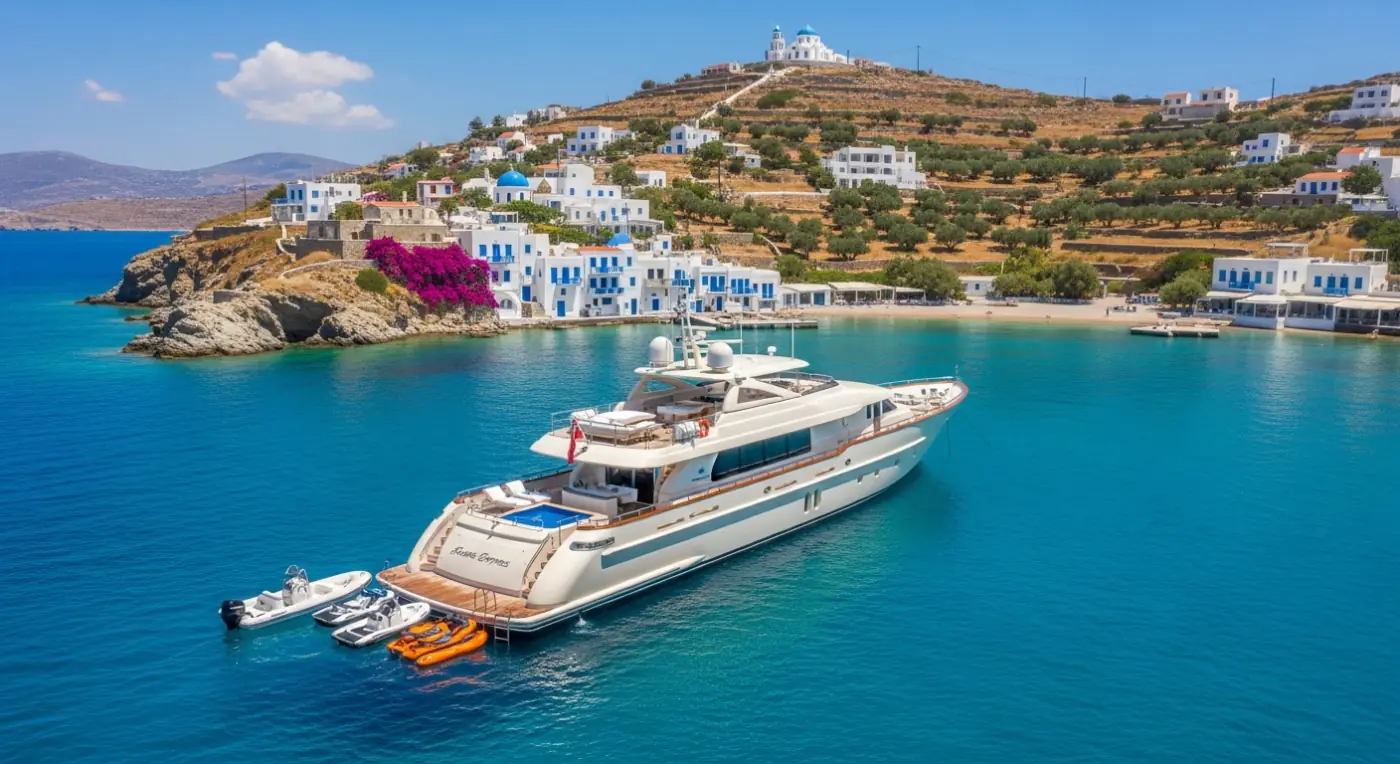
Greek Cyclades. Mykonos and Santorini drive the headline demand but the Small Cyclades — Koufonisi, Iraklia — offer extraordinary anchorages with a fraction of the crowd. The Meltemi wind is the dominant variable from late June through August and shapes itinerary direction.
The Operations Stack
An itinerary on paper is one thing; turning it into a delivered charter week with happy guests is another. The operational stack behind a good charter season includes:
- Provisioning: planned by route, accounting for guest preferences, dietary restrictions, and what is genuinely available at each port.
- Fuel logistics: bunkering at the right ports at the right time, which is rarely just the cheapest.
- Crew rotation and rest: charter crew operate under MLC 2006 hours-of-rest rules; itineraries that look impressive but break crew rest cycles are a regulatory and safety problem.
- Berth booking: in peak season, marina berths book months in advance. The charter manager who is still calling marinas the day before is not in control.
- Permits and customs: cruising permits in Greece, fiscal representation in France, advance crew lists in Italy and Spain. Each region has its own paperwork, and the operator who has good document templates and a good calendar saves days per season.
Where Software Earns Its Place
The reason this is not a romantic art form alone is that the volume of variables makes it intractable to manage in spreadsheets reliably. SupaSailing's charter management module is built around exactly this workflow: itinerary design with anchorage and port libraries; guest preference sheets with privacy-by-design (see our GDPR for charter operators article); crew schedules aligned to MLC; provisioning lists by leg; fuel logs by port; and a single audit trail that the central agent and the captain share.
This means the captain is not re-typing the same information into three systems. The provisioning list is generated from the guest preference sheet. The fuel log is reconciled automatically. The post-charter report — fuel consumed, distance, anchorages visited, guest feedback — is produced in one click and ready for the next central agent conversation.
Making the Recommendation Layer Work
Some of the highest-leverage moments in central agency happen during the booking conversation, when the agent is pitching an itinerary to a prospective charter client. The agent who can offer informed recommendations — "for your dates, given that you mentioned dietary restrictions and a preference for less-crowded anchorages, I would suggest a Greek Cyclades route starting on Tuesday rather than the Côte d'Azur" — closes more business at higher rates.
Doing this well requires a memory of which itineraries worked, when, for which kind of guest. That memory cannot live in one person's head. It lives in a system that records every charter, the conditions, the guest feedback and the operational outcomes.
"The brokers who consistently win the highest-value charter mandates are the ones whose recommendations are obviously informed by experience the client cannot themselves access."— MYBA Charter Brokers Association industry report, 2025
The MYBA Standard and the Document Layer
The dominant contractual standard for European Mediterranean charter is the MYBA Charter Agreement. The 2024 update introduced more rigorous force-majeure language reflecting climate-related disruption, clearer cancellation rules, and standardised provisioning vs APA accounting. Operators who manage their charter documentation in a system that auto-populates MYBA templates from the booking record save themselves significant manual work and reduce the risk of clerical error.
Sustainability in Itinerary Design
Increasingly, charter clients ask sustainability questions: what is the emissions profile of the proposed route? Are we anchoring in protected areas? Is there local provisioning? The operator who builds these answers into the itinerary recommendation, rather than scrambling to produce them after the booking, wins. See our article on sustainable yachting for the broader framework.
Closing Thought
The best Mediterranean charter itineraries are designed by people who know the region, listen carefully to the guest, build a realistic plan, and have the operational discipline to deliver it consistently. Software does not replace any of that. But the operators who treat each charter as a learning event captured in a structured system, rather than a one-off effort to be remembered loosely, build a compounding advantage that is increasingly hard to compete with.
To see how SupaSailing supports the entire charter season — from itinerary design through delivery to post-charter analytics — get in touch or book a demo.
The APA, Provisioning and the Transparent Wallet
The Advance Provisioning Allowance — the funds the charterer transfers in advance to cover fuel, food, beverages, dockage and incidentals — is a foundational mechanism of European charter, but it has historically been a source of friction. The transparent APA, where the charterer can see in real time how the funds are being spent, has become the differentiator for premium operators in 2026.
The technical realisation is simple: every operational charge incurred during the charter — fuel bunkered, provisioning, marina fees, fuel for the tender — is recorded with date, amount and supporting evidence in the charter management system, and visible to the charterer through a private link. At the end of the charter, the reconciliation is essentially automatic; disputes are dramatically reduced; and the experience is materially better. Operators who have moved to this model report higher repeat-charter rates and noticeably fewer post-charter disputes.
Crew Tip Management and MLC Compliance
Charter tips are a significant component of crew compensation, and their handling is increasingly under regulatory scrutiny. The combination of MLC 2006 transparency requirements and the tax positions of various flag states means that operators cannot treat tips as an off-the-books matter. The compliant pattern: tips received in cash or transferred to the captain are recorded against the charter; the distribution policy among the crew is documented; and each crew member's share is reflected in their payslip. None of this is difficult; all of it is easier when the charter management system knows about the tip and feeds it to payroll, rather than living in a notebook in the captain's drawer.
"The professional charter operators we work with treat tips with the same documentation rigor as any other compensation component. The operators who do not are the ones who eventually get a difficult conversation with a flag-state inspector."— Senior maritime accountant, Monaco
Frequently Asked Questions
How early should we book Mediterranean berths in peak season?
For Saint-Tropez, Cannes, Monaco and Portofino in July and August, three to six months in advance is the realistic minimum, and the most desirable berths book a year ahead. For shoulder-season options and Greek islands, two to three months ahead is usually sufficient.
What is the difference between a Central Agency mandate and an Open mandate?
Under a Central Agency mandate, the broker has exclusive authority to market the yacht for sale or charter, with all enquiries flowing through them. Under an Open mandate, multiple brokers can market the yacht concurrently, with commission going to whichever broker closes the deal. Central Agency typically delivers better-coordinated marketing and clearer accountability; Open can produce faster results in markets with strong broker competition.
Can a chef adapt to vegan or kosher requirements at sea?
Most professional charter chefs can — the planning is the constraint, not the execution. Provisioning vegan or kosher options reliably across a multi-port itinerary requires advance ordering and careful supplier selection. The lead time for the central agent is the key variable: late-arriving dietary information results in compromise, not excellence.
What permits do we need for cruising the Greek islands?
Greek waters require a Cruising Permit (DEKPA or TEPAI depending on flag), with documentation submitted in advance. Foreign-flag yachts also pay the TEPAI per-day cruising tax. The administrative burden is real, and any operator running multiple Greek-island weeks per season benefits from a single integrated documentation system rather than per-charter scrambling.
Do guests really care about local sourcing?
Increasingly, yes — particularly the next generation of charter clients. The yacht that arrives at a Sicilian anchorage and serves the same imported produce available in any global supermarket misses the point of being there. The yacht that integrates local fish, local wines, local cheese into the menu without ostentation delivers the experience that justifies the rate.
Related solutions
See how SupaSailing is built around these roles:
See SupaSailing in action
Book a free demo call and discover how one platform can run your charter, marina, fleet, shipyard or brokerage.
Book a Free DemoShare this article