Maritime Software Solutions: How Integrated Platforms Replace Legacy Systems
Ask any fleet manager, marina operator, or charter company director about their biggest operational headache, and the answer is rarely a technical problem. It is almost always a coordination problem: the maintenance log lives in one system, the charter bookings in another, crew certifications in a filing cabinet, and financial reporting in a spreadsheet assembled manually each month. When critical information is scattered across disconnected tools, every operational decision requires a time-consuming data-gathering exercise before any analysis can begin.
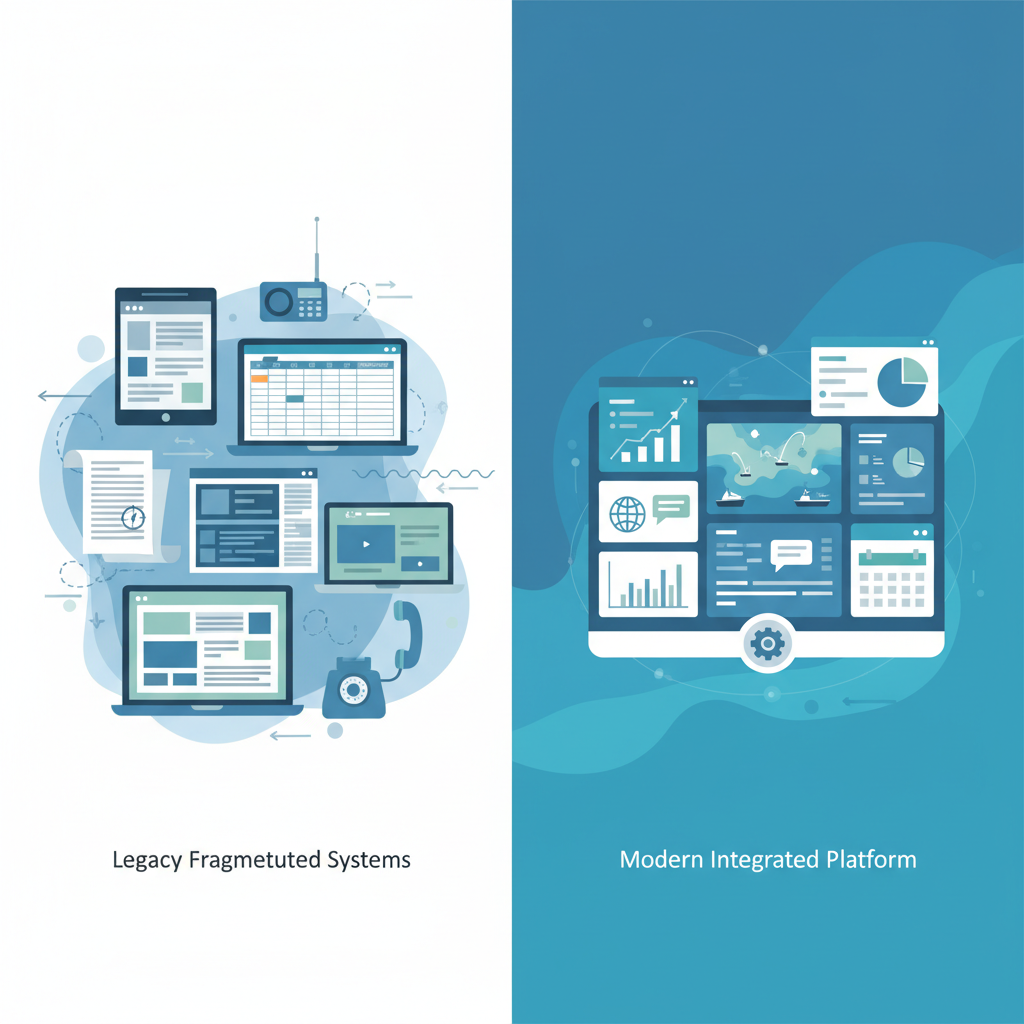
This fragmentation is not accidental—it is the accumulated result of years of purchasing specialised software to solve individual problems without a plan for how those solutions would work together. The result is a landscape of legacy systems that individually perform their specific function but collectively create enormous operational friction, data inconsistency, and hidden costs.
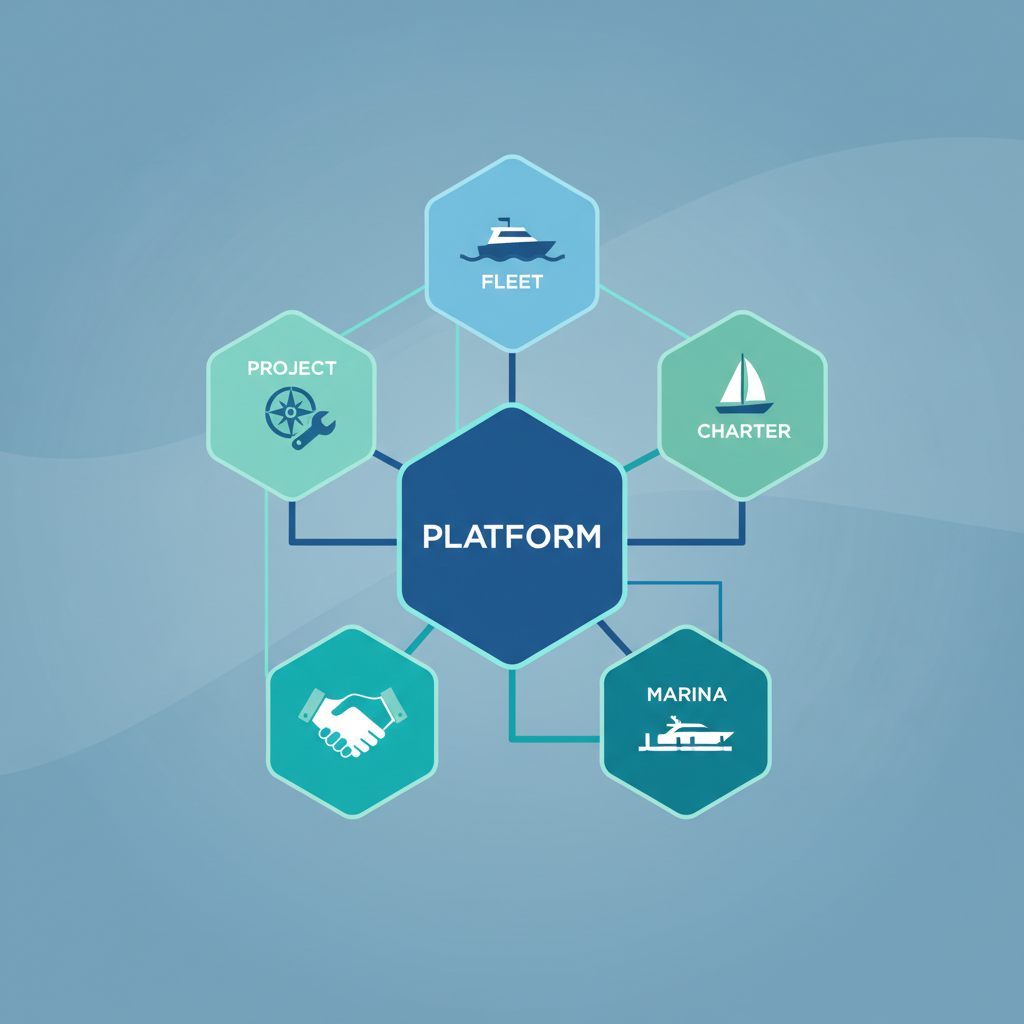
Maritime software solutions have evolved dramatically in the past decade. Where operators once had no alternative to building a patchwork of point solutions, modern integrated platforms now deliver the full range of maritime management capabilities—fleet, charter, marina, brokerage, compliance—within a single unified architecture. This guide examines why the shift from legacy systems to integrated platforms is accelerating, what the migration journey looks like, and how to quantify the return on investment.
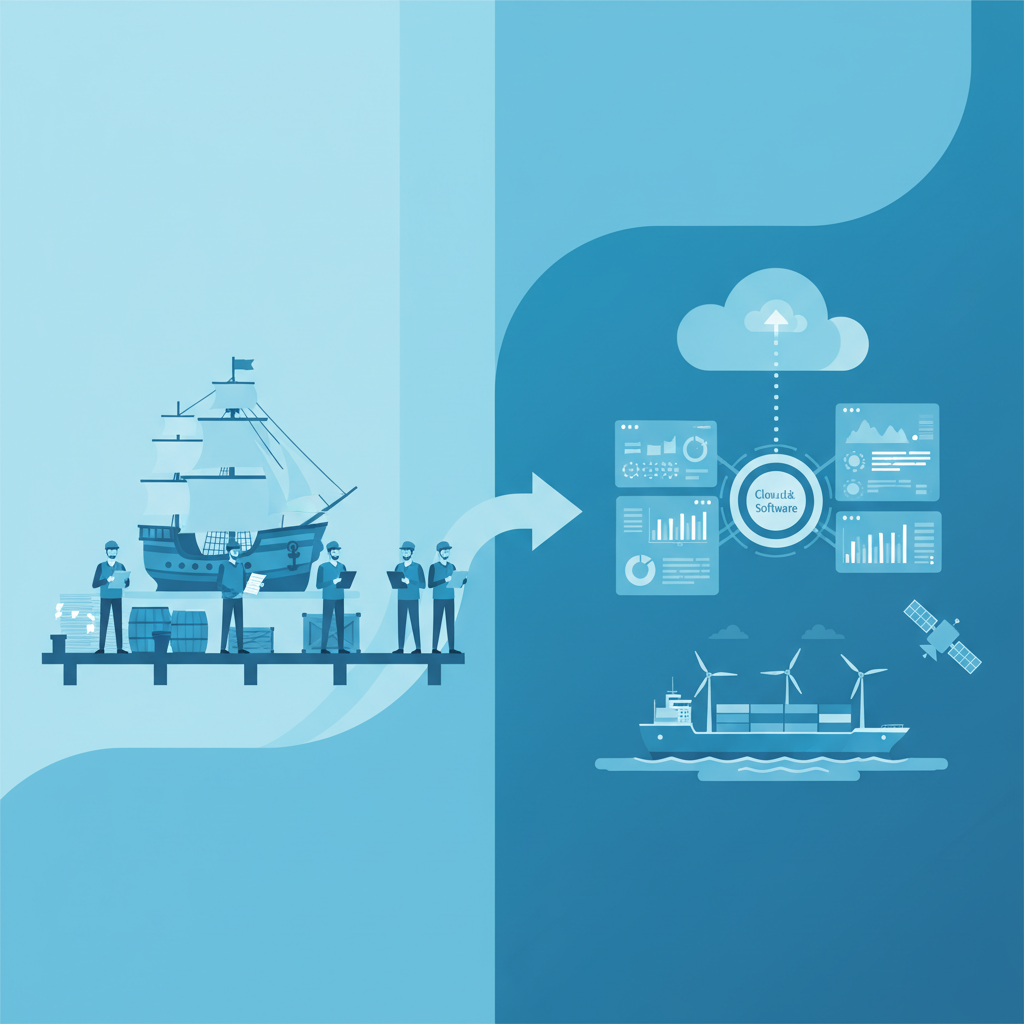
The Real Cost of Maritime Legacy Systems
Legacy systems impose costs that rarely appear as a single line item in any budget. They are instead distributed across dozens of small inefficiencies, workarounds, and failure modes that collectively consume enormous amounts of management time and operational capital.
Data Silos and Manual Reconciliation
When maintenance records, bookings, crew data, compliance documents, and financial accounts live in separate systems with no integration, staff must manually transfer information between them. A single charter booking might require data entry in a reservations system, a maintenance checklist system, a crew scheduling tool, and a financial ledger—four separate actions that could be handled by a single integrated record update.
The time cost is significant. Research across maritime operations consistently finds that administrative staff spend 30–40% of their working hours on data transfer and reconciliation tasks that would be eliminated entirely by integrated software. For an operation with five administrative staff, that represents two full-time equivalent positions consumed entirely by work that produces no operational value.
Reporting Delays and Decision Lag
Perhaps the most damaging consequence of legacy systems is the delay between operational events and management awareness of them. When a vessel requires an unplanned maintenance intervention, how long does it take for that information to propagate from the engineering team to the operations manager, the charter scheduler, the revenue manager, and the financial controller? In fragmented environments, the answer is often days—sometimes longer if the information requires manual report compilation across multiple systems.
Those delays translate directly into poor decisions: charter schedules built around vessel availability that has already changed, maintenance budgets that do not reflect actual expenditure until month-end reconciliation, compliance deadlines that slip because no one has visibility of the full certification picture across the fleet.
Security and Compliance Vulnerabilities
Legacy systems—particularly those built a decade or more ago—often lack modern security architecture. Outdated authentication mechanisms, unencrypted data transmission, and systems that have not received security patches for years represent real risks in an industry handling sensitive crew personal data, charter client financial information, and vessel tracking records.
Compliance with maritime regulations—ISM Code, MLC 2006, GDPR for European operations, flag state requirements—is also harder to demonstrate when records are fragmented. Audit preparation that takes weeks in a legacy environment can be completed in hours with an integrated platform that maintains a complete, searchable compliance record.
What Integrated Maritime Software Platforms Actually Deliver
The value proposition of integrated platforms goes beyond simply replacing multiple tools with one. The qualitative shift—from a collection of data repositories to a connected operational intelligence system—creates capabilities that no combination of legacy tools can replicate.
Unified Data Architecture
In an integrated platform, every module shares the same underlying data model. A vessel record is not recreated in the maintenance system, the charter system, and the compliance system—it exists once, and all modules reference the same record. When a vessel's status changes—availability, location, maintenance state, certification validity—that change propagates instantly across every function that depends on it.
This unified architecture enables a level of operational intelligence that simply cannot be achieved with separate systems. Real-time dashboards can show, for a single vessel, its current charter commitment, upcoming maintenance schedule, crew certification status, insurance validity, and financial performance—all from a single screen, updated continuously.
Automated Workflows and Process Orchestration
Digital transformation in maritime operations is most visibly expressed through automation of repetitive, rule-based processes that previously required manual intervention. Integrated platforms can automate:
- Charter booking workflows: Automatic availability checks, deposit collection, contract generation, crew assignment notification, pre-departure checklist activation, and post-charter invoice generation—all triggered by a single booking confirmation
- Maintenance scheduling: Engine-hour-based service reminders automatically triggered by underway time tracking, spare parts reorder alerts when inventory falls below safety stock levels, and contractor notification workflows for scheduled haul-outs
- Compliance management: Automatic reminders for certification renewals, document expiry alerts distributed to relevant personnel, and audit trail maintenance with no manual record-keeping required
- Financial reporting: Real-time revenue recognition as charter deposits clear, automatic cost allocation to vessel profit-and-loss accounts as invoices are processed, and period-end reports generated automatically without spreadsheet assembly
Real-Time Analytics and Business Intelligence
Integrated platforms transform maritime data from a historical record into a forward-looking management tool. With all operational data flowing through a single system, analytics capabilities become dramatically more powerful:
- Fleet utilisation analysis across the entire portfolio, identifying vessels with below-average booking rates before season-end
- Charter revenue forecasting that combines current booking pace with historical seasonal patterns to project end-of-year performance
- Maintenance cost trending that identifies vessels trending toward above-average repair costs before they become operational liabilities
- Crew productivity and scheduling optimisation across multi-vessel operations
Legacy vs. Modern: A Direct Comparison
The table below summarises the key operational differences between legacy point-solution environments and modern integrated maritime software solutions:
| Capability | Legacy Systems | Integrated Platform |
|---|---|---|
| Data entry | Re-entered in 3–6 separate systems | Entered once, shared across all modules |
| Reporting | Manual spreadsheet compilation, 1–3 days | Real-time dashboards, instant reports |
| Process automation | Manual step-by-step coordination | Automated workflow orchestration |
| Compliance tracking | Fragmented records, manual audit prep | Unified compliance record, automatic alerts |
| Vessel status visibility | Requires querying multiple systems | Single-screen real-time overview |
| Integration cost | High ongoing API maintenance costs | Native integration, no connector maintenance |
| Security posture | Variable across vendors, often outdated | Consistent, modern security architecture |
| Total cost of ownership | Multiple licences plus integration overhead | Single subscription, predictable cost |
Migration Strategies: Moving from Legacy to Integrated
The prospect of migrating from a collection of legacy systems to a single integrated platform is often the primary barrier to adoption. The migration challenge is real—data must be extracted, cleansed, and migrated; staff must be trained; and operations must continue without disruption throughout the transition. However, with the right approach, migration risks are manageable and the process is well-established.
Phased Migration Approach
The most successful maritime digital transformation projects adopt a phased approach rather than attempting a simultaneous cutover across all functions. A typical phased migration might proceed as follows:
- Phase 1 – Core fleet and maintenance (months 1–3): Migrate vessel records, maintenance schedules, and work order management. This provides immediate operational value and establishes the foundation for subsequent phases
- Phase 2 – Charter and booking management (months 3–5): Migrate charter reservations, client records, and contract management. Begin capturing the workflow automation benefits that deliver the largest time savings
- Phase 3 – Compliance and crew management (months 5–7): Migrate certification records, safety management documentation, and crew scheduling
- Phase 4 – Financial integration and reporting (months 7–9): Integrate with accounting systems or activate the platform's financial management module, completing the data unification
Data Migration and Cleansing
Data quality is the most common underestimated challenge in legacy migration projects. Years of inconsistent data entry across multiple systems inevitably produces duplicate records, conflicting vessel specifications, and incomplete historical data that must be resolved before migration.
A practical approach is to run parallel systems for a defined period—typically one to three months—allowing the new integrated platform to accumulate live operational data while legacy records serve as the reference for historical enquiries. This eliminates the pressure of achieving perfect data quality before go-live and allows teams to migrate and cleanse historical records progressively.
The ROI of Maritime Software Integration
The business case for investing in integrated maritime software solutions is supported by consistent evidence from operators who have completed the transition. Measurable benefits include:
- 25–35% reduction in administrative overhead costs as manual data transfer and report compilation tasks are eliminated through automation and unified data architecture
- 15–20% improvement in fleet utilisation rates resulting from real-time availability visibility and automated charter scheduling that eliminates manual booking conflicts
- Up to 40% reduction in compliance management time as certification tracking, audit preparation, and regulatory reporting are handled automatically by the platform
- 10–18% revenue increase from improved charter pricing decisions enabled by real-time analytics across booking pace, vessel performance, and market data
- Significant reduction in emergency maintenance costs as proactive maintenance scheduling, driven by integrated usage tracking, prevents breakdowns that previously caused last-minute charter cancellations
For a charter company operating 15 vessels with annual revenue of €3 million, a conservative combined benefit of 20% operational cost reduction and 12% revenue increase represents approximately €900,000 in annual value improvement—a return that typically exceeds the platform investment cost within the first operating year.
Frequently Asked Questions
What are maritime legacy systems and why are they a problem?
Maritime legacy systems are specialised software tools—often purchased over many years to solve individual operational problems—that operate independently without sharing data. The problem is not any individual system but the fragmentation they collectively create: data silos, manual reconciliation overhead, delayed reporting, and inability to automate cross-functional workflows.
How long does it take to migrate from legacy systems to an integrated maritime platform?
A phased migration for a mid-sized maritime operation typically takes six to nine months from initial data migration to full operational deployment across all modules. Some basic operational benefits are available within the first two to three months as core modules go live. The exact timeline depends on data complexity, operational scale, and the number of legacy systems being replaced.
What is the ROI of integrated maritime software solutions?
Operators consistently report 25–35% reductions in administrative costs, 15–20% improvements in fleet utilisation, and 10–18% revenue increases following successful digital transformation projects. The combination of cost reduction and revenue improvement typically produces a return on investment within 12–18 months of full deployment.
Making the Move to Integrated Maritime Software
The maritime industry's digital transformation is not a future event—it is happening now. Operators who continue to manage their fleets, charter operations, and marinas with disconnected legacy systems are falling further behind competitors who have made the integration investment and are reaping the compounding benefits of unified operational data.
The question for most maritime businesses is no longer whether to replace legacy systems with an integrated platform, but how to execute the migration effectively and which platform best fits their operational model and growth ambitions.
SupaSailing's integrated maritime software suite combines fleet management, charter operations, marina management, brokerage CRM, and compliance tracking in a single platform purpose-built for the marine industry. The platform is designed to replace legacy system landscapes with minimal operational disruption and maximum speed to value.
Explore the full capabilities at SupaSailing Solutions or contact our team to discuss a migration plan tailored to your operation's specific requirements and timeline.
See SupaSailing in action
Book a free demo call and discover how one platform can run your charter, marina, fleet, shipyard or brokerage.
Book a Free DemoShare this article