Custom Maritime Software Development: Build vs Buy Guide
A maritime operator considering new software faces one of the most consequential decisions in fleet management: build a custom solution tailored to every operational quirk, or buy an established platform and adapt processes to fit. Get it wrong and the consequences are severe — either a multi-million dollar custom development project that delivers years late and half-finished, or an off-the-shelf system so generic that crew members route around it with spreadsheets within six months.
The maritime software development landscape has changed dramatically over the past decade. What was once a binary choice between expensive bespoke development and basic commercial systems has evolved into a spectrum of options — from fully custom builds to highly configurable modern platforms. Yet the core analytical framework for making this decision remains poorly understood by most ship operators and fleet managers, who are experts in maritime operations, not software procurement.
This guide provides a rigorous, numbers-based framework for evaluating build vs buy decisions in maritime software, covering total cost of ownership, development timelines, integration requirements, and the conditions that genuinely favour each approach.
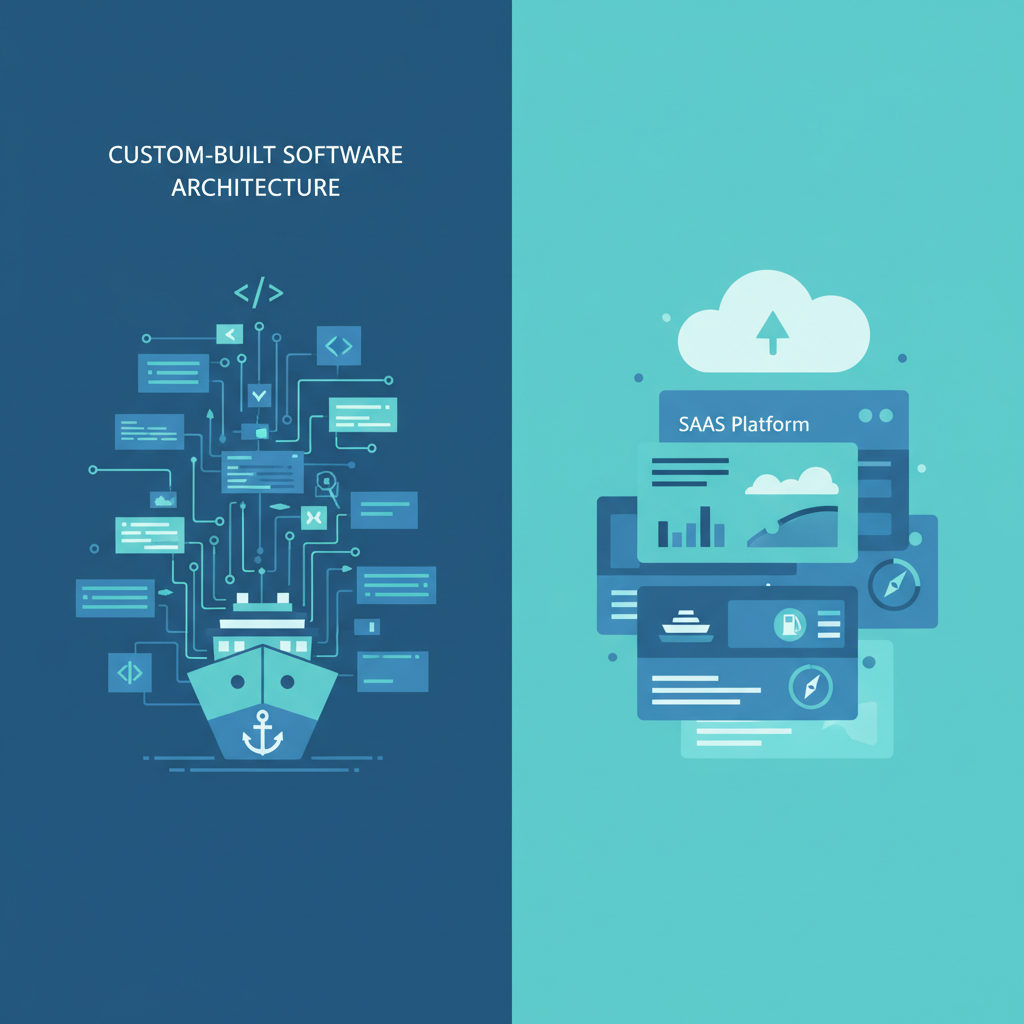
Understanding the True Cost of Custom Maritime Software Development
The most common mistake operators make when evaluating custom development is calculating only the initial build cost. The true total cost of ownership (TCO) for custom maritime software extends far beyond the first invoice from a development agency.
Initial Development Costs
A functional maritime management system — covering fleet operations, maintenance planning, crew management, and compliance documentation — requires significant development investment. Based on industry data from maritime technology consultancies:
- Basic fleet tracking and reporting system: $150,000 – $400,000
- Planned maintenance system with parts inventory: $300,000 – $700,000
- Integrated fleet management platform (operations, maintenance, compliance, crew): $800,000 – $2,500,000+
- Mobile applications for vessel crew: Add $100,000 – $300,000 per platform
These figures assume a competent development team with maritime domain knowledge — a combination that is genuinely scarce and commands premium rates.
The Hidden Cost Categories
Initial development is typically only 30-40% of total 5-year ownership costs for custom software. The remaining costs — which operators consistently underestimate — include:
- Ongoing maintenance and bug fixes: Industry standard is 15-20% of initial development cost per year
- Feature additions and enhancements: Business requirements change; the initial specification is never the final specification
- Infrastructure and hosting: Servers, databases, backups, security monitoring, and CDN for vessel connectivity
- Integration maintenance: APIs from third-party services change; regulations require new data fields; AIS providers update their formats
- Security patching: Custom software has no automatic security updates; vulnerabilities require dedicated development effort to remediate
- Internal IT staff: Custom systems typically require 1-2 dedicated IT staff for a fleet of 20+ vessels
A system that costs $1,000,000 to build will typically cost $150,000–$250,000 per year to maintain properly. Over five years, the true TCO reaches $1,750,000 – $2,250,000 before accounting for major feature additions.
The Buy Option: Commercial and SaaS Maritime Platforms
Commercial maritime software platforms have matured significantly. Modern SaaS-based solutions offer sophisticated functionality at subscription costs that are a fraction of custom development TCO.
Typical Commercial Platform Costs
- Entry-level fleet management platforms: $200 – $600 per vessel per month
- Comprehensive maritime management suites: $500 – $1,500 per vessel per month
- Enterprise platforms with full customization: $1,000 – $3,000 per vessel per month
For a fleet of 10 vessels on a mid-tier platform at $800/vessel/month, the annual cost is $96,000. Over five years: $480,000 — potentially $1,500,000+ less than custom development for equivalent functionality.
What You Get with Commercial Platforms
Beyond raw cost savings, established maritime software platforms offer advantages that custom development cannot easily replicate:
- Immediate deployment: Go live within weeks, not years
- Continuous feature development: Platform vendors invest in R&D across their entire customer base
- Regulatory updates included: When IMO issues new requirements, the vendor updates the platform
- Proven reliability: Enterprise platforms have undergone years of testing across diverse operational conditions
- Support and expertise: Dedicated support teams with maritime domain knowledge
- Integration ecosystem: Pre-built connectors to AIS providers, port databases, classification societies, and MRV reporting systems
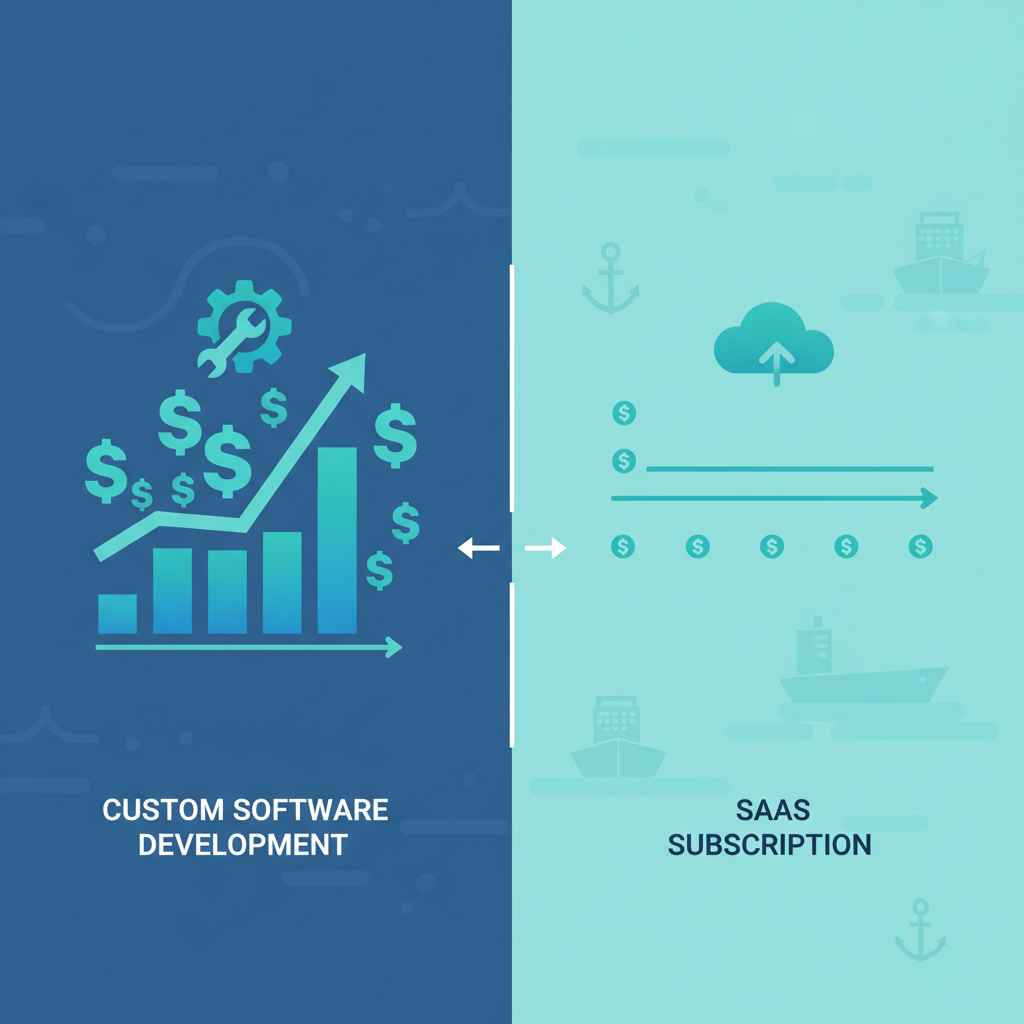
Development Timeline Reality Check
Timeline is often the decisive factor that operators underweight. Maritime businesses operate in real time — vessels need management tools now, not in 18 months.
Custom maritime software development timelines, based on industry experience:
- Requirements gathering and specification: 2-4 months (typically underestimated by 50%)
- Core development: 6-18 months depending on scope
- Testing and quality assurance: 2-4 months (typically the most compressed phase)
- User acceptance testing with vessel crews: 1-3 months
- Deployment and training: 1-2 months
Total realistic timeline for a comprehensive maritime management system: 12-31 months.
During this entire period, the fleet continues operating on legacy systems. Vessel managers accumulate workarounds. Data silos deepen. Meanwhile, a commercial platform could have been deployed and delivering value within 4-8 weeks.
Scope creep — the silent budget killer in custom development — extends timelines further. Maritime operations are complex; stakeholders invariably discover requirements they did not articulate during the initial specification phase. Every addition requires additional development time, testing, and deployment effort.
Integration Requirements: A Critical Decision Factor
Modern maritime operations depend on data flowing between multiple systems: Class society portals, port state control databases, AIS providers, weather routing services, bunker management systems, crew payroll platforms, and accounting software. The integration landscape is a critical factor in the build vs buy decision.
Custom Development Integration Challenges
Building integrations from scratch requires:
- Dedicated API development for each connected system
- Ongoing maintenance as third-party APIs change (which they do, regularly)
- Security reviews for each data exchange point
- Testing across all integration touchpoints after any system update
Integration maintenance alone can consume 20-30% of ongoing development resources for a custom maritime platform.
Commercial Platform Integration Advantages
Established maritime software vendors maintain pre-built integrations with the major industry data providers. When AIS providers update their APIs, the vendor updates the integration for all customers simultaneously. This represents an enormous ongoing cost and risk reduction for operators who choose commercial platforms.
When Custom Development Actually Makes Sense
Custom maritime software development is not always the wrong choice. There are specific circumstances where building makes strategic sense:
- Genuinely unique operational requirements that no commercial platform can accommodate — typically specialized vessel types with proprietary operational models
- Regulatory or competitive sensitivity that makes sharing infrastructure with other operators unacceptable
- Existing software assets that represent substantial IP and need augmentation rather than replacement
- Scale — for very large fleets (100+ vessels), the per-vessel economics of custom development can eventually become competitive with enterprise SaaS pricing
For most maritime operators — from yacht charter companies and ferry operators to offshore vessel fleets — none of these conditions apply. The operational requirements, while feeling unique from the inside, are well-served by modern configurable platforms.
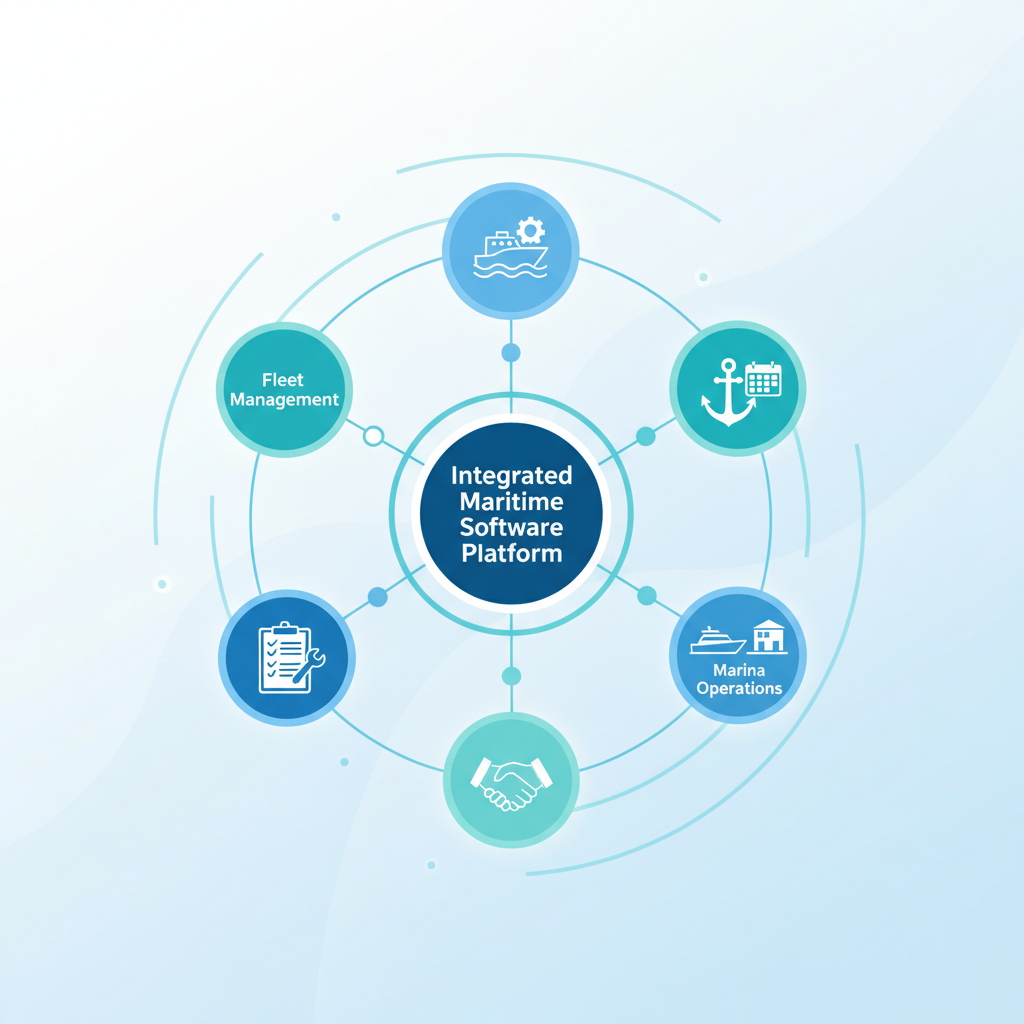
The Modern Alternative: Configurable Maritime Platforms
The false binary of "fully custom" vs "rigid off-the-shelf" has been replaced by a third option: modern configurable maritime platforms designed for flexibility. These platforms provide:
- Core functionality delivered immediately — fleet tracking, maintenance planning, crew management, compliance documentation
- Configuration without code — forms, workflows, report templates, and data fields configurable by operators
- API-first architecture — clean integration surfaces for connecting to existing systems
- White-label or branded options — for operators who need to present a branded experience to clients
Platforms like SupaSailing represent this modern approach — purpose-built for maritime operators with the flexibility to adapt to diverse operational models without the cost and risk of custom development. Rather than choosing between a rigid system that fits poorly or a custom build that breaks budgets and timelines, operators can deploy a sophisticated platform tailored to their workflows within weeks.
Build vs Buy Decision Matrix
| Factor | Buy (Commercial Platform) | Build (Custom Development) |
|---|---|---|
| Time to deploy | 4–8 weeks | 12–31 months |
| 5-year TCO (10 vessels) | $300K – $900K | $1.5M – $3M+ |
| Regulatory updates | Included by vendor | Your development cost |
| Integration ecosystem | Pre-built connectors | Build from scratch |
| Scalability risk | Low (vendor scales infra) | High (your responsibility) |
| Unique requirements fit | Good (with configurable platforms) | Excellent |
Benefits and ROI of Choosing the Right Approach
The financial stakes of this decision are substantial:
- Operators who choose commercial platforms over custom builds typically save $500K–$2M over a 5-year period on a 10-vessel fleet
- Time-to-value acceleration: Commercial deployment in weeks vs. custom deployment in 12+ months means earlier operational benefits, data insights, and compliance improvements
- Risk reduction: Custom development projects in the maritime sector have a 35-45% rate of significant cost overrun or delayed delivery
- Staff efficiency: Modern SaaS platforms require minimal internal IT support compared to 1-2 FTE for custom systems
- Competitive agility: Commercial platforms release new features regularly, keeping operators current with evolving industry best practices
Frequently Asked Questions About Maritime Software Development
Can we customize a commercial maritime platform to match our existing processes?
Modern configurable maritime platforms offer extensive customization without code — including custom forms, workflow configurations, report templates, and data fields. For the vast majority of operator requirements, this level of configuration is sufficient. The key is selecting a platform with genuine configurability rather than a rigid system with limited flexibility.
What happens to our data if we choose a SaaS platform and want to switch later?
Reputable maritime SaaS vendors provide data export capabilities in standard formats. Before committing to any platform, verify the data portability terms in the service agreement, including export formats and any associated costs. This is a standard due diligence item in the procurement process.
How do we evaluate whether a commercial platform truly meets our operational requirements?
The most effective approach is a structured pilot — running the platform against your actual operational data for 60-90 days on a subset of vessels. This exposes real fit issues far more reliably than a demo or reference call. Reputable vendors will support this process.
Conclusion
For most maritime operators, the build vs buy analysis leads to a clear conclusion: modern configurable commercial platforms deliver better outcomes at a fraction of the cost and risk of custom development. The economics are compelling, the timelines are dramatically shorter, and the operational risks of custom development — scope creep, talent dependency, maintenance burden — are well-documented.
Custom development remains the right choice for a small number of operators with genuinely unique requirements. For everyone else, the question is not whether to buy, but which platform best fits the operation. SupaSailing's maritime management platform is designed for exactly this purpose — providing the flexibility, depth, and integration capabilities that modern fleet operators need, without the cost and complexity of building from scratch.
See SupaSailing in action
Book a free demo call and discover how one platform can run your charter, marina, fleet, shipyard or brokerage.
Book a Free DemoShare this article